


Key facts.
- Deployed agents bound autonomy: 68% run at most ten steps before human intervention, 70% prompt off-the-shelf models, 74% rely on human evaluation. source
- Research on extreme decomposition shows per-step error correction is what carries long plans, matching the production instinct to keep runs short and checked. source
- Both sides agree reliability is a systems property addressed through design, not a capability you buy with a bigger model. source
Where do research and production actually agree?
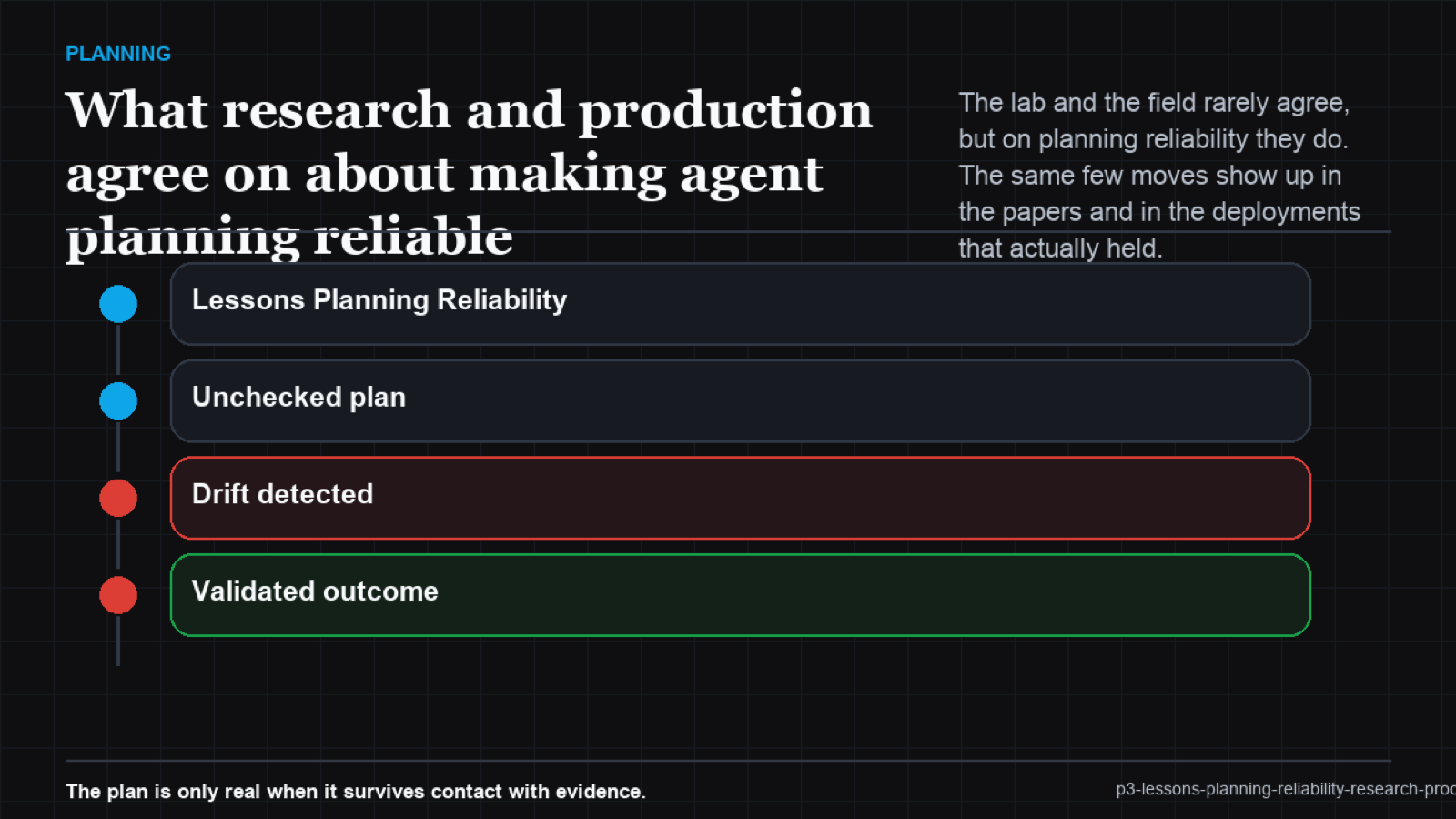
On four moves. Decompose the work, because both the lab result behind extreme-decomposition systems and the production habit of short runs say long unbroken plans are where reliability dies. Verify each step, because research on per-step correction and the production reliance on human evaluation are the same instinct expressed differently. Bound the autonomy, because the field data shows most agents deliberately stop after a handful of steps. And keep a human on the consequential calls, because three in four deployed agents do exactly that. These are not exotic findings. They are the boring, repeated lessons that show up wherever planning has to hold, in a paper or in a pager rotation.
What is striking is how the production numbers read like the research recommendations operationalized. The lab says decompose and correct; the field says short runs with human checks. The lab says reliability is systemic; the field says off-the-shelf models with bounded autonomy. They are describing the same agent from two directions, which is the strongest signal you can get that these moves are right.
What does this mean for what you build?
Stop treating reliable planning as an open research question and start treating it as a known recipe. Decompose into checkable steps. Put verification on each one. Bound the autonomy and widen it on evidence. Keep human judgment on the calls that warrant it. The teams whose agents are in production did not discover a secret. They applied the moves both the research and the field already agree on and they applied them as system design rather than waiting for a model that would not need them.
| Shared move | Research signal | Production signal |
|---|---|---|
| Decompose | Per-step correction scales plans | Short runs dominate |
| Verify each step | Verifier-generator separation | 74% human evaluation |
| Bound autonomy | Smaller scope, fewer failures | 68% stop within ten steps |
Encoding those agreed moves is exactly what VibeModel does as the Pattern Intelligence Layer. We model the planning patterns that both research and production found reliable, so you build from the consensus recipe instead of rediscovering it one incident at a time.
Frequently asked questions
Did the teams that succeeded just buy the best model?
In the field, 68% of agents run under ten steps before a human; the frontier model did not make them reliable, the system did. (arXiv:2512.04123)
Is bounded autonomy a permanent limit?
No. It is the starting point you widen as reliability is proven. Both sides treat it as discipline, not a ceiling.
Why do production agents avoid fine-tuning?
Off-the-shelf prompting ships faster and the reliability gains come from the system design, which is where both research and production focus.
Do I need a frontier model for this?
Less than you think. The shared moves are about the system around the model, which is why off-the-shelf models dominate production.