


Key facts.
- MIT NANDA's "GenAI Divide" found roughly 95% of enterprise GenAI initiatives showed no measurable business return despite heavy investment, with only about 5% achieving real operational or financial impact.source
- The report identifies the core barrier as learning, not infrastructure: most GenAI systems do not retain feedback, adapt to context or improve over time.source
- The projects that worked shared deep process integration, continuous learning and evaluation against business outcomes not benchmarks.source
Why does autonomy depend on reliable planning?
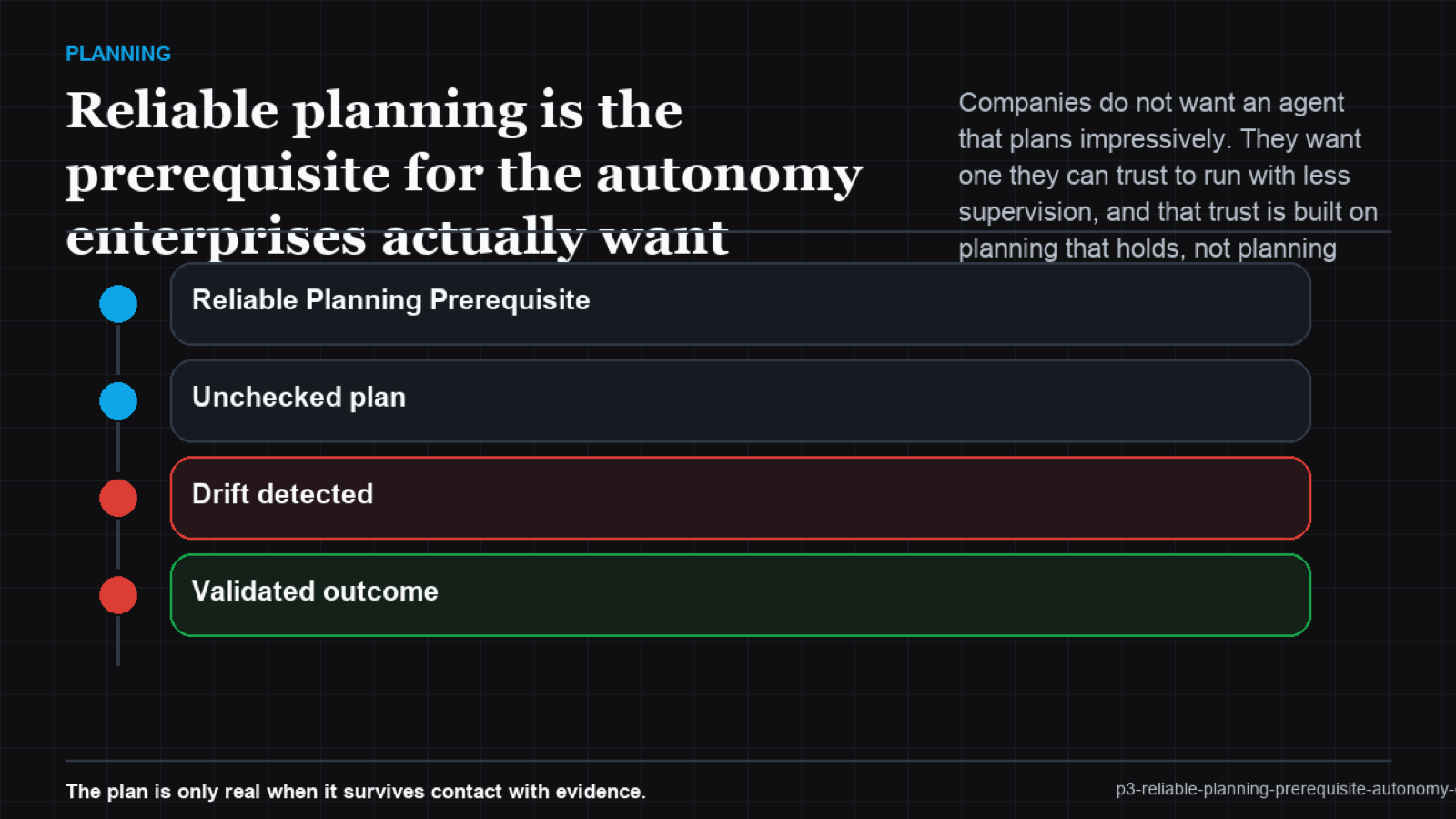
Because autonomy is the act of trusting the agent to run without a human checking each step and that trust can only be extended as far as the planning has earned it. An agent whose plans hold up, that satisfies constraints, recovers from execution failures and knows when it is unsure, can be granted more room. That happens because the cost of a mistake is bounded and rare. An agent whose planning is unreliable cannot be granted that room. That happens because every increment of autonomy multiplies the blast radius of a failure you already know will happen. The MIT result is the macro version of this: enterprises poured tens of billions into agents and saw almost no return, not because the models were weak. Because the systems did not reliably improve or hold, so the value never materialized and the autonomy was never safely extended.
This reframes the goal. The thing enterprises are buying is not clever planning, it is the ability to step back. That ability is earned through reliability, the unglamorous property that lets you remove supervision without removing safety. Planning that dazzles in a demo but does not hold in production buys you nothing. That happens because you can never actually let go of it.
How do you build toward earned autonomy?
Make planning reliable in a narrow scope, measure that it holds and widen the autonomy on evidence. Bake in the things the working projects shared: integrate deeply into the specific process. Close the learning loop so the agent improves and judge it on business outcomes rather than benchmark scores. Each increment of autonomy is a withdrawal against reliability you have already proven. Not a bet on reliability you hope will appear. The enterprises on the right side of the divide built the reliability first and earned the autonomy second.
| Order of operations | Result |
|---|---|
| Grant autonomy, hope planning holds | Failures scale with the autonomy |
| Prove reliability, then widen autonomy | Supervision removed safely, value realized |
Building that earned reliability is the whole point of VibeModel as the Pattern Intelligence Layer. We model the patterns that make planning hold. You can extend autonomy against proven reliability instead of granting it on faith and joining the side of the divide that saw no return.
Frequently asked questions
Is the 95% figure about the models failing?
No. MIT points to the systems around the models, especially the missing learning loop, not raw model capability. Reliability is a system property.
How much autonomy should I start with?
As little as the task allows, widened as reliability is measured. Autonomy is earned per increment, not granted up front.
What did the 5% do differently?
Deep process integration, continuous learning and outcome-based evaluation. They built reliability into the system, not just the model.