


Key facts.
- Self-Preference Bias finds GPT-4 rates familiar, low-perplexity outputs higher than humans do, so an LLM judging its own work is systematically biased toward it.source
- The bias holds regardless of actual quality, meaning the agent's confidence in its plan is not a reliable signal of the plan's soundness.source
- The gap shows up in enterprise benchmarks too: Galileo's Agent Leaderboard v2, which scores multi-step business tasks, found the top model completing only 62% of full action sequences, so a human reviewer on the consequential calls is catching what the agent's own judgment misses.source
Why not automate the whole plan?
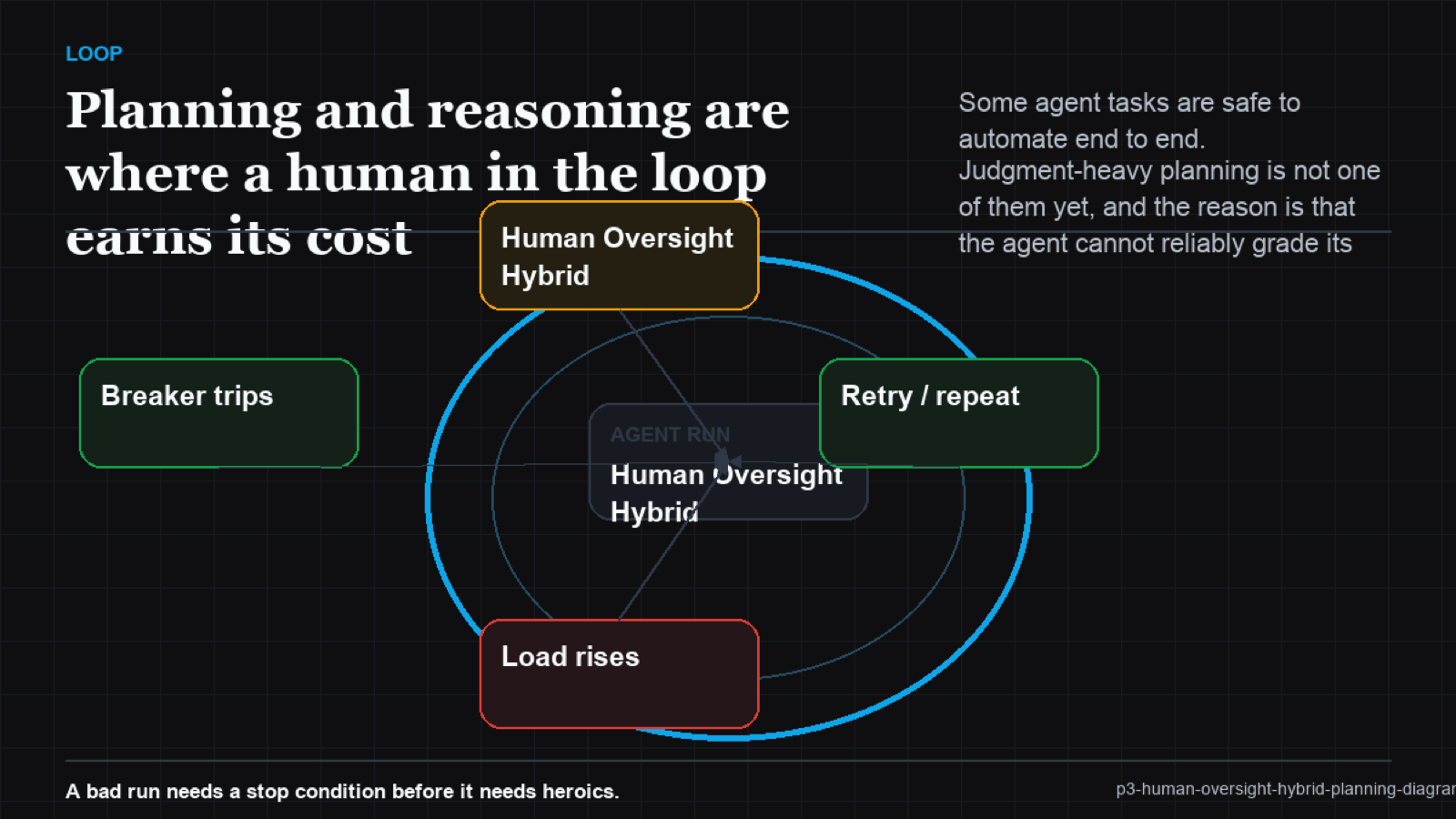
The judgment-heavy parts of planning are where the agent's self-assessment fails, and self-assessment is what an end-to-end automated plan relies on. The Self-Preference Bias result makes the mechanism concrete: the model favors reasoning that looks familiar to it. It rates its own plan more highly than a neutral judge would, independent of whether the plan is good. An agent that plans and then judges its own plan is grading with a thumb on the scale. For routine, mechanical steps that bias does little harm, because there is little judgment involved. For the consequential calls, the priority tradeoff, the ambiguous case, the irreversible action, that bias is exactly where a human reviewer adds value the agent cannot supply for itself.
This is not a permanent verdict against automation. It is a statement about where the line sits today. The mechanical share of planning is large and worth automating. The judgment share is smaller and worth a human, and the skill is telling them apart rather than automating both or neither.
Where does the human belong?
On the decisions where a wrong call is expensive and the agent's self-judgment is least trustworthy. The priority conflict between competing goals. The plan that touches money, safety or a customer relationship. The case that falls outside what the agent was characterized to handle. Put the human there and automate the rest fully. The oversight cost lands on the decisions that earn it rather than spread thin across every routine step. A hybrid that targets human judgment well outperforms both full autonomy and full manual review.
| Task share | Best owner | Why |
|---|---|---|
| Mechanical planning steps | The agent | Low judgment, self-bias does little harm |
| Consequential judgment calls | A human reviewer | Agent self-judgment is biased exactly here |
Drawing that line is part of what VibeModel does as the Pattern Intelligence Layer. We model the patterns that separate a mechanical planning step from a judgment-heavy one. Human oversight lands where the agent cannot reliably judge itself and nowhere it is not needed.
Frequently asked questions
Can a better model replace the human reviewer?
Self-Preference Bias: GPT-4 rates its own output above humans; a more capable model judges its plan worse, so a reviewer pays off. (arXiv:2410.21819)
Doesn't human review kill the efficiency?
Only if you apply it everywhere. Targeted at the judgment calls, it is a small share of volume and the highest-value share of oversight.
Can a second model replace the human?
It helps, but self-preference and shared blind spots limit it. For the consequential calls, a human still catches what models miss.
Will this change as models improve?
The automated share grows, but judgment-heavy calls with biased self-assessment keep a human valuable for the foreseeable term.