


Key facts.
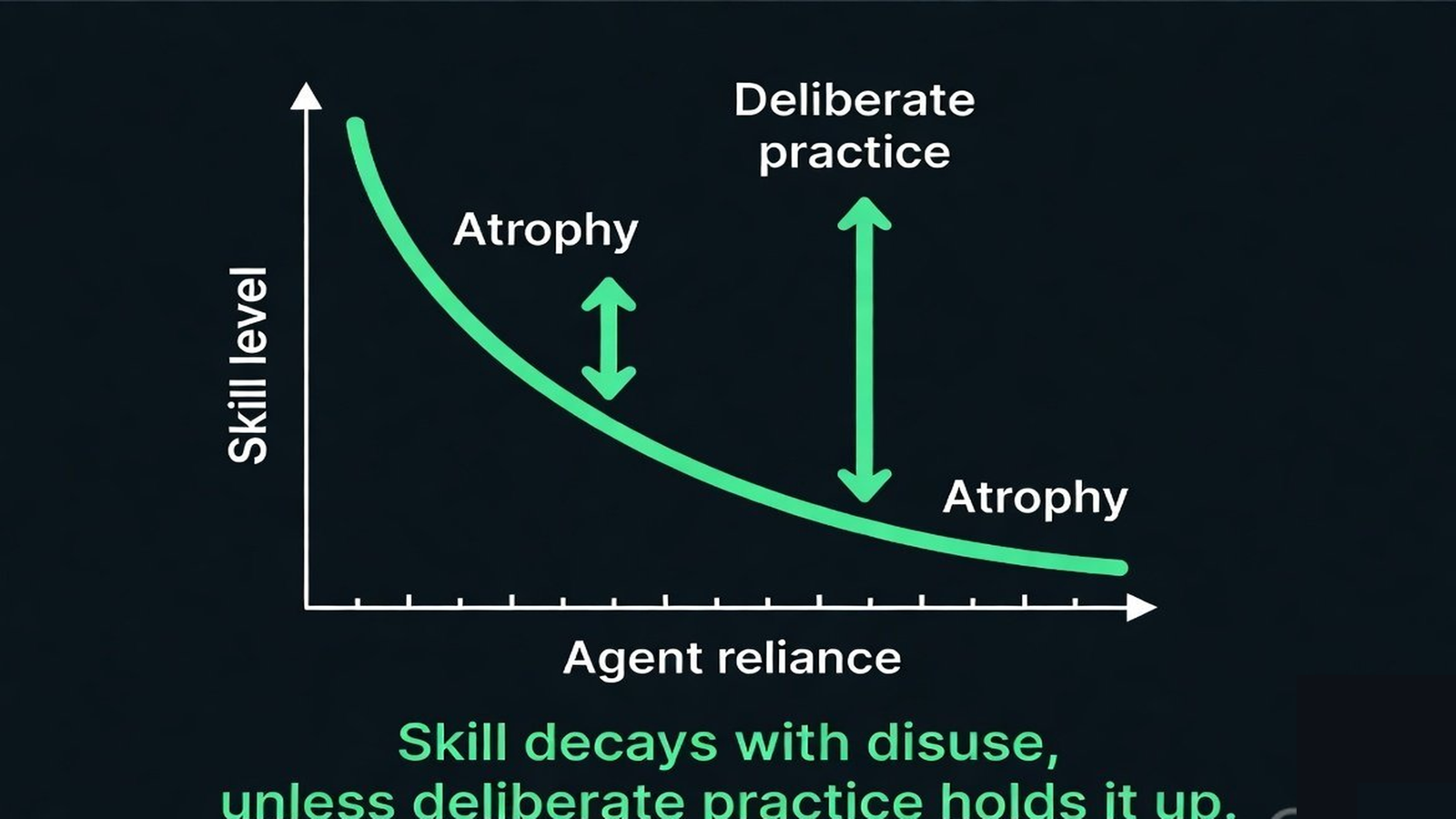
- A growing body of research links heavy reliance on AI to cognitive atrophy, reduced critical thinking and deskilling, the predictable cost of outsourcing judgment. source
- On WildToolBench, no model exceeds about 15% session-level accuracy on real multi-tool sessions, so a practiced human remains the backstop when the agent fails. source
Why does handing work to an agent erode the very skill you need?
Expertise is maintained by use. A loan officer who stops underwriting because the agent does it, a clinician who stops reasoning through cases because the model suggests one, an analyst who stops building the model because the agent drafts it, all slowly lose the edge that let them catch a bad answer in the first place. The overdependence research names this directly: heavy reliance correlates with cognitive atrophy and deskilling. The cruel part is the timing. The skill fades quietly during the long stretch when the agent works and you discover it is gone at the worst moment, when the agent fails and there is no practiced human left to catch it.
The WildToolBench number is why this is not paranoia. Agents are unreliable enough on real multi-step work that failures are not rare events, they are a standing condition. An organization that let its human expertise atrophy has removed its own backstop precisely where the agent is weakest. Keeping people sharp is not nostalgia for the old way; it is maintaining the capability that makes relying on the agent safe.
How do you keep expertise alive?
| Practice | Full handoff | Expertise maintained |
|---|---|---|
| Who does the work | Always the agent | Rotate humans through it |
| Hard cases | Agent handles all | Reserved for human reasoning |
| Review | Rubber-stamp | Active, skill-keeping review |
| The day it fails | No one can step in | Practiced human takes over |
Let the agent think for you and a frontier model still fails near 15% on WildToolBench, so the practiced human is the backstop. (arXiv:2604.06185)
Maintaining expertise is easier when you can see exactly where the agent is reliable and where it is not, which is what the Pattern Intelligence Layer provides. VibeModel makes reliability legible at the pattern level, so you can let the agent own the patterns it handles the same correct way every time and deliberately keep humans practiced on the patterns it does not, preserving the judgment you will need the day a pattern breaks.
Frequently asked questions
Is some deskilling just the price of automation?
Only if you let it happen by default. Deliberate rotation and hard-case practice keep the expertise you need as a backstop, at modest cost.
Which skills should you protect?
The judgment needed to catch the agent's failures and to take over when it cannot cope, especially on the high-consequence work.
Doesn't keeping humans practiced waste the agent's savings?
A little and it buys you a backstop. Given how often agents fail on real multi-step work, that insurance is cheap.