


Key facts.
- McKinsey's State of AI 2025 found executive sponsorship among the factors that most separate AI leaders from the rest, with leaders reporting roughly 3.8 times the performance improvement of the bottom half. source
- Work on long-horizon reliability (MAKER) shows errors compound across many steps, so dependable long runs require deliberate decomposition and per-step checking, not just a stronger model. source
- The same McKinsey research ties senior leaders actively championing and role-modeling AI use to materially higher reported business value. source
- Per-step reliability collapses across a chain, so daily care, not a bigger model, makes the agent dependable (MAKER). (arXiv:2511.09030)
Why do misaligned incentives quietly kill reliability?
An agent gets reliable through a thousand small acts of care: a rep who reports a recurring mistake, an analyst who teaches it an edge case, a manager who funds another round of testing. Every one of those acts costs the person something now for a payoff that accrues to the agent. If the person fears the agent is being built to replace them or if their bonus is unaffected by whether it works, they will not pay that cost. They will do the minimum and the agent will stay exactly as fragile as the day it launched.
The MAKER finding is why that fragility is fatal rather than annoying. Errors compound. A system that is a little unreliable at each step is very unreliable across a long task and only deliberate investment closes that gap. That investment is human behavior and human behavior follows incentives. Align them and the care shows up. Leave them misaligned and no model upgrade buys it back.
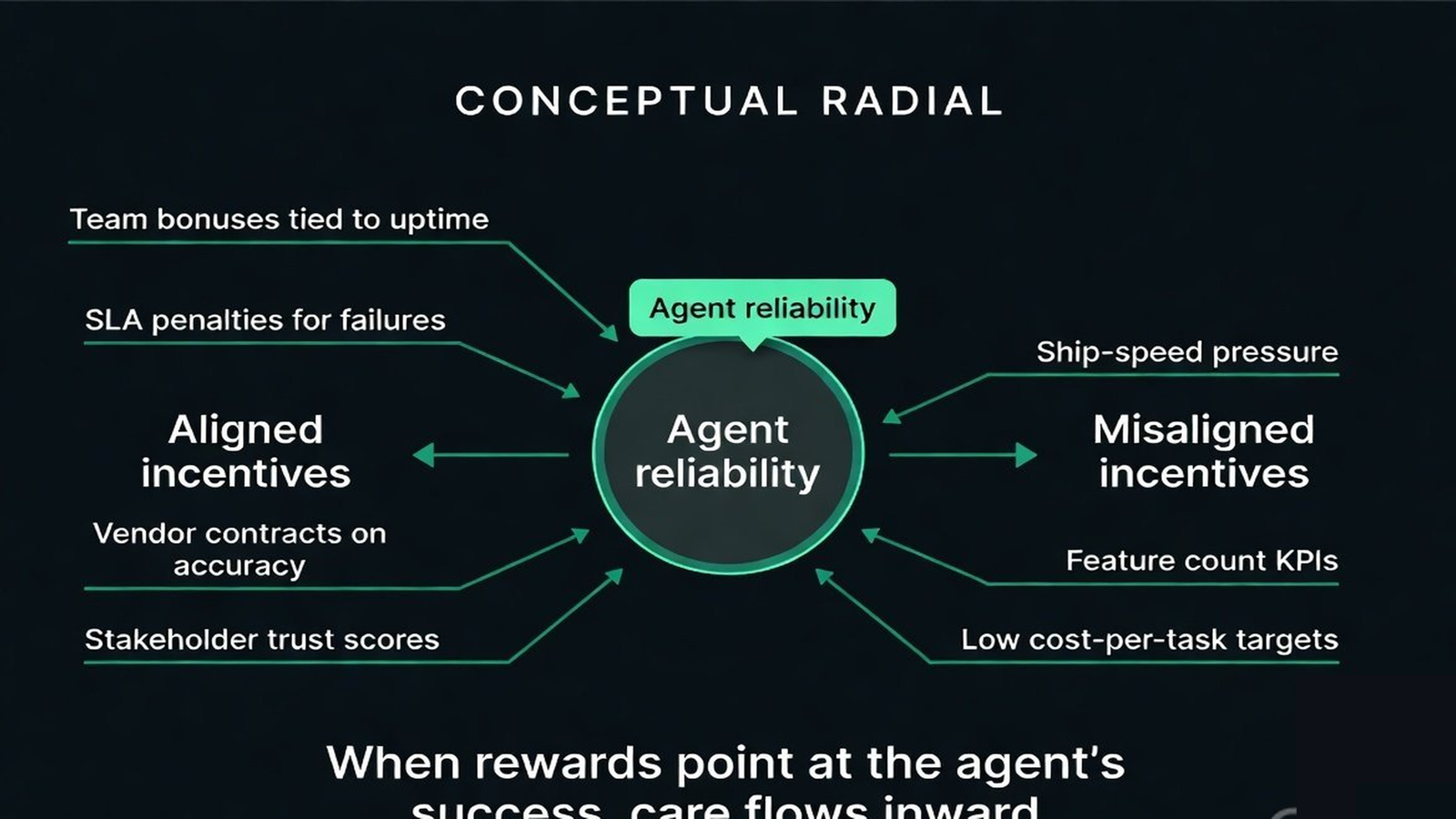
What does aligned look like in practice?
| Lever | Misaligned | Aligned |
|---|---|---|
| Who benefits | The company, abstractly | The team running the agent |
| What gets measured | Headline automation rate | Agent reliability and corrections logged |
| The fear | This replaces me | This makes my numbers |
| Result | Minimum effort, fragile agent | Daily care, reliable agent |
Reliability is the bridge between the incentive and the outcome. People will invest their care in an agent whose improvements they can see and be credited for. VibeModel is the Pattern Intelligence Layer because it makes those improvements legible at the pattern level, so a correction a person makes today visibly tightens the agent's behavior tomorrow and the incentive to keep investing stays intact.
Frequently asked questions
Is this about money or recognition?
Both. Tie team metrics and credit to the agent working, not just to automation volume, so the people closest to it benefit when it improves.
Why does compounding error make incentives urgent?
Because small per-step unreliability becomes large failure over a long task and only deliberate human investment closes it. Incentives are what produce that investment.
What if the agent really does reduce headcount?
Then say so honestly and redesign roles around it. Pretending otherwise produces the quiet sabotage that makes the agent fail anyway.