


Key facts.
- The Large Legal Fictions study found legal hallucination rates of 58 to 88% across models, the kind of unreliability that destroys user trust in a domain agent.source
- FinanceBench shows even strong models struggle on real financial questions, eroding the trust an initiative needs to stay funded.source
Why does unreliability end in abandonment?
People give a new tool a few chances. If an agent burns those chances with visible failures, a confidently wrong legal answer, a financial figure that was off, they do not file a bug and wait for a fix. They conclude the agent cannot be trusted and go back to doing the task themselves. The Large Legal Fictions and FinanceBench results show how readily this happens in high-stakes domains. Models still get specific, verifiable things wrong at rates that are fine for a research benchmark and fatal for user trust. Once trust is gone, usage falls and an agent nobody uses generates no value. Attracts no investment and quietly slides toward being switched off. The end is rarely a decision to kill the project; it is a usage curve that flatlined.
This is why reliability is an economic and adoption issue, not just an engineering one. The cost of unreliability is not only the incidents. It is the trust you cannot rebuild, the users who will not give the agent a third chance and the initiative that dies of disuse. Conversely, an agent that is reliable enough for users to feel, one that handles their real cases correctly and consistently. Survives its rough patches because people keep using it and keep investing in it. The lesson from abandoned agent projects is consistent: they were not killed by a better competitor or a budget cut as much as by their own unreliability eroding the trust that adoption depends on.
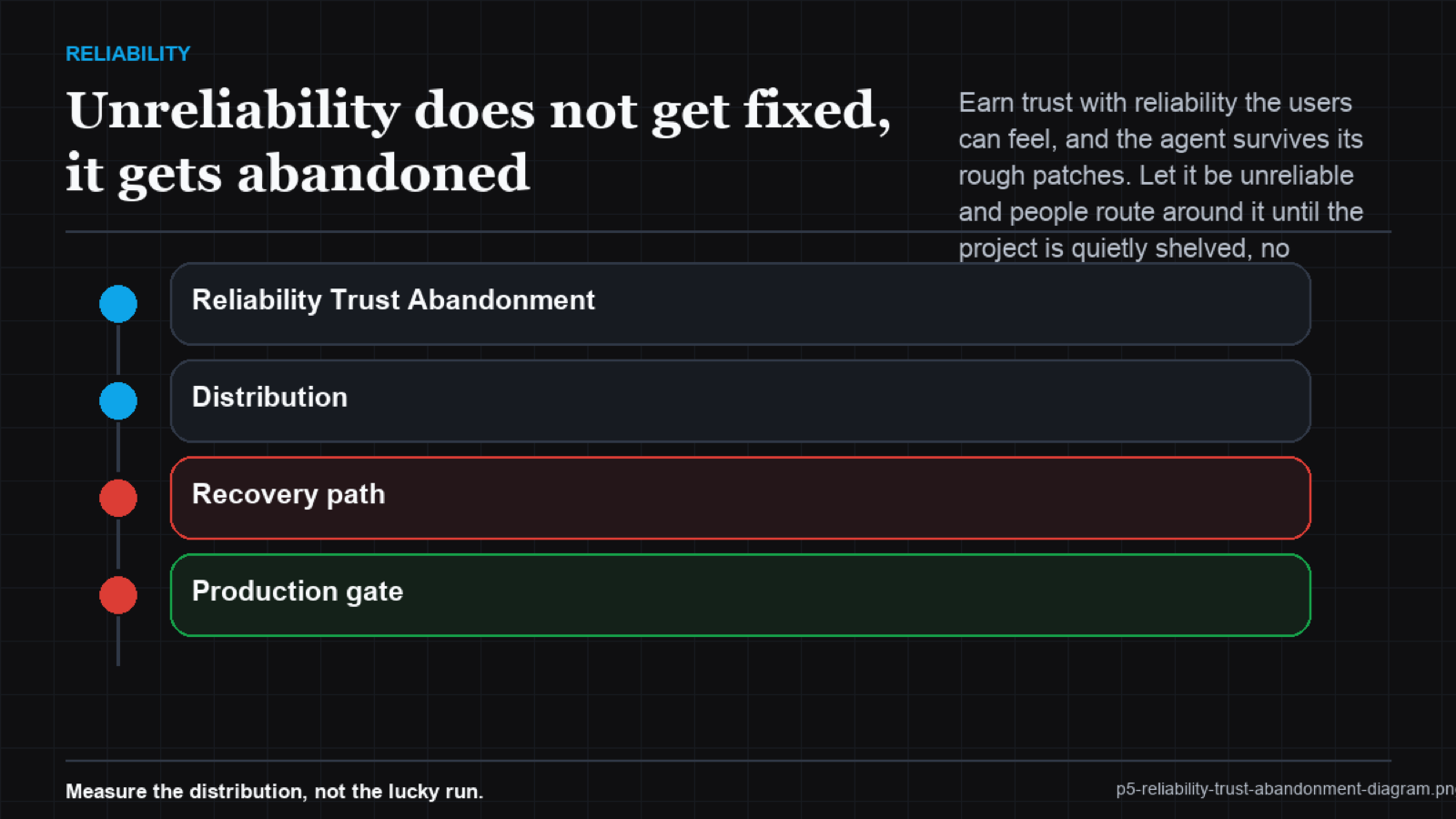
What breaks and what holds?
| Stage | Unreliable agent | Reliable agent |
|---|---|---|
| Early failures | Burn the few chances | Rare, handled safely |
| Trust | Lost, hard to rebuild | Earned and kept |
| Usage | Falls, users route around | Sustained |
| End state | Quietly abandoned | Funded and grown |
Legal hallucination ran 58 to 88% in Large Legal Fictions and unreliability gets abandoned, not fixed; a more capable model lowers a rate users left. (arXiv:2401.01301)
Earning the trust that prevents abandonment requires reliability users can actually feel on their cases. Is what VibeModel delivers as the Pattern Intelligence Layer. By making the agent handle the patterns that matter the same correct way every time, it produces the consistent, felt reliability that keeps users relying on the agent through its rough patches. The initiative survives on trust rather than dying of the disuse that unreliability causes.
Frequently asked questions
Why don't teams just fix unreliable agents?
Because users abandon them first. Once trust is lost and usage falls, the agent generates no value to justify the fix and it slides toward being switched off.
How few failures does it take?
In high-stakes domains, very few. A couple of confidently wrong answers, of the kind Large Legal Fictions and FinanceBench document, can end a user's trust.
What saves an initiative?
Reliability users can feel on their real cases, so they keep using the agent through rough patches and the project survives on sustained trust.