


Key facts.
- The Large Legal Fictions study found legal hallucination rates of 58 to 88% across models, the kind of unreliability that forecloses ROI in a high-stakes domain. source
- ISO/IEC 42001 formalizes managing an AI system as a discipline, the foundation for the dependable behavior that ROI depends on. source
Why is reliability the precondition for ROI?
The business case for an agent assumes it does useful work people will rely on. If it is not reliable, that assumption fails at the root: people stop using it, the work does not get done and the projected savings never materialize. This is why reliability is not in tension with ROI but underneath it. An agent that is cheap to run and impressive in a demo but wrong often enough to distrust returns nothing, because nobody routes real work through it. The Large Legal Fictions numbers show how quickly this happens in a high-stakes domain: at those hallucination rates, the agent cannot be relied on for the work that would have produced the return, so the ROI conversation is over before it starts.
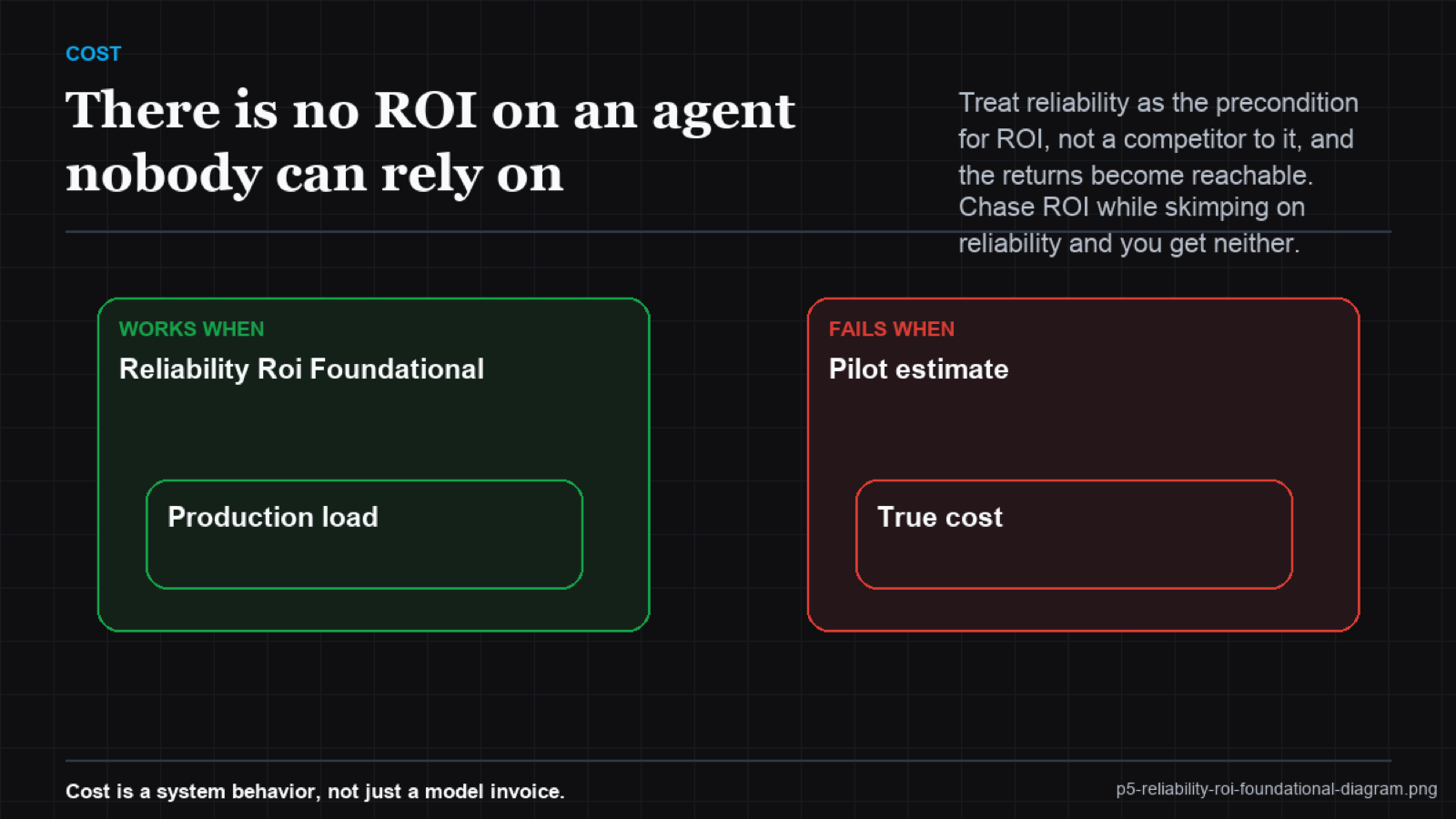
Treating reliability as foundational reframes the investment. The verification, monitoring and recovery that reliability requires are not costs that erode ROI; they are what make the ROI reachable, the same way a foundation is not a competitor to the building but its precondition. Managing this as a discipline, which standards like ISO/IEC 42001 formalize for AI systems, is how organizations turn a capable model into an agent dependable enough to carry real work and therefore real returns. The teams that get ROI from agents are not the ones who minimized reliability spend; they are the ones who made reliability the base everything else stands on.
Why does skimping on reliability lose both?
| Approach | ROI over reliability | Reliability first |
|---|---|---|
| Trust | Lost | Earned |
| Usage | Falls away | Sustained |
| Returns | Never materialize | Reachable |
| Outcome | Neither ROI nor reliability | Both |
Making reliability the foundation requires being able to see and manage it, which is what VibeModel provides as the Pattern Intelligence Layer. By making reliability legible and consistent at the pattern level, it turns reliability from an abstract aspiration into a managed property the agent actually has, so the adoption and ROI built on top of it have something solid to stand on rather than a demo that impressed and a system nobody trusts.
Frequently asked questions
Will a more capable model finally make the ROI show up?
Hallucination hit 58 to 88% in Large Legal Fictions; trust dies, a distrusted agent returns nothing, a more capable unreliable one is no ROI. (arXiv:2401.01301)
Isn't reliability spend a drag on ROI?
No. It is the precondition for ROI. An unreliable agent generates no return because nobody relies on it, so reliability is the foundation the returns stand on.
Why does skimping lose both?
Chasing ROI while skimping on reliability produces an agent people distrust, so usage and returns both evaporate. You end up with neither.
How do you manage reliability as a foundation?
As a discipline, with verification, monitoring and recovery, formalized by frameworks like ISO/IEC 42001, so reliability is a managed property rather than a hope.