


Key facts.
- TravelPlanner shows agents solve only a tiny fraction of realistic, complex tasks, with GPT-4 around 0.6%, so reliability is fragile and small environmental shifts erode it. source
- Cloud Security Alliance survey work on AI repeatedly flags changing conditions and oversight gaps as ongoing risks that require continuous attention. source
Why does reliability decay?
An agent is validated against the world as it was at launch and the world does not hold still. The data it reads drifts as products, customers and content change. The APIs it calls change their behavior, their formats, their error modes, sometimes without notice. Users learn the agent and start phrasing requests differently, probing edges the original design never saw. Each shift is small and each chips at the assumptions the agent's reliability rested on, so a system that was dependable at launch degrades gradually until, one day, it is not. The TravelPlanner result is the reason this is dangerous rather than merely annoying: agents handle only a thin slice of realistic complexity to begin with, so they have little margin and a small environmental change can push a marginally-reliable agent into failure.
Because the decay is gradual and externally driven, it is invisible to anyone watching only the agent's code, which has not changed. The countermeasure is to treat reliability as a maintained quantity with a half-life: monitor the agent's real-world performance continuously, watch the data, APIs and usage patterns it depends on for shifts and refresh the agent, its prompts, its examples, its tests, when the environment moves. The Cloud Security Alliance survey work reinforces that changing conditions are a standing risk, not a one-time one, so the maintenance has to be ongoing. The teams whose agents stay reliable are the ones who assume erosion and counter it deliberately, not the ones who assume launch-day reliability is permanent.
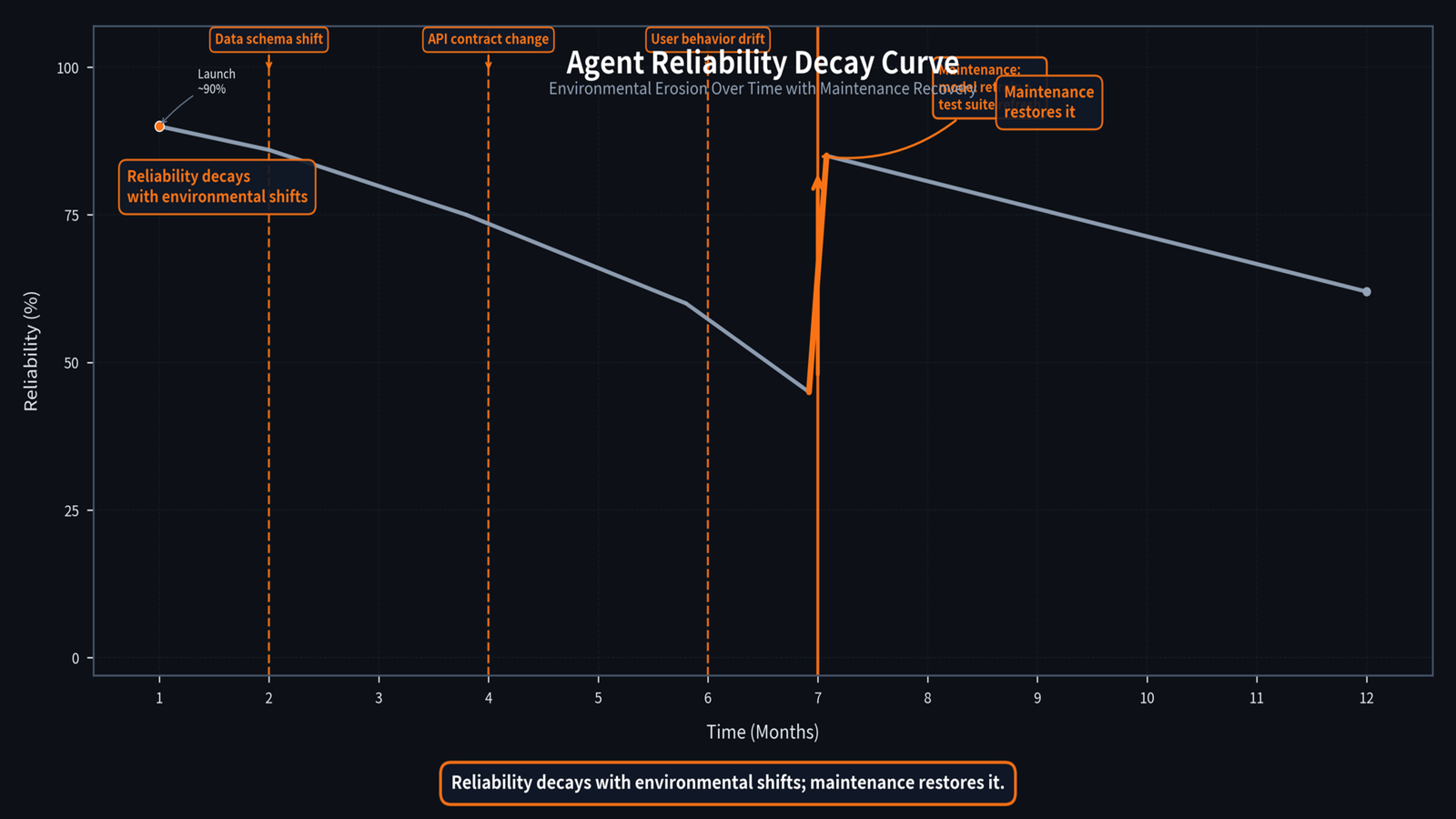
What erodes reliability and how do you counter it?
| Shift | Assume it holds | Maintain deliberately |
|---|---|---|
| Data drift | Unnoticed | Monitored and refreshed |
| API changes | Break silently | Watched and adapted |
| User behavior | Outgrows the design | Tracked and accommodated |
| Reliability | Erodes until failure | Maintained over time |
Detecting erosion early requires knowing what reliable behavior looks like so you can see it slipping, which is what the Pattern Intelligence Layer provides. VibeModel makes the agent's expected handling of each situation explicit, so a gradual drift away from those patterns, as the data or the world shifts, is visible and correctable, turning reliability from a launch-day property that quietly decays into a maintained quantity you actively defend.
Frequently asked questions
Will the next model stop my agent's reliability decaying?
On TravelPlanner GPT-4 solved roughly 0.6%, so reliability decays as APIs shift; a newer model resets the half-life, rework recurs. (arXiv:2402.01622)
Why does an unchanged agent lose reliability?
Because its environment changes: data drifts, APIs change, users behave differently. The agent was validated against a world that no longer exists.
Why is the decay dangerous?
Agents have little margin, solving only a thin slice of realistic complexity, so a small environmental shift can push a marginally-reliable agent into failure.
How do you counter erosion?
Monitor real-world performance and the data, APIs and usage it depends on and refresh the agent when the environment moves, as ongoing maintenance.