


Key facts.
- Public hallucination leaderboards from Vectara (HHEM) and Galileo continuously update measured rates, evidence that model behavior is a moving target worth monitoring over time. source
- FActScore provides fine-grained factual-precision evaluation, the kind of ongoing measurement continuous drift monitoring depends on. source
Why does an unchanged agent drift?
Reliability is often treated as a launch gate: test the agent, confirm it works, ship it. But an agent's reliability is not a property of the agent alone; it is a property of the agent in its environment and the environment never holds still. The data it reads shifts, the users phrase things in new ways, the upstream APIs change their behavior and the underlying model gets updated beneath the agent. The agent's code did not change, yet its real-world performance degrades, a phenomenon the continuously updating hallucination leaderboards capture by refusing to publish a single static number; the right value keeps moving. An agent validated once is reliable against a world that no longer exists.
The answer is to treat reliability as a continuous signal, not a one-time gate. Run an ongoing evaluation suite against current data, monitor key behaviors for drift and alert when measured performance moves outside an expected band. This is where fine-grained evaluation methods like FActScore matter, because catching drift requires measuring the right things precisely enough to see a gradual decline before it becomes an incident. The teams whose agents stay reliable are not the ones who tested hardest at launch; they are the ones who kept testing, watching for the day the agent's world changed and its behavior quietly followed.
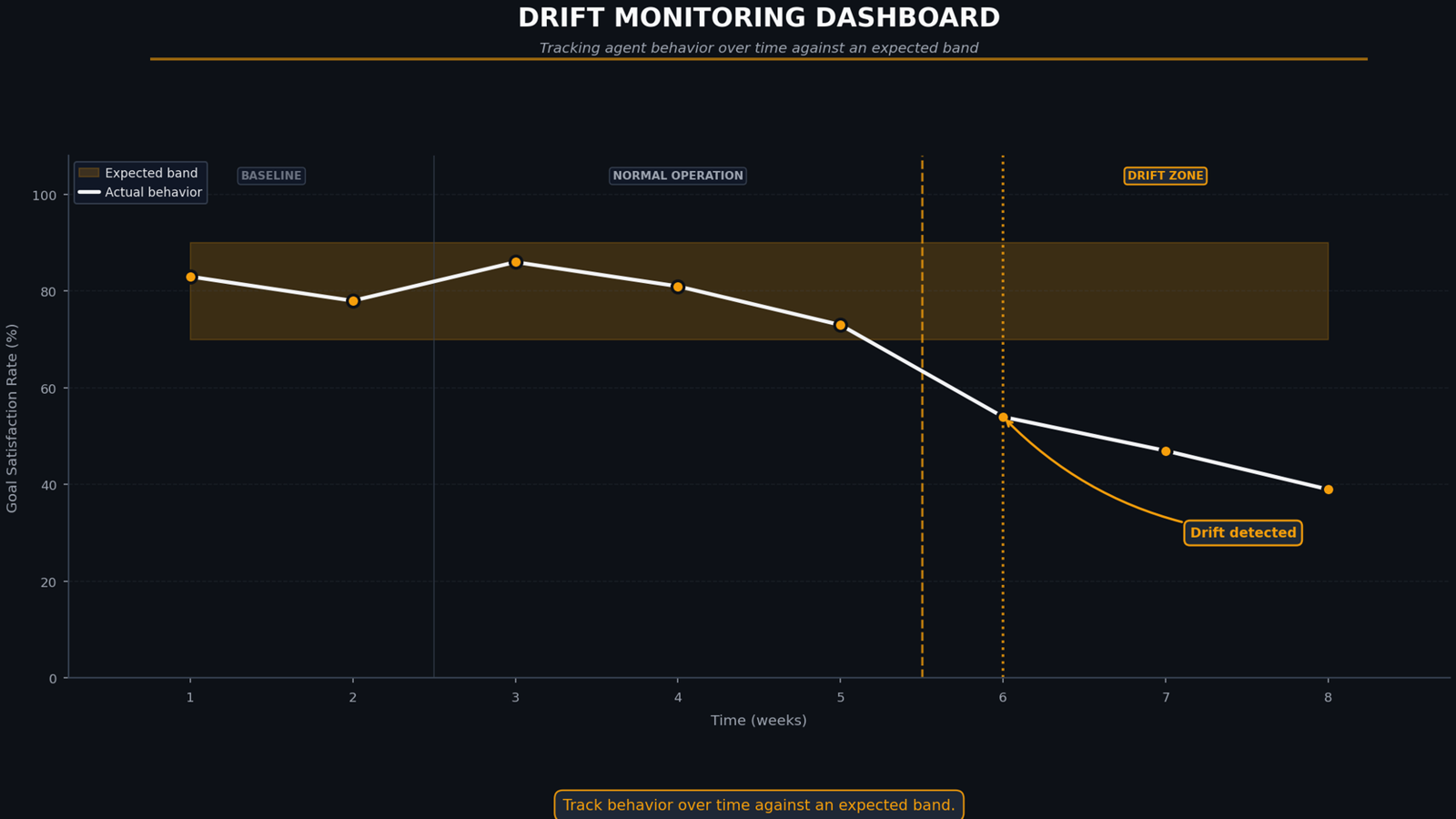
What does continuous evaluation include?
| Practice | Test once at launch | Continuous evaluation |
|---|---|---|
| Cadence | One-time gate | Ongoing against current data |
| What it watches | Launch-day behavior | Drift in key behaviors |
| Alerting | None | When performance leaves the band |
| Failure | Found by users | Caught by monitoring |
Vectara keeps re-measuring hallucination because the rate moves; the agent held still, its world did not and a newer model resets the snapshot. (arXiv:2305.14251)
Detecting drift requires knowing what correct behavior looks like for each situation, which is what the Pattern Intelligence Layer defines. VibeModel makes the expected handling of each pattern explicit, so continuous evaluation can measure whether the agent still matches those patterns and flag the moment it starts to drift, turning slow degradation from the thing your customers discover into the thing your monitoring catches first.
Frequently asked questions
Why monitor an agent that has not changed?
Because its environment changes: data, users, APIs and the underlying model. Reliability is the agent in its world and the world keeps moving.
Isn't a strong launch test enough?
No. A launch test is a snapshot. Continuous evaluation catches the drift that a one-time gate cannot, before users do.
What do you actually monitor?
Key behaviors against an expected band, using fine-grained evaluation, so a gradual decline triggers an alert rather than an incident.