


Key facts.
- Reflexion shows structured self-reflection can improve an agent's performance across iterations, a mechanism a feedback loop operationalizes at scale.source
- Self-Consistency shows aggregating multiple attempts beats a single shot, the principle that more feedback and signal raise reliability.source
Why does improvement require a closed loop?
An agent does not get better by running. It gets better when what it learns in production changes what it does next. That requires a loop: capture the corrections and outcomes from real use, turn them into updates to the agent's behavior and verify the updates took effect. The research shows the building blocks work. Structured reflection like Reflexion improves performance across iterations, and aggregating signal via self-consistency beats a single attempt, which is the same principle a feedback loop scales over time. But the building blocks only matter if the loop is closed. An agent with rich feedback that never reaches its behavior is an agent frozen at launch, accumulating complaints instead of competence.
Most agents do not improve because the loop is open somewhere. Feedback is collected but not applied. Corrections land in a backlog. Updates are made but never verified, so no one knows if they worked. Closing the loop is deliberate engineering: a path from a real correction to a behavior change to a confirmation that the change held on the next occurrence. Done well, every month of production makes the agent more reliable, because the long tail it meets becomes the long tail it has learned. The difference between an agent that compounds and one that stagnates is entirely whether that loop closes.
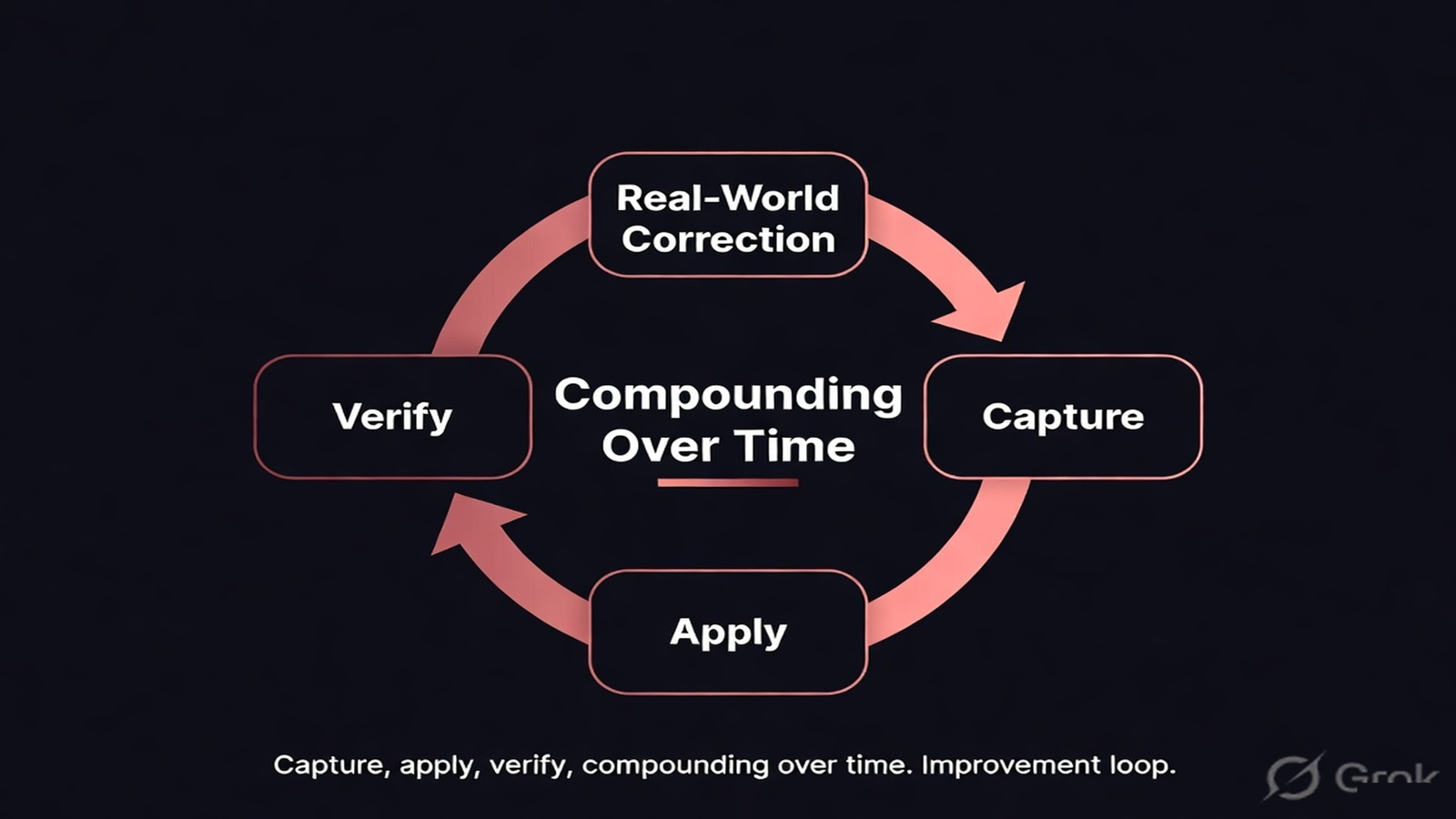
What makes the loop close?
| Step | Open loop | Closed loop |
|---|---|---|
| Capture | Feedback collected | Corrections and outcomes |
| Apply | Lands in a backlog | Changes behavior where used |
| Verify | Assumed | Confirmed on next occurrence |
| Over time | Frozen at launch | Compounds month over month |
Reflexion lifts reliability only when the loop closes; a more capable model freezes at launch-day quality, costing rework, if corrections never land. (arXiv:2303.11366)
The loop closes cleanly when corrections attach to the patterns the agent actually uses, which is what VibeModel enables as the Pattern Intelligence Layer. By tying a real-world correction to the pattern it applies to, it ensures the agent applies the learning consistently the next time the situation arises, turning feedback into compounding reliability rather than a backlog that never changes the agent.
Frequently asked questions
Why doesn't my agent improve over time?
Because the loop is open: feedback is collected but never reaches the agent's behavior, so it stays frozen at launch-day quality.
Do techniques like Reflexion help?
Yes, as mechanisms, but only if the loop closes. Self-reflection and aggregating signal improve reliability when the improvement is actually applied and verified.
How do you confirm a correction worked?
Verify the changed behavior on the next occurrence of the situation, rather than assuming the update worked because it was entered.