


Key facts.
- G2's 2025 adoption data shows the agents that reach and stay in production are the ones organizations iterate on from pilot forward, not set-and-forget deployments. source
- The lost-in-the-middle effect shows models miss relevant information placed mid-context, so a correction has to be surfaced deliberately or it is ignored. source
Why do most feedback loops fail to close?
Teams set up a way for users to flag agent mistakes and then assume improvement follows. It does not, because flagging is the easy half. The hard half is turning a flagged mistake into a change in the agent's behavior, through an updated instruction, a corrected example, a tightened rule and verifying the change actually stuck. When that half is missing, users report the same error repeatedly, watch nothing happen and stop reporting, at which point the agent is frozen at its launch-day quality and the feedback channel is decoration. The lost-in-the-middle effect is one concrete reason naive approaches fail: stuffing the correction into a long prompt does not work, because the model skips the middle.
A loop that closes treats each correction as a unit of work: capture it, apply it where the agent will actually use it and confirm the behavior changed. The G2 pattern reflects this, with the agents that stay in production being the ones their owners keep improving. The difference between an agent that gets better every week and one that stagnates is entirely whether the corrections reach it and take hold.
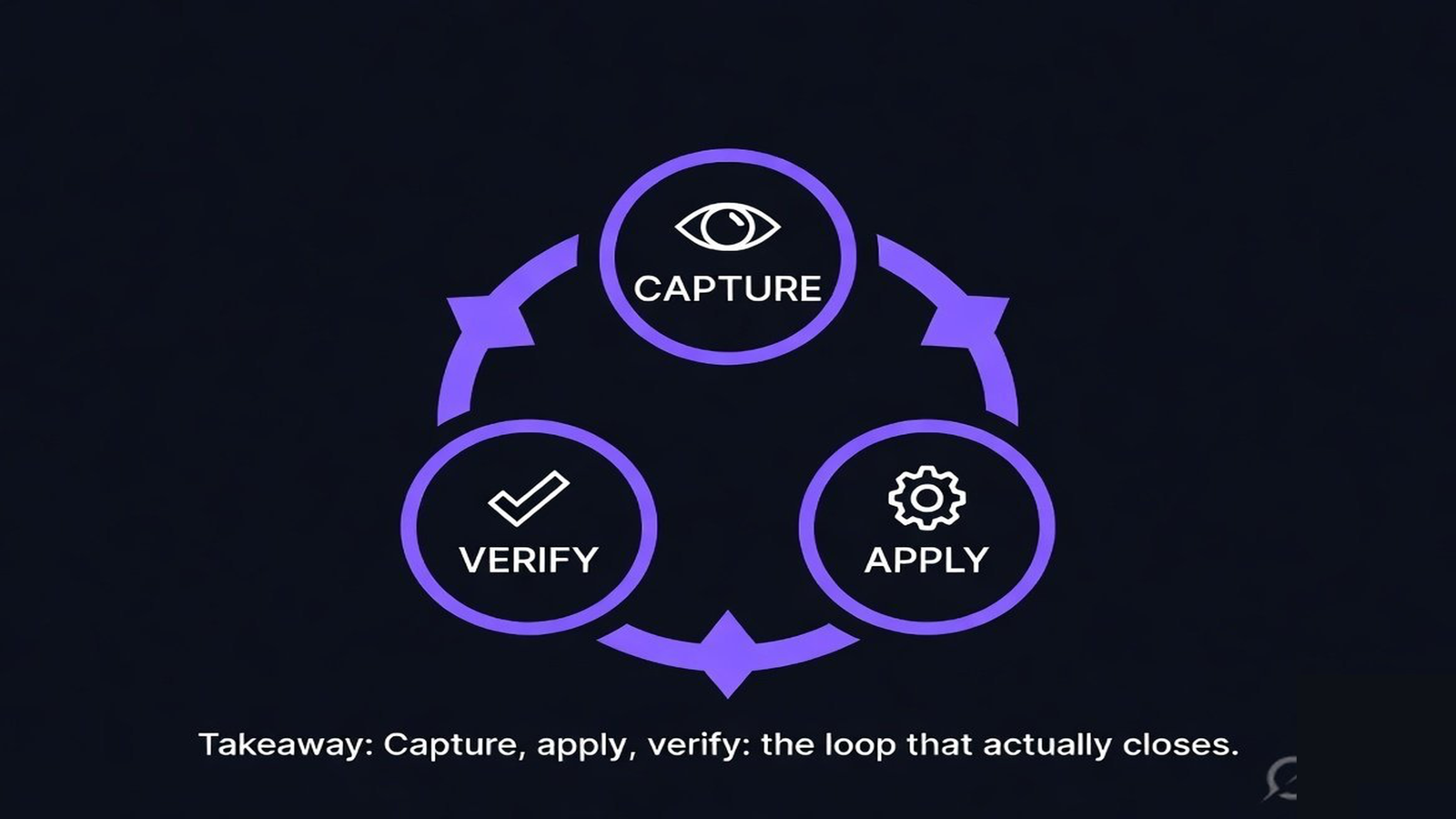
What does a loop that closes require?
| Step | Open loop | Closed loop |
|---|---|---|
| Capture | A feedback form | Structured correction |
| Apply | Lands in a backlog | Changes behavior where used |
| Verify | Assumed | Confirmed the change stuck |
| Result | Frozen at launch | Improves every week |
Corrections take hold when they attach to the pattern the agent uses, not to a prompt it might skim past, which is what the Pattern Intelligence Layer enables. VibeModel makes the agent's handling of a situation a durable pattern, so a human correction updates that pattern and the agent applies it consistently the next time the situation appears, turning feedback into compounding improvement instead of a form nobody reads.
Frequently asked questions
Will a smarter model learn from our corrections on its own?
Corrections dropped mid-prompt vanish even on a newer model, so improvement is an engineered loop you pay for late. (arXiv:2307.03172)
Why does collected feedback not improve the agent?
Because collection is only the first step. Without applying the correction where the agent uses it and verifying it stuck, the behavior never changes.
What is lost-in-the-middle?
Models tend to miss information placed in the middle of a long context, so a correction buried in a big prompt can be ignored. Corrections must be surfaced deliberately.
How do you know a correction took hold?
Verify the behavior changed on the next occurrence of the situation, rather than assuming the update worked because it was entered.