


Key facts.
- Harder, contamination-resistant evaluations like SWE-bench Pro show measured agent performance shifts when the model or the test changes, so reliability is not fixed across versions. source
- Google's DORA research links changes in AI tooling to delivery performance tradeoffs, so updates can degrade previously stable behavior. source
Why does an update break a working agent?
An update is a dependency change shipped untested: SWE-bench Pro moves when the model shifts, so the upgrade costs you yesterday's agent. (source)
An agent's behavior is an emergent property of a specific model, specific prompts and specific tools interacting. Change any one of them and the interaction can change, sometimes invisibly. A model upgrade that is better on average can be worse on your specific workflow. A prompt tweak to fix one case can regress three others. A tool that changes its output format can quietly feed the agent something it now misreads. None of these announce themselves, because the agent still runs and still returns answers; it just returns different ones and the reliability you validated last month no longer holds. That benchmark performance shifts with the model and the evaluation, as SWE-bench Pro illustrates, is the formal version of the same truth: there is no version-independent reliability to coast on.
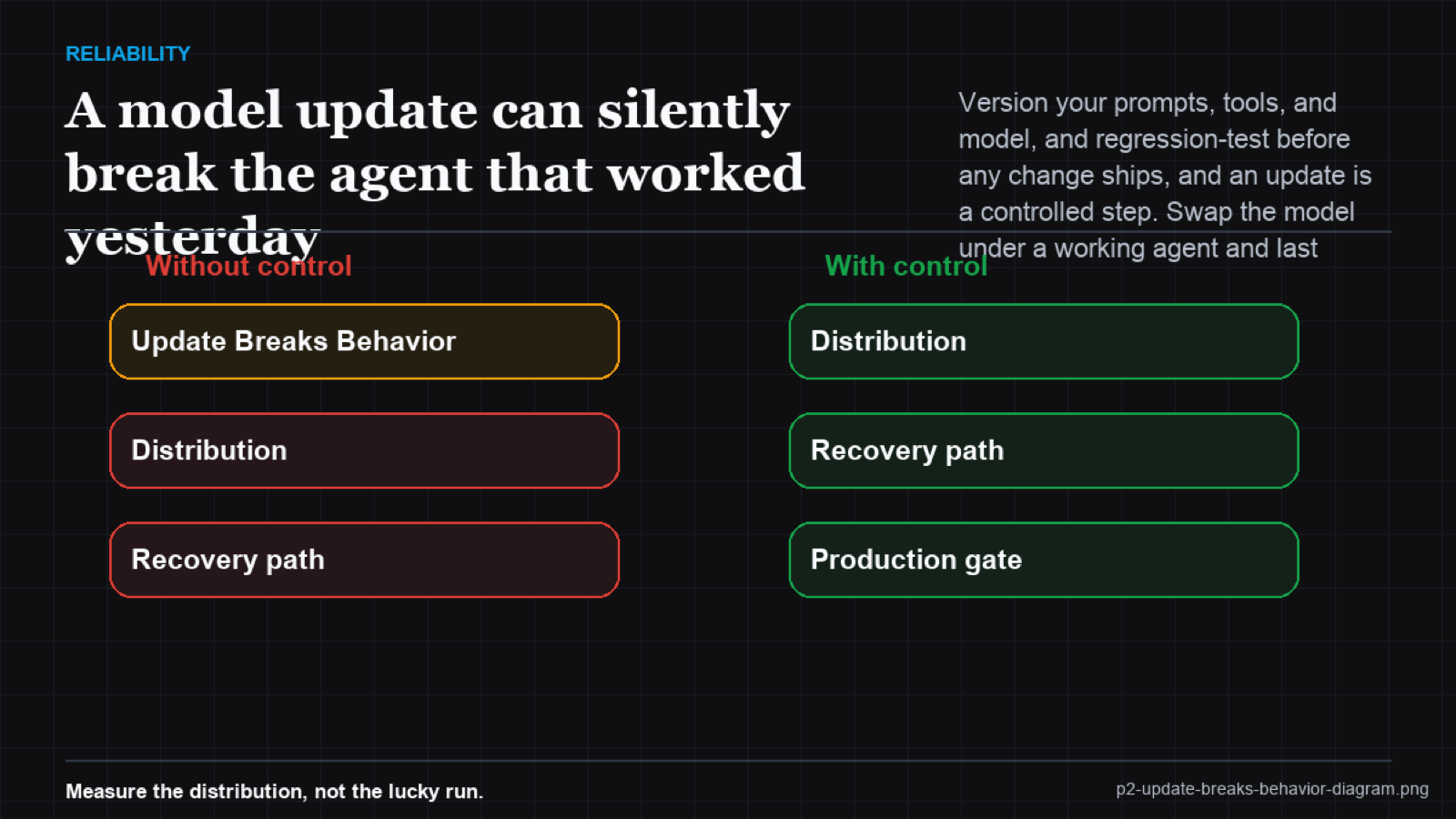
The discipline is borrowed from software and applied to the agent's full dependency set. Version the model, the prompts and the tool contracts, so you know exactly what is running. Keep a regression suite of your real cases and run it before any of those change, so a degradation is caught in test rather than in production. Roll changes out gradually with monitoring, so if behavior shifts despite the tests, you catch it on a small slice. The DORA finding that AI-tooling changes carry delivery tradeoffs is the reminder that this is not paranoia; changes to AI dependencies have measurable downside and the teams that treat a model update like any other dependency upgrade are the ones whose agents survive it.
What controls an update?
| Practice | Unmanaged update | Controlled change |
|---|---|---|
| Versioning | Model swapped silently | Model, prompts, tools pinned |
| Regression test | None | Real cases run before ship |
| Rollout | All at once | Gradual, monitored |
| A bad change | Breaks production | Caught in test or canary |
A regression suite is only as good as its coverage of the behavior that matters, which is where the Pattern Intelligence Layer helps. VibeModel makes the agent's expected handling of each situation an explicit pattern, so a regression test can check that an update preserves those patterns and a change that would have silently broken a reliable behavior is caught because the pattern it violated was something you could test against.
Frequently asked questions
Won't a newer model just be better?
On average, maybe. On your specific workflow it can be worse, because behavior is an interaction of model, prompts and tools. Only a regression test on your cases tells you.
What should you version?
The model, the prompts and the tool contracts, so you always know exactly what is running and can roll back a change that breaks behavior.
How do you catch silent breakage?
Run a regression suite of real cases before shipping any change, then roll out gradually with monitoring to catch what the tests missed.