


Key facts.
- WorkBench shows agents post low success on realistic workplace tasks, so some regressions will not be caught before release and must be caught in a limited rollout. source
- AppWorld similarly shows low success on complex interactive tasks, reinforcing that pre-release testing cannot validate everything and a canary is needed. source
Why canary an agent change?
Every change to an agent, a new model, a prompt edit, a tool update, can regress behavior in ways your test suite did not cover, because, as the WorkBench and AppWorld results show, agent behavior on realistic tasks is hard enough that no pre-release test is complete. Shipping the change to everyone at once bets that your testing caught every regression and that bet loses periodically, turning an unnoticed regression into a full-blast incident. A canary changes the math: release the new version to a small slice of traffic, watch it against the old version on real outcomes and only widen if it holds. The regression that slips past test now shows up in production at a fraction of the impact, on users you are watching closely, with the old version still serving everyone else.
The discipline has a few parts. Route a small percentage to the new version while the rest stay on the known-good one. Monitor behavioral outcomes, not just technical health, since the regressions that matter are behavioral. Compare the canary against the baseline on real success and automate rollback so a bad canary reverts without a human scrambling at 3am. Then widen in stages, each a checkpoint, rather than flipping to full deployment. This is standard progressive-delivery practice and it is doubly valuable for agents precisely because their behavior is the part you could not fully verify before release.
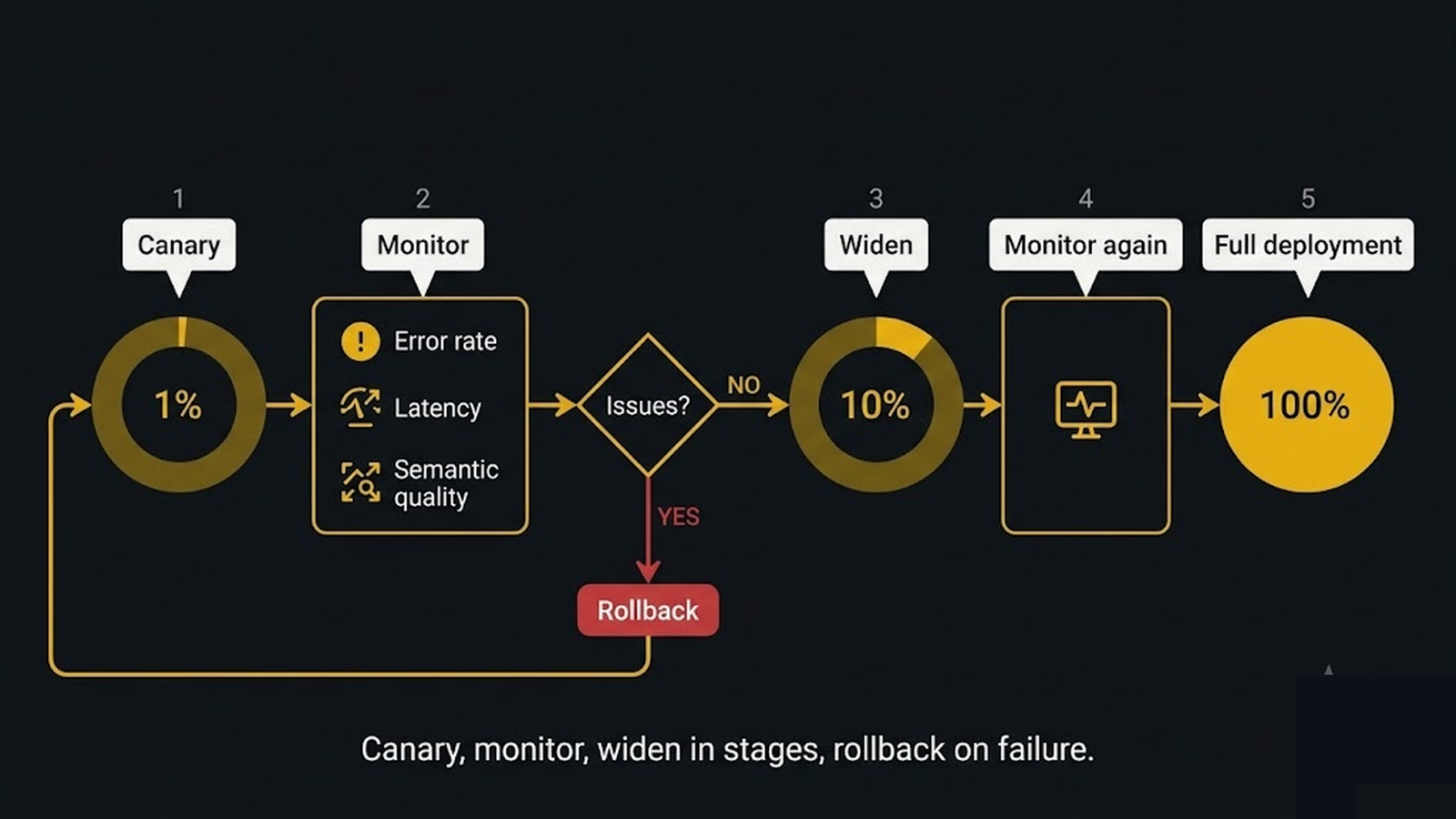
What does a safe rollout include?
| Element | Ship to everyone | Gradual rollout |
|---|---|---|
| Initial exposure | 100% of users | A small canary slice |
| Comparison | None | Canary vs known-good |
| On regression | Full outage | Automatic rollback |
| Widening | All at once | Staged checkpoints |
A canary only works if you can tell whether the new version is behaving correctly, which is what the Pattern Intelligence Layer enables. VibeModel makes the agent's expected behavior an explicit pattern, so the canary can be compared against the baseline on whether it still satisfies those patterns and a behavioral regression triggers rollback before the change ever reaches the full user base.
Frequently asked questions
Does a better model make gradual rollout unnecessary?
On WorkBench agent success is low, so regressions slip past test; a newer model slips different ones, so canary before it hits all. (arXiv:2405.00823)
Why not rely on testing before release?
Because agent behavior on realistic tasks is hard to fully validate, as WorkBench and AppWorld show, so some regressions only appear in production. A canary catches them at small scale.
What should the canary monitor?
Behavioral outcomes against the known-good version, not just uptime, since the regressions that matter are behavioral.
How fast should you widen?
In staged checkpoints, each confirming the new version holds, rather than flipping straight to full deployment.