


Key facts.
- G2's August 2025 survey reports roughly 57% of companies with agents in production, 22% in pilot, and 21% pre-pilot, showing how many stall at the pilot-to-production jump. source
- METR's randomized controlled trial found experienced open-source developers were about 19% slower using early-2025 AI tools, despite believing they were faster, evidence that perceived pilot success can mislead. source
- The gap wears a new costume each stage; a newer model still let METR's devs feel faster while slower, so rework hides till rollout. (arXiv:2507.09089)
Why does the pilot mislead you?
A pilot runs under conditions a rollout cannot reproduce: a hand-picked enthusiastic team, the cleanest slice of the process, the builders on call to patch problems in real time. Of course it works. The trouble is reading that success as proof the agent is ready for everyone, when what it actually proved is that the agent works for that team, on that slice, with that support. The METR trial is the cautionary note underneath: even the people using the tool felt faster while measurably moving slower, so the pilot team's glowing report is a feeling, not a measurement and the rollout inherits the gap.
The deployments that scale treat the rollout as its own project with the change work the pilot never needed: training for teams who are not early adopters, integration into messier real workflows and ownership that does not depend on the original builders. The G2 stage data is the shape of the failure when that work is skipped, with organizations clustered at the pilot and pre-pilot stages because the jump to broad production is a different problem than the pilot solved.
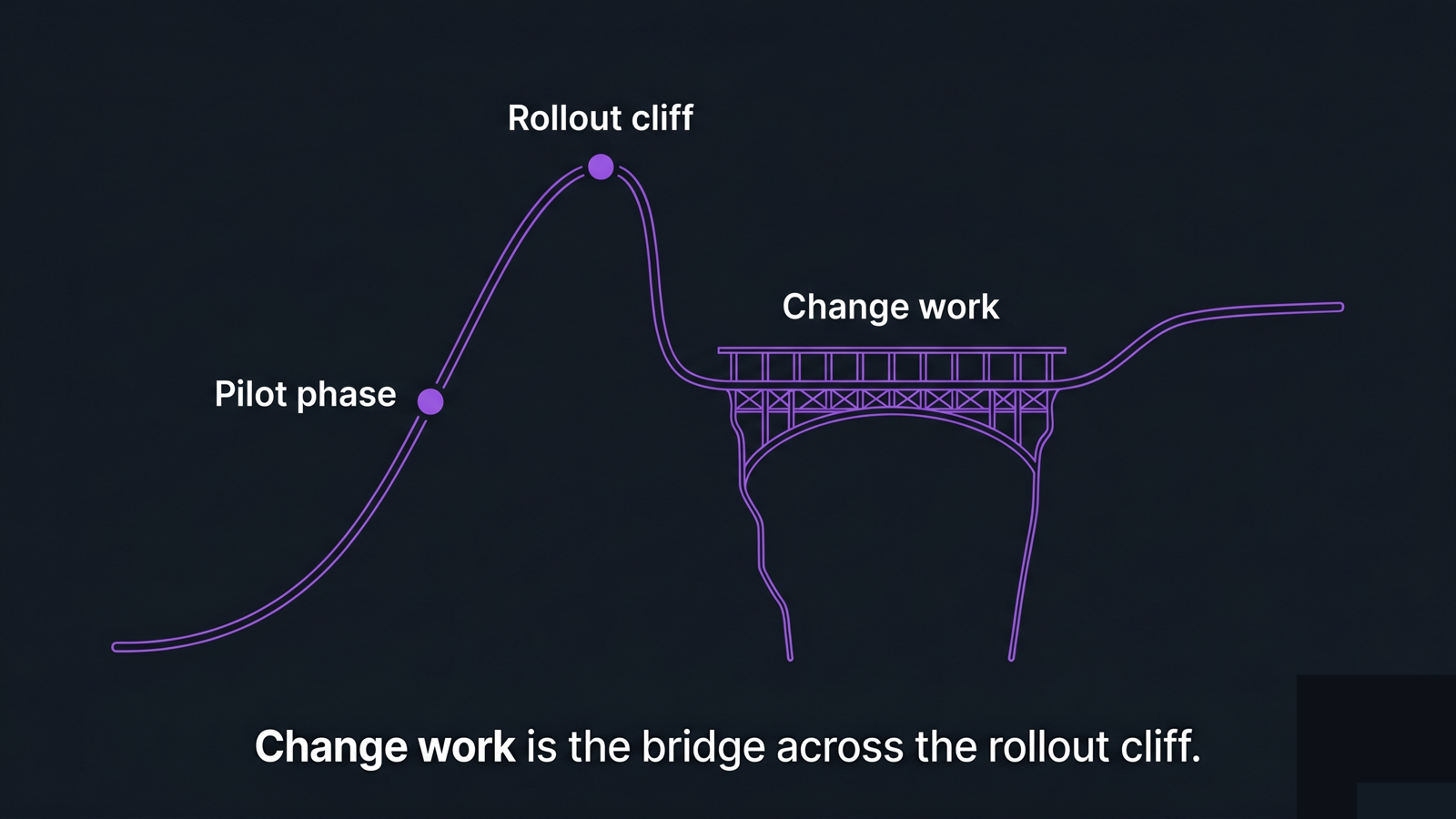
What does the rollout need that the pilot did not?
| Factor | Pilot conditions | Rollout reality |
|---|---|---|
| Team | Hand-picked enthusiasts | Everyone, including skeptics |
| Process slice | Cleanest case | Full messy variety |
| Support | Builders on call | Standing ownership needed |
| Proof | A good feeling | Measured reliability at scale |
Crossing the cliff takes reliability that holds outside the pilot's friendly conditions, which is what VibeModel delivers as the Pattern Intelligence Layer. When the agent handles its patterns the same correct way every time across the full variety a rollout brings, the pilot's success becomes evidence you can scale on rather than a feeling that evaporates the moment the friendly conditions end.
Frequently asked questions
Why not just expand the pilot gradually?
Gradual is good, but only if each step adds the change work, training, integration, ownership, that the pilot did not need. Expansion without that work hits the same cliff slower.
How do you tell real pilot success from a good feeling?
Measure outcomes, not sentiment. METR's trial showed users can feel faster while being slower, so trust the numbers over the enthusiasm.
Who owns the rollout?
A named owner independent of the original builders, with budget for the change work, so the agent does not collapse when the pilot team moves on.