

Key facts.
- The Asleep at the Keyboard study found about 40% of Copilot completions insecure, showing AI-produced artifacts carry version-sensitive risk that demands tracking. source
- PoisonedRAG shows the sources an agent reads can be poisoned, so the provenance and versioning of tools and context sources is a reliability and security concern. source
Why version the prompts and tools?
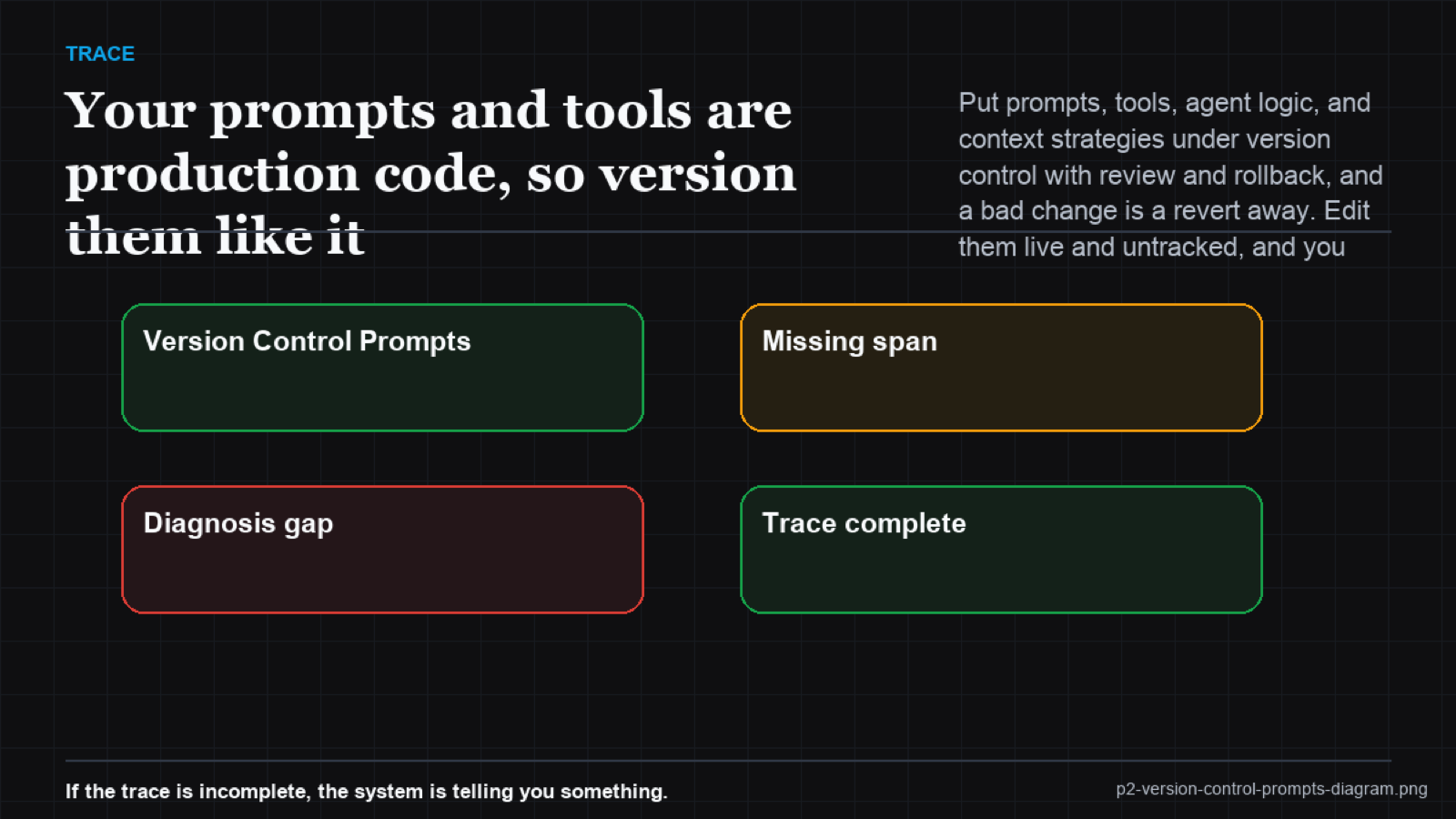
An agent's behavior is determined by more than its code. The prompt, the tool definitions, the agent's control logic and the context-management strategy all shape what it does and any of them can change behavior dramatically. Yet teams that would never edit production code live in a text box routinely do exactly that with prompts, tweaking them in place, untracked, while the agent runs. Then the agent's behavior shifts and there is no record of what changed, no review that might have caught the regression and no clean way to roll back. The same discipline that protects code, version control, review, rollback, has to extend to every artifact that determines behavior, because all of them are, in effect, production code.
The risk is concrete on both reliability and security fronts. AI-produced artifacts are not automatically safe, as the roughly 40% insecure-completion finding shows, so a prompt or tool change needs the same scrutiny as a code change. And the context sources an agent reads are an attack surface, as PoisonedRAG demonstrates, so knowing exactly which version of which source the agent used is part of being able to trust and audit its behavior. Versioning all of this gives you the things you cannot operate without: a record of what changed, a review gate before it ships and a rollback when a change breaks the agent. Without it, every behavior change is a mystery and every fix is a guess.
What belongs under version control?
| Artifact | Edited live, untracked | Version-controlled |
|---|---|---|
| Prompts | Changed in a text box | Tracked, reviewed, revertible |
| Tool definitions | Modified ad hoc | Versioned with contracts |
| Agent logic | Unrecorded | In source control |
| Context sources | Unknown provenance | Pinned and tracked |
Prompts and tools drive behavior like code, ~40% of completions flawed; a better model edited live and untracked costs an unrevertable break. (arXiv:2108.09293)
Versioning is most powerful when you can tie a change to the behavior it affected, which is what the Pattern Intelligence Layer enables. VibeModel links the agent's behavior to explicit patterns, so a versioned change to a prompt or tool can be connected to the patterns it altered and regression-tested against them, turning version control from a record of edits into a way to know exactly what each change did to the agent's behavior.
Frequently asked questions
Are prompts really production code?
Functionally yes. They determine behavior as much as code does, so a bad prompt change can break the agent just like a bad code change.
Why version context sources?
Because they can be poisoned, as PoisonedRAG shows, so knowing which version of which source the agent used is part of trusting and auditing it.
What does version control give you?
A record of what changed, a review gate before it ships and a rollback when a change breaks the agent, none of which live editing provides.