


Key facts.
- LLMs and agents produce different outputs from identical inputs run to run, the assumption that you can reproduce a bug by rerunning it doesn't hold. source
- Checkpoint-based state persistence (LangGraph's time travel) turns an ephemeral agent run into a reproducible, walkable workflow by freezing state at each step, so you can inspect the exact moment logic drifted. source
- A practical testing strategy separates layers: deterministic logic (tool routing, argument parsing, state transitions) gets ordinary unit tests, while probabilistic behavior gets averaged scores across multiple runs to absorb variance. source
- Debugging tooling for agents is shifting from raw log reading to interactive steering over conversation trees and recorded traces. source
Why do breakpoints and rerun-to-reproduce break down?
A breakpoint requires execution to reach the same line under the same conditions. With an agent, the path can diverge mid-run, the decision you wanted to pause on may simply not happen the same way again. Rerun-to-reproduce is worse: the whole technique assumes the failure is deterministic. When a hallucination or a bad tool choice shows up on run three and vanishes on run four, you aren't debugging, you're chasing a ghost. Logs and stack traces give you a snapshot of one path, not an explanation for why this run diverged.
The mistake is treating non-determinism as flakiness to eliminate. It's a property of the system. The debugging method has to assume the run won't repeat and capture enough of the single run you have to understand it fully.
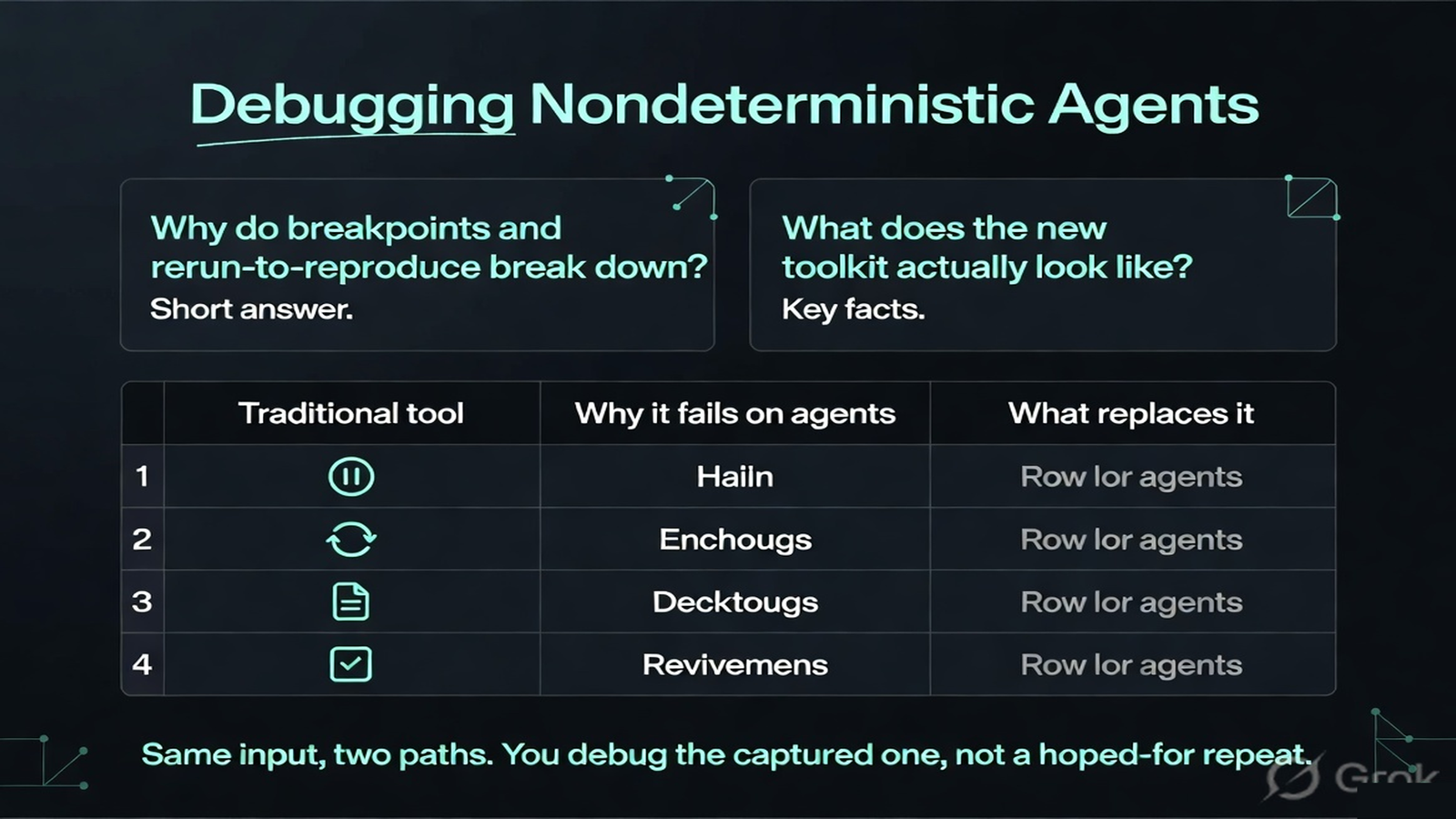
What does the new toolkit actually look like?
Three methods do the work the old tools can't. Replay (or time travel) persists agent state at every checkpoint so a run that already happened becomes something you can freeze, rewind, and step through, the only reliable way to inspect a path that won't recur. Layered testing splits the system by determinism: deterministic plumbing (routing, parsing, state machine) takes ordinary unit tests, while model-driven behavior gets averaged across several runs so one lucky or unlucky sample doesn't decide the verdict. Interactive stepping over a recorded trace replaces scrolling raw logs with walking the actual decision sequence. Vendor framing around one-click "AI debugging" is marketing. The durable ideas, replay, layered tests, multi-run evaluation, are grounded in how non-deterministic systems actually get debugged.
| Traditional tool | Why it fails on agents | What replaces it |
|---|---|---|
| Breakpoint | The path may not reach it twice | Replay a captured run, step its checkpoints |
| Rerun-to-reproduce | The bug may not recur | Average evaluations across multiple runs |
| Raw log reading | One snapshot, no decision context | Interactive stepping over the trace |
| One unit test | Cannot pin a probabilistic output | Unit-test deterministic parts, evaluate the rest |
Breakpoints assume the bug repeats; a stochastic run never reappears the same, and a better model doesn't fix it, since Thinking Machines ran one prompt 1,000 times at temp 0 for 80 outputs, so catches come late. (source)
This is the methodology the Pattern Intelligence Layer formalizes. Reliability at the pattern level means you stop trying to reproduce one-off runs and start capturing and replaying behavior as a pattern, the recurring failure shows up across many recorded runs even when no single run repeats. The toolkit moves from "make it happen again" to "see clearly what happened." That's the only debugging stance that survives a system whose nature is to not repeat itself.
Frequently asked questions
Can I just set temperature to zero and debug normally?
No. Even with low temperature, retrieval, tool outcomes, and batching variability keep runs from repeating reliably. The debugging method still has to assume non-repeatable runs.
What's the single most useful new tool?
Checkpoint-based replay. Freezing and walking a captured run is the closest thing to a breakpoint that actually works when the path won't recur.
How do I test something that gives different answers?
Split it. Unit-test the deterministic plumbing, and evaluate probabilistic behavior by averaging scores across several runs rather than trusting one.