


Key facts.
- "LLMs Get Lost in Multi-Turn Conversation" finds an average performance drop of roughly 39% from single-turn to multi-turn, so failures depend on conversational context and resist simple reproduction.source
- TRAIL provides a taxonomy of agent-trace errors and 148 annotated traces for localizing them, evidence that the bug lives in a trace you have to capture and read.source
Why are agent bugs so hard to reproduce?
Classic debugging leans on reproduction: trigger the bug again, watch it happen, fix it. Agents break that workflow because their behavior is context-dependent and non-deterministic. The multi-turn research shows how much context matters, with performance dropping around 39% once a conversation has history. A failure that happened on turn nine depends on the exact path of the first eight turns and the model's stochastic choices along the way. Re-running the same prompt does not recreate that state. The bug vanishes the moment you try to study it and the postmortem stalls at "we could not reproduce it."
The answer is to stop relying on reproduction and start relying on capture. If every run records a full trace, the inputs, the tool calls and their results, the intermediate reasoning. The context state, then an intermittent failure can be reconstructed from the trace even if it never recurs. TRAIL is the evidence that this is both needed and feasible: the errors are hard to spot but can be taxonomized and localized when you have the trace to examine. Without that capture, debugging an agent is archaeology with no artifacts. With it, even a one-time failure becomes a case you can open, read and fix.
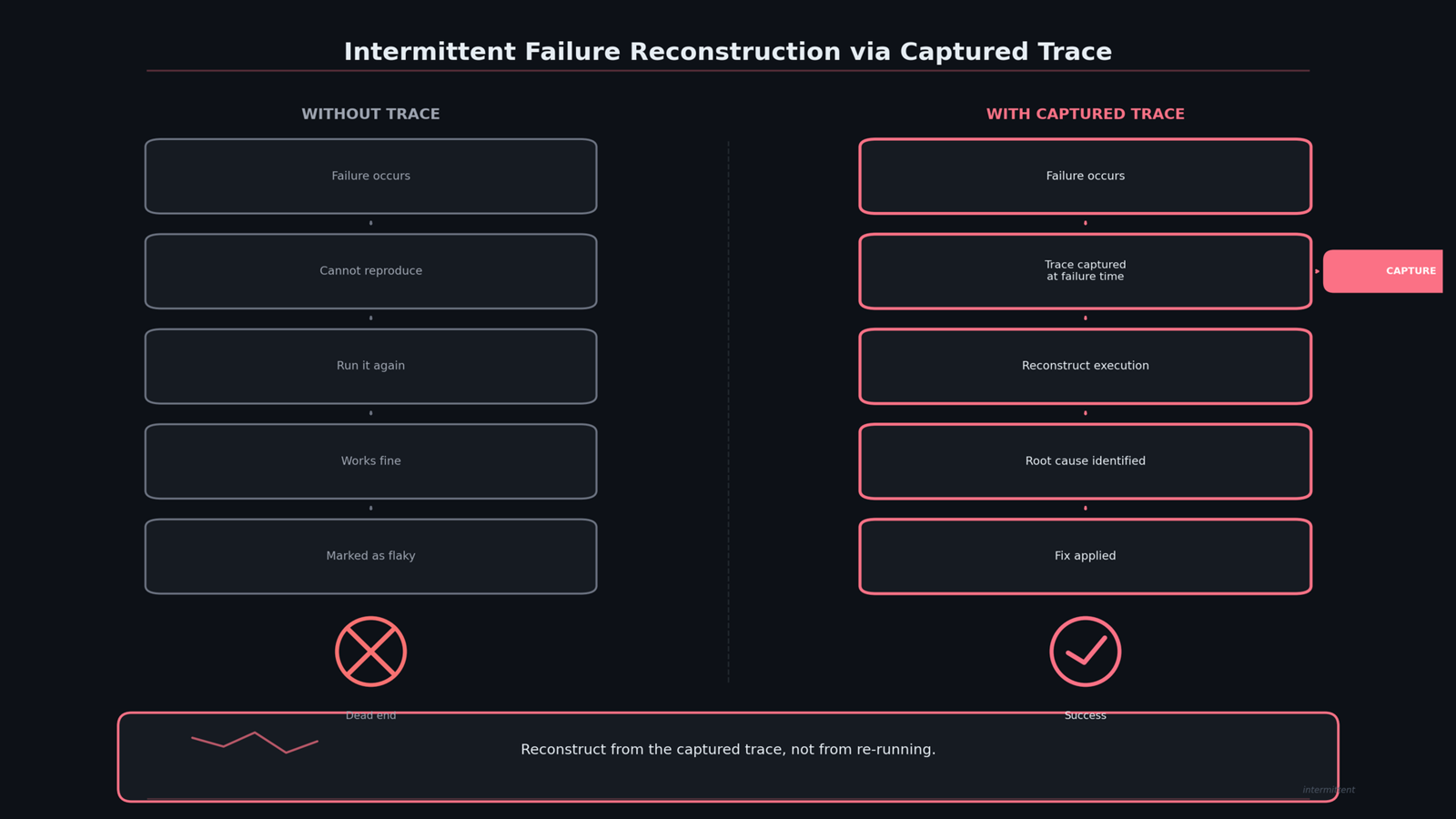
What lets you debug the intermittent?
| Approach | Rely on reproduction | Rely on capture |
|---|---|---|
| Method | Re-run the input | Read the recorded trace |
| Context | Lost | Captured at failure time |
| One-time bug | Cannot study | Reconstructable |
| Postmortem | Could not reproduce | Root cause found |
Intermittent agent failures are a class: about 39% drops over multi-turn that an upgrade reprices, not removes, so the retry cost stays. (arXiv:2505.06120)
A trace is most useful when you can tell which step diverged from the pattern that should have held. Is what the Pattern Intelligence Layer adds. VibeModel makes the agent's expected handling of a situation explicit. A captured trace can be compared against the pattern to pinpoint exactly where an intermittent run went wrong, turning a failure you could never reproduce into one you can diagnose from the record.
Frequently asked questions
Why not just re-run to reproduce?
Because agent failures are context-dependent and non-deterministic. Multi-turn performance drops ~39%, so the failing state depends on history you cannot recreate by re-running the prompt.
What should the trace capture?
Inputs, every tool call and result, intermediate reasoning and context state, enough to reconstruct the run without needing it to recur.
How do you find the error in a long trace?
Compare it against the expected pattern to localize the divergence, which is what taxonomized trace analysis like TRAIL enables.