


Key facts.
- The agent improvement loop starts with the trace: enrich traces with evals and human feedback, identify failure patterns, make targeted changes, and validate before shipping.source
- Automated clustering over production traces surfaces usage patterns, failure modes, and edge cases that are invisible in any single session (for example LangSmith's Insights-style clustering).source
- The MAST taxonomy, built from 1,600+ annotated multi-agent traces, names the recurring failure modes across system design, inter-agent misalignment, and task verification, giving the patterns a research-grounded vocabulary.source
- Common patterns these methods find include repetitive loops, context loss, failing to follow task requirements, not recognizing task completion, coordination loops and deadlocks, role drift, and error propagation across agents (specific rates vary by study and should be treated as reported).source
What clustering finds that a single trace hides
It turns each run into something comparable and looks across all of them. A trace-mining tool extracts features from every run, span sequence, tools used, latency profile, error types, state changes, and clusters similar executions to flag outliers and recurring anomalies. You query by attribute (tool name, plan type, confidence score) and let the system surface the patterns. Instead of reading hundreds of traces by hand hoping to spot a theme, clustering shows you that a particular tool always precedes a retry loop, or a class of inputs reliably triggers context loss. That theme was always in the data. It was invisible one trace at a time.
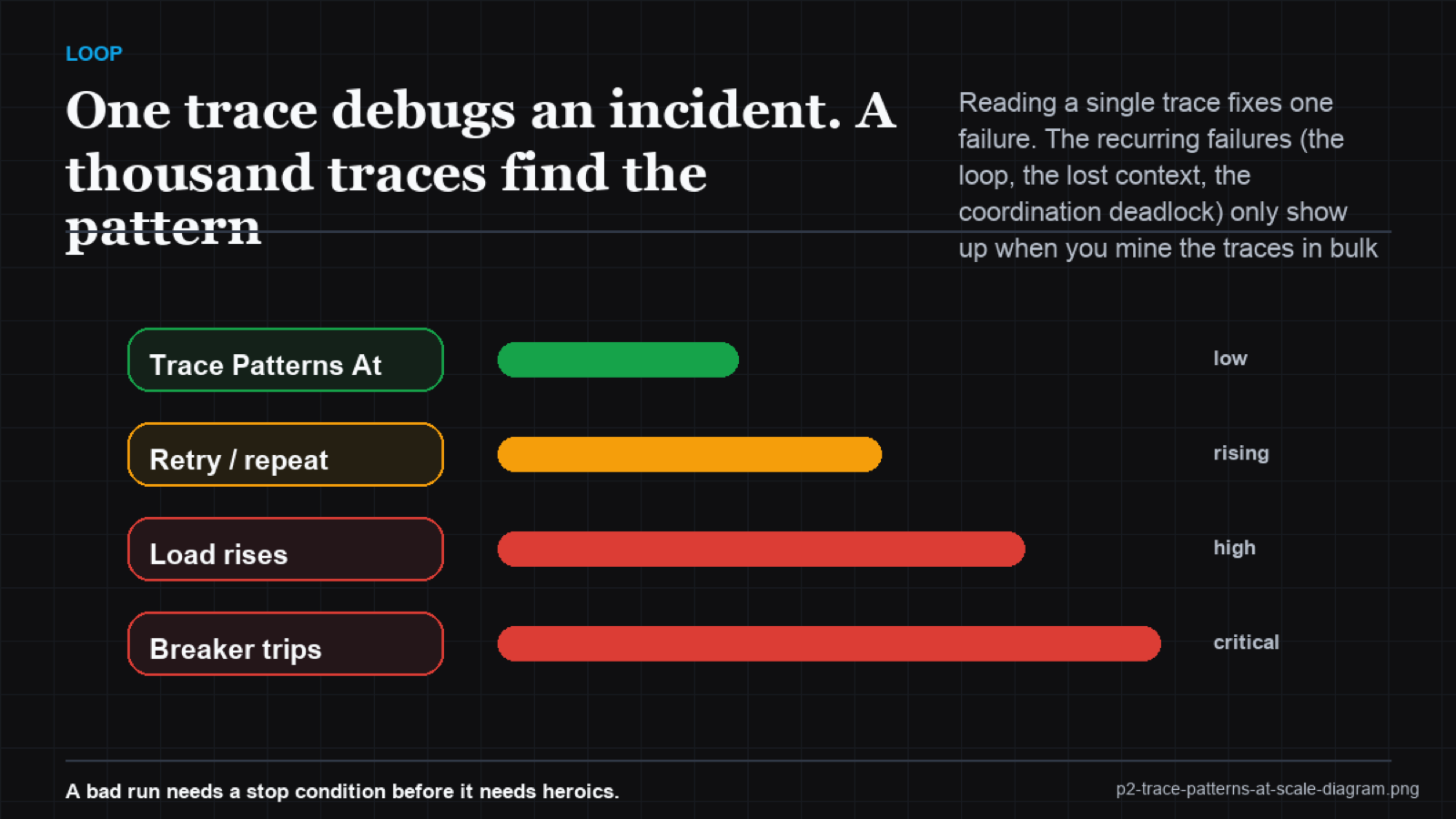
That's why recurring failures keep escaping single-incident workflows. Each instance looks like a one-off when read alone. In aggregate it's a cluster, a fixable pattern with a known cause, not a string of unrelated mysteries.
Turning this into a systematic improvement loop
Close the loop from pattern to fix to verification. Mine the traces to find the recurring failure mode, name it against a taxonomy like MAST so the team shares a vocabulary, make the targeted change, a tool description, a planning constraint, a loop guard, then validate against the same trace data before shipping. After the change, watch the cluster. If it shrinks, the fix held. If it doesn't, you learned the cause was elsewhere, that's still progress. Be honest about vendor framing: clustering surfaces correlations, not conclusions. A flagged cluster is a lead for a human to confirm, not a verdict. The discipline is the loop, mine, name, fix, validate, not any single dashboard.
| Approach | One trace at a time | Pattern-mining at scale |
|---|---|---|
| What you catch | The incident in front of you | The recurring failure mode |
| Step repetition / loops | Looks like a one-off | Shows up as a cluster |
| Coordination deadlocks | Hard to see in one run | Visible across many runs |
| Outcome | Sporadic fixes | Systematic, validated improvement |
Pattern-mining over traces is the Pattern Intelligence Layer doing exactly what its name says. One trace tells you what happened in one incident. A thousand traces, clustered, tell you what keeps happening, and that's the knowledge that actually raises reliability. Fix the pattern once instead of re-debugging each instance as if it's new.
Frequently asked questions
Why not just review more traces by hand?
Because humans cap out at a few hundred a day and recurring patterns are easy to miss one at a time. Clustering looks across thousands at once and surfaces the theme.
What patterns does clustering reliably find?
Repetitive loops, context loss, failing to follow task requirements, not recognizing completion, coordination deadlocks, role drift, and error propagation. Treat specific published rates as reported.
Is a flagged cluster a confirmed bug?
No. it's a correlation and a strong lead. A human confirms the cause and the fix, then you validate against the trace data before shipping.