


Key facts.
- TRAIL builds a formal taxonomy of agent error types over 841 annotated errors, showing failures cluster into a small set of recurring, labelable modes, the precondition for automated classification rather than manual triage.source
- Thinking Machines Lab found that even at temperature 0, sampling 1,000 completions yielded 80 distinct outputs because of batch-level numerical variance, so the same agent is inconsistent across repeats and the signal lives in the distribution of runs, not any single one.source
- A 2025 enterprise survey ranks observability and evaluation as the top forward investment, and most teams still can't trace failures through multi-step workflows by hand.source
- OpenTelemetry GenAI semantic conventions give traces a consistent shape, which is what makes automated analysis across tools and models possible at all.source
Why can a human not just read the traces?
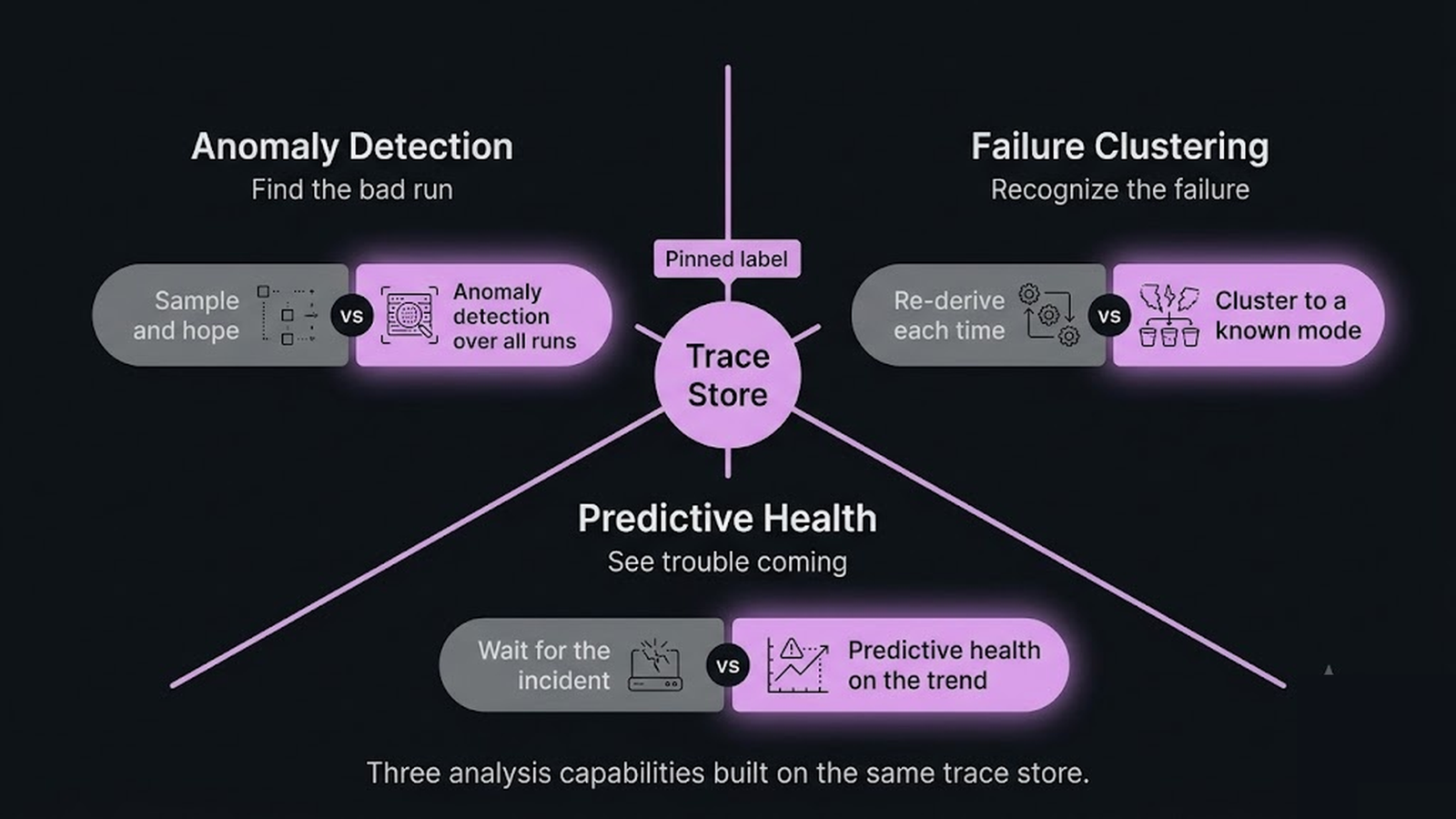
At a thousand runs a day, a human can sample. At a million, sampling misses the rare failure that costs the most, because the rare failure is, by definition, not in your sample. Automated analysis inverts the problem: instead of a person deciding which runs to read, the system reads all of them and hands the person the few that are anomalous. Anomaly detection finds the run that diverged from the norm. Clustering groups a new failure with the ones you have seen, so you recognize it instantly. Predictive health watches the trend and warns when success rate is sliding before it crosses the line into an incident.
None of this replaces the engineer. It changes what the engineer spends attention on, from hunting for the needle to fixing it once it has been handed over. that's the same move observability made for traditional systems a decade ago, arriving now for agents.
What has to be true before automation helps?
Two things. The traces have to be consistent, which is what the OpenTelemetry GenAI conventions provide, so the analysis isn't rewritten for every framework. And the failures have to be categorizable, which TRAIL's error taxonomy demonstrates they're. Given both, automated analysis is tractable. Skip either, and you're running pattern detection over noise. The teams getting value here invested in the boring standardization first, then turned analysis on.
| Capability | Manual era | Automated phase |
|---|---|---|
| Find the bad run | Sample and hope | Anomaly detection over all runs |
| Recognize the failure | Re-derive each time | Cluster to a known mode |
| See trouble coming | Wait for the incident | Predictive health on the trend |
Manual review stalls past thousands of runs; on TRAIL a frontier model localizes the error ~11% of the time, the case for automation. (arXiv:2505.08638)
The Pattern Intelligence Layer is where this lives. Reliability at the pattern level means the analysis operates on the behavior of the agent across runs, independent of which model produced any single trace. Anomaly detection, clustering, and predictive health become standing properties of the pattern, so an upgrade to a new model doesn't reset your ability to see what it's doing. that's the difference between observability you store and observability that works for you.
Frequently asked questions
Is this just more dashboards?
No. A dashboard shows aggregates. Automated analysis hands you the specific anomalous run and the cluster it belongs to, which is what you act on.
Can the analysis itself be an agent that hallucinates?
It can, which is why it surfaces evidence (the actual traces) for a human to confirm, rather than issuing verdicts on its own.
what's the prerequisite?
Consistent trace structure and a failure taxonomy. Standardize first, automate second.