


Key facts.
- Human reviewers max out at a few hundred responses a day, so as an agent serves thousands or millions of interactions, manual root cause analysis simply can't keep up.source
- LLM-as-judge has become the dominant automated evaluation method: LangChain's 2025 State of AI Agents survey reports a majority of teams with deployed agents using it, at a fraction of the cost of human review.source
- Automated RCA and anomaly detection apply machine learning to logs, metrics, and traces to detect performance dips, errors, and failure patterns in real time, reducing time to resolution.source
- The honest limit: LLM judges carry systematic biases that most teams never measure, so the recommended practice is a human-labeled calibration set, tracking judge-human agreement, and recalibrating when it drops below a threshold.source
Why does manual root cause analysis hit a wall?
Reviewers read hundreds of traces a day; agents emit millions, so failures hide. The frontier won't shrink the pile: on TRAIL, models localize the faulty step ~11% of the time. (source)
Volume and difficulty together. A single agent run can be dozens to hundreds of spans, reasoning, tool calls, state changes. Reviewing one properly takes attention. Run that against production traffic and the math breaks: a few hundred careful reviews a day against millions of runs means you're sampling a rounding error. And the failures that matter are the hard ones, non-deterministic paths, silent semantic errors where the format looks right but the meaning is wrong. Manual RCA works in a pilot. It collapses in production.
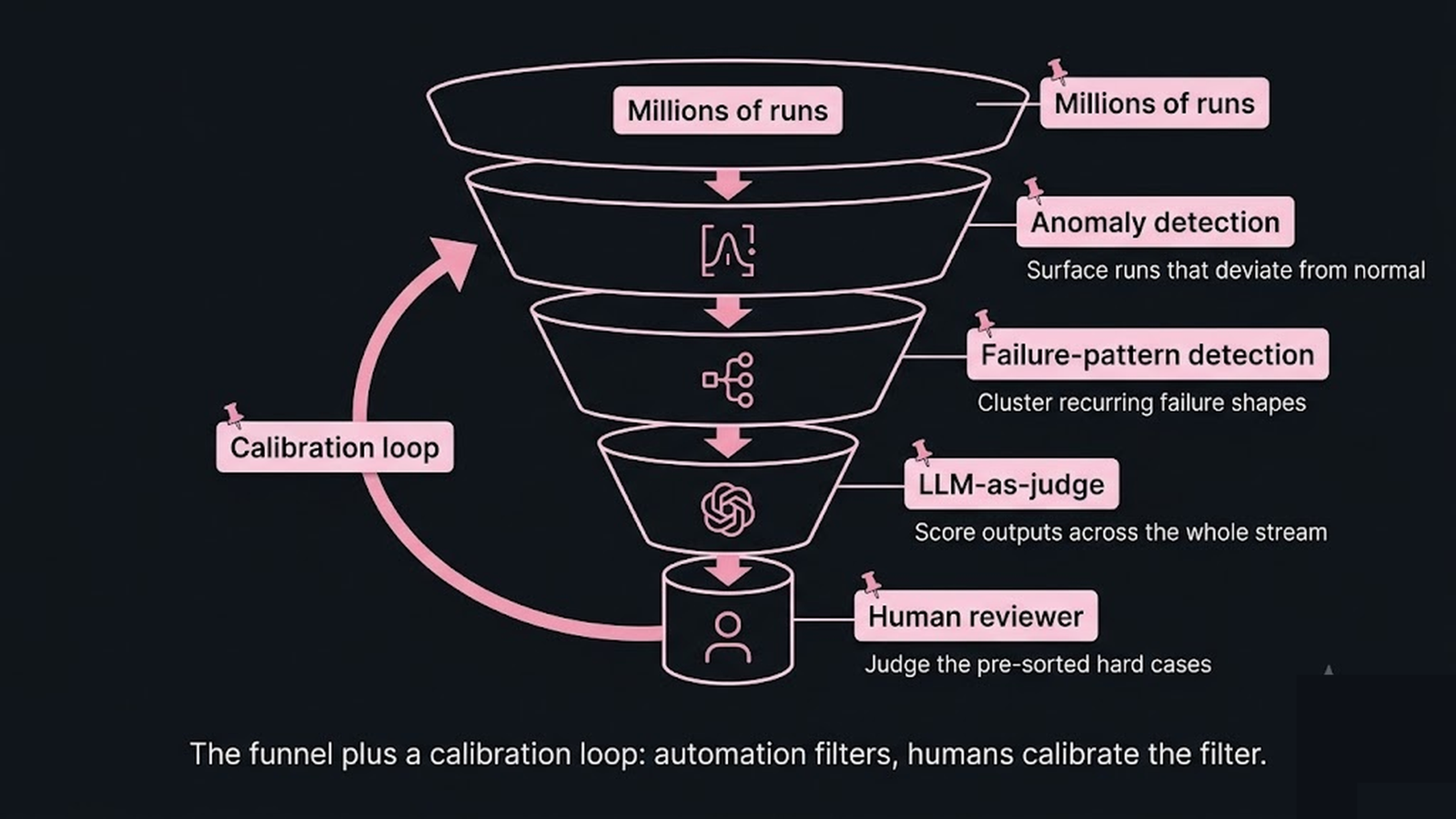
Automation changes the unit of work. You let anomaly detection surface the runs that deviate from normal, pattern detection group the recurring failure shapes, and an LLM judge score outputs against explicit criteria across the whole stream. The human stops being the first filter. They review the small, pre-sorted set that actually needs judgment.
Where the automation quietly goes wrong
The LLM judge is the part that looks finished and isn't. It scales evaluation well, which is why teams adopt it, measure the savings, and stop there. Nobody measures the biases. The result is an evaluation pipeline that looks automated and is wrong in systematic, repeatable ways. The fix isn't to drop it, it's to anchor it. Keep a small, high-quality human-labeled set, run the judge against it on a schedule, track agreement, recalibrate when it slips. Vendor cost-and-agreement figures are reported numbers. Verify them on your own data. Same for anomaly detection: it flags unusual runs, but unusual isn't the same as wrong. A human still decides.
| Layer | What it does at scale | What it cannot be trusted to do alone |
|---|---|---|
| Anomaly detection | Surface runs that deviate from normal | Decide whether the deviation is actually bad |
| Failure-pattern detection | Cluster recurring failure shapes | Explain the true root cause without review |
| LLM-as-judge | Score outputs across the whole stream | Stay accurate without a human calibration set |
| Human reviewer | Judge the pre-sorted hard cases | Read millions of raw runs |
This division of labor is what the Pattern Intelligence Layer runs in practice. Automation handles the scale, finding anomalies and recurring failure patterns. Humans stay where judgment matters: calibrating the automated graders so they don't drift. You get automation's throughput and human review's trust, instead of choosing one and paying for it with the other.
Frequently asked questions
Can I replace human review entirely with an LLM judge?
No. Use it for scale, but keep a human-labeled calibration set and track agreement. Judges drift and carry biases; the calibration loop is what keeps them honest.
What does anomaly detection actually catch?
Runs that deviate from your normal pattern across logs, metrics, and traces. It narrows millions of runs to the few worth a human look; it doesn't decide they're bad.
How often should I recalibrate the judge?
On a schedule, against your human-labeled set, and immediately when agreement drops below your threshold. The point is to notice drift before it corrupts your evaluation.