


Key facts.
- TRAIL provides 148 human-annotated agent traces with 841 errors across reasoning, system-execution and planning/coordination categories, drawn from real GAIA and SWE-bench runs.source
- The interplay of tool outputs and model reasoning makes agent error analysis harder than traditional software debugging.source
- Manual, domain-specific trace analysis does not scale with the volume and complexity of agentic output.source
Why is an agent failure harder to debug than a code bug?
Because a normal bug is in deterministic code you can read and re-run, while an agent failure is spread across reasoning steps, tool calls and tool results that interact in ways the code alone does not show. TRAIL's taxonomy makes this concrete: the errors fall into reasoning, system-execution and planning categories and they often arise from the interplay between what the model thought and what a tool returned, which is exactly the part a standard log does not capture. So If an agent's change breaks production, the question is not just what the code does, it is why the agent decided to make that change, what tool result it was reacting to and where its reasoning went wrong and none of that is in your normal observability stack. You are left reconstructing the agent's intent from the visible effects, which TRAIL shows is hard enough that even expert manual analysis does not scale.
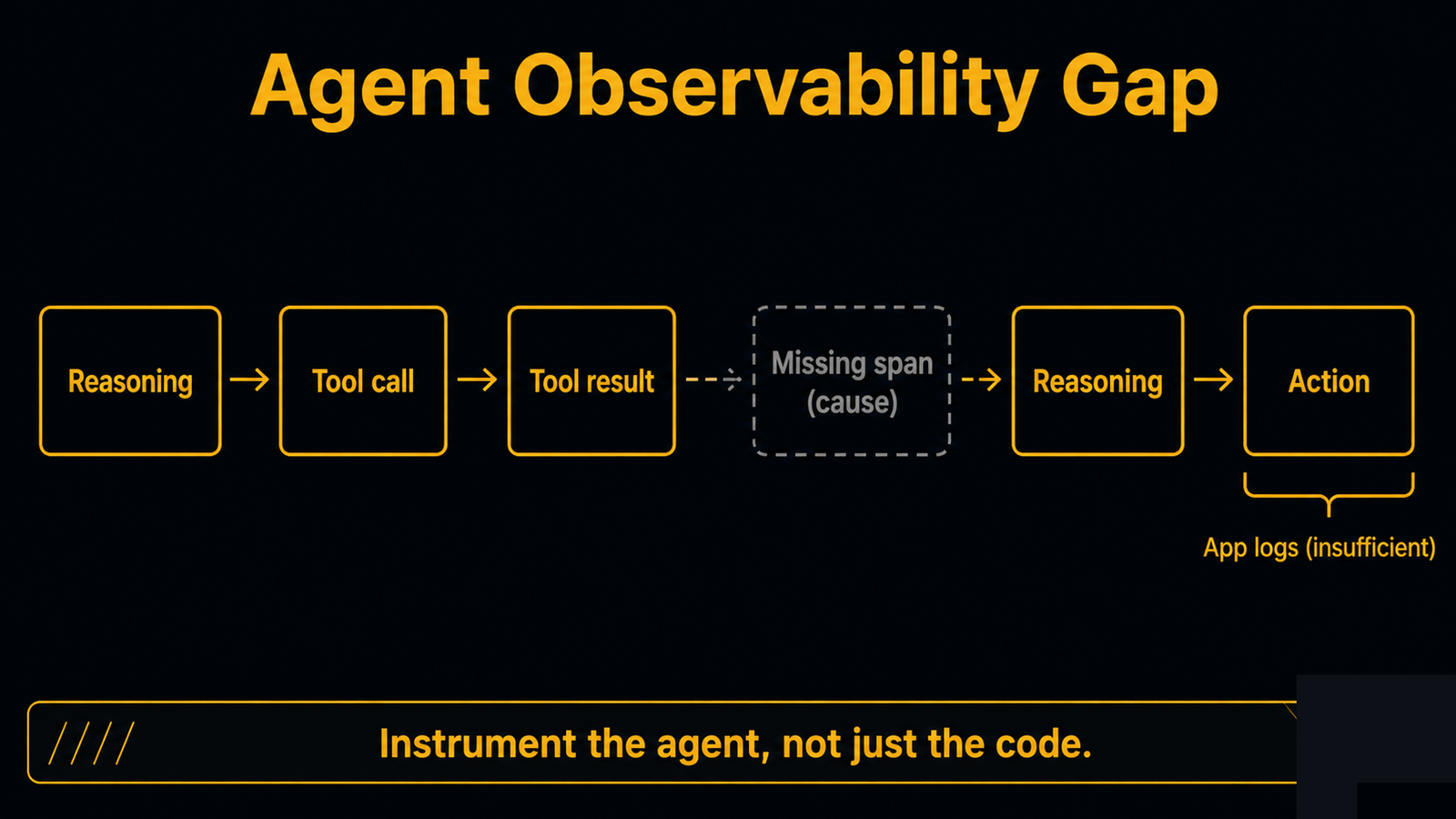
This is the gap that bites in production. The agent ran, something is wrong and the trace that would explain the decision, the reasoning, the tool outputs it consumed, the planning that connected them, was never recorded, because the team instrumented the code and not the agent. Debugging then becomes archaeology and the same failure recurs because nobody could see its cause.
What observability do coding agents need?
Structured traces of the agent's reasoning and actions, not just the code's behavior. Capture each reasoning step, each tool call and its result and the planning that connected them, as linked spans you can replay, so a failure can be localized to the decision that caused it. This is a different layer than application observability, which watches the running code; agent observability watches the agent that wrote or drove the code. TRAIL's whole premise is that this trace-level analysis is needed and hard, which is why you build it in before the incident rather than wishing for it during one.
| Observability | What you can debug |
|---|---|
| Application logs only | What the code did, not why the agent did it |
| Structured agent traces | The reasoning and tool result behind the failure |
Capturing that agent-level trace is part of what VibeModel does as the Pattern Intelligence Layer. We model the patterns a debuggable agent trace must record, the reasoning, the tool results, the planning, so an agent failure can be localized and fixed instead of reconstructed from its wreckage.
Frequently asked questions
Isn't my application monitoring enough?
No. It watches the running code, not the agent's reasoning and tool interplay, which TRAIL shows is where agent errors live and where debugging is hardest.
What do I capture?
Reasoning steps, tool calls and results and the planning connecting them, as linked spans you can replay to localize a failure.
Why build it before an incident?
Because the trace cannot be recovered after the fact and manual reconstruction does not scale. Instrument the agent first.