

Key facts.
- Frontier models reach perfect root-cause-analysis accuracy only in roughly the 4 to 12% range on benchmarks like OpenRCA, so diagnosis depends on rich observability. source
- An agent acting on live systems adds a layer of decisions and actions that must themselves be traced, on top of the underlying system. source
- Without deep observability, an incident the agent worsened cannot be untangled, because its actions and reasoning are not visible. source
Why does the agent raise the observability bar?
Because it adds a second thing you have to be able to see. You already needed deep observability to diagnose incidents in a complex system and root-cause analysis is hard enough that agents manage it only 4 to 12% of the time, which means accurate diagnosis depends heavily on rich traces, metrics and logs being available to whoever, human or agent, is trying to find the cause. Now put an agent into the operations: it observes the system, decides on a diagnosis and takes actions and every one of those decisions and actions is a new thing that must be traced, because when an incident goes wrong, you need to know not only what the system did but what the agent did to it and why. Without that, an incident the agent misdiagnosed and then made worse with a wrong remediation is a tangle you cannot unravel, since the agent's actions and reasoning are invisible and you are left guessing whether the current state is the original incident, the agent's failed fix or both. So the agent does not reduce the need for observability by automating diagnosis, it increases it, because it is both a consumer of observability, needing rich data to diagnose at all given its low accuracy and a producer of new activity, its own decisions and actions, that must be observable in turn. An ops environment with an agent in it needs deeper observability than one without, not shallower.
The temptation to think the agent reduces the observability burden is exactly backwards. The agent's low diagnostic accuracy means it leans harder on observability to function and its actions on live systems mean there is more to observe, so cutting observability because an agent is handling ops removes the data the agent needs and hides the actions you most need to see.
What observability does agent-run ops need?
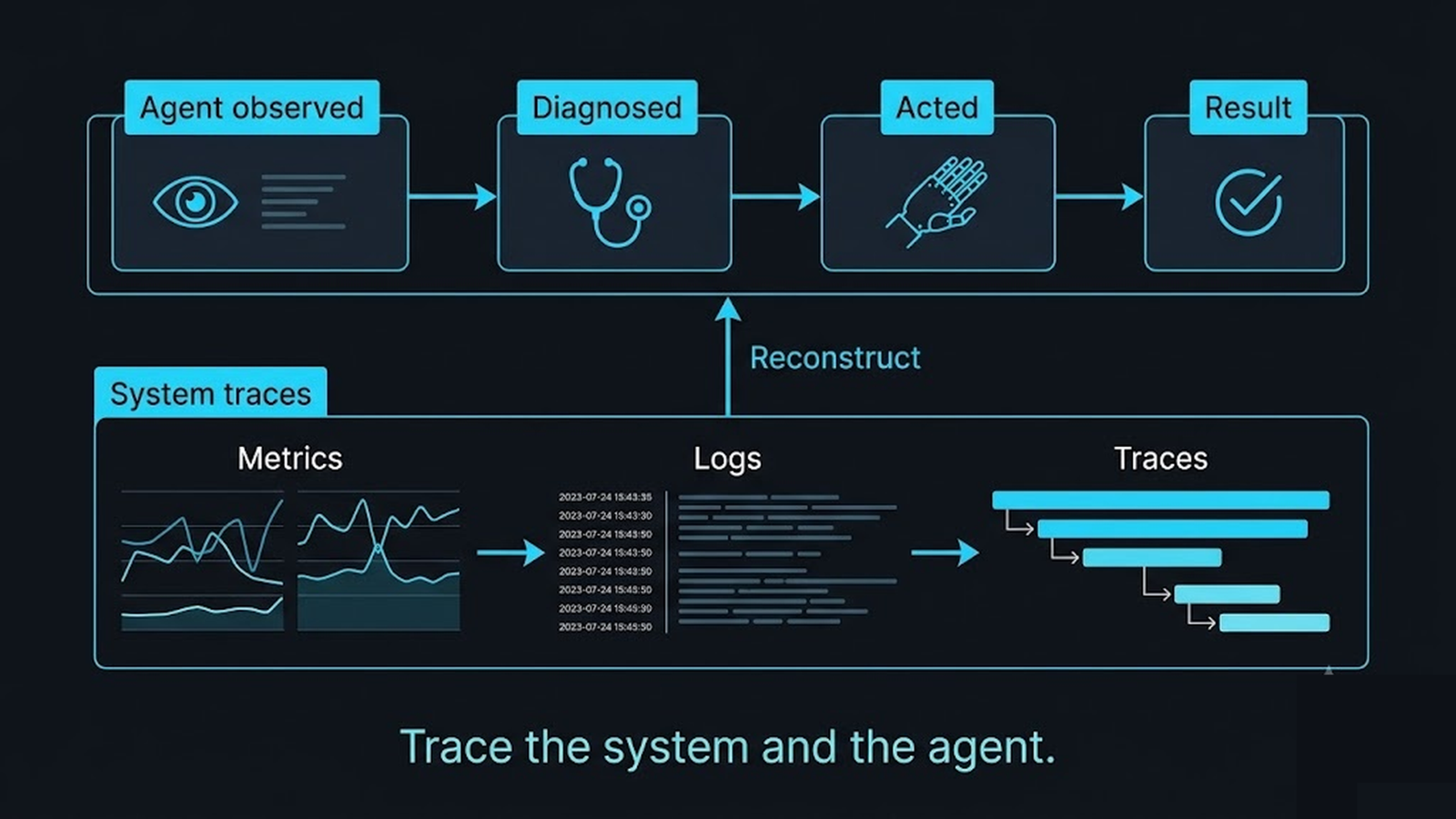
Deep system observability plus full tracing of the agent's own decisions and actions. Keep rich traces, metrics and logs of the underlying system, because the agent needs them to diagnose at all given its low RCA accuracy and your humans need them when the agent cannot. And capture the agent's activity as first-class observable events, what it observed, what it diagnosed, what action it took and why, so an incident involving the agent can be reconstructed: the original fault, the agent's diagnosis, its remediation and the result. This layered observability is what lets you untangle an incident the agent touched, distinguishing the original problem from the agent's effect on it, which is impossible if the agent's actions are invisible. The agent raises the stakes of observability, so the investment goes up, not down.
| Observability posture | When the agent is involved in an incident |
|---|---|
| System traces only, agent invisible | Cannot tell the original fault from the agent's effect |
| System plus agent-action tracing | The full incident, including the agent, is reconstructable |
Capturing that layered observability is part of what VibeModel does as the Pattern Intelligence Layer. We model the patterns of an observable agent decision and action alongside the system's behavior, so an incident an agent touched can be fully reconstructed rather than turning into a tangle you cannot see into.
Frequently asked questions
Doesn't automating ops reduce the need to watch it?
The opposite. The agent's low diagnostic accuracy means it leans harder on observability and its actions add new things to trace.
What must I trace about the agent?
What it observed, what it diagnosed, what action it took and why, as first-class events, so an incident it touched can be reconstructed.
Why is reconstructing an agent incident hard?
Because without agent-action tracing you cannot distinguish the original fault from the agent's failed remediation, leaving a tangle you cannot unravel.