


Key facts.
- DORA research finds elite performers restore service in under an hour, while low performers can take far longer, and reaching elite MTTR requires observability: fast alerting, structured logging, metrics thresholds, and distributed tracing.source
- DORA's headline finding is that speed and stability reinforce each other: the fastest-deploying teams are also the most stable, which makes observability a driver of both at once, not a tax on speed.source
- Elite performers also post better business outcomes (higher profitability, market share, and customer satisfaction) and are more likely to meet organizational goals, tying engineering visibility to results leadership tracks.source
- Reported (vendor-influenced, treat as directional): AI-assisted observability tools claim MTTR reductions in the 40 to 70% range, and the AI-in-observability market is forecast to grow at a strong double-digit CAGR, signalling real enterprise demand.source
- Observability gets DORA's elite teams restoring in under an hour, and a stronger model isn't the lever, since on tau2-bench agents average only 79% task success, so reliability comes from seeing the agent. (source)
where's the evidence strong, and where's it soft?
Strong: DORA's elite-versus-low gap is independent, long-running, survey-based research, and it consistently shows that teams with mature observability recover faster and run more stably. The causal story is clean too. You can't recover from an incident you can't see, so the alerting and tracing that observability provides is upstream of fast MTTR. That isn't a vendor claim. it's a structural fact about how incidents get resolved.
Soft, and worth saying plainly: the eye-catching "we cut MTTR 55%" and "3x ROI in year one" numbers mostly come from the companies selling observability tools. they're directionally consistent with the DORA pattern, but you should baseline against your own systems rather than quote a vendor average as if it were your result. And for AI agents specifically, large independent ROI studies barely exist yet, because production agents are new. The honest position is that the general observability case is well-established and the agent-specific case is emerging on top of it.
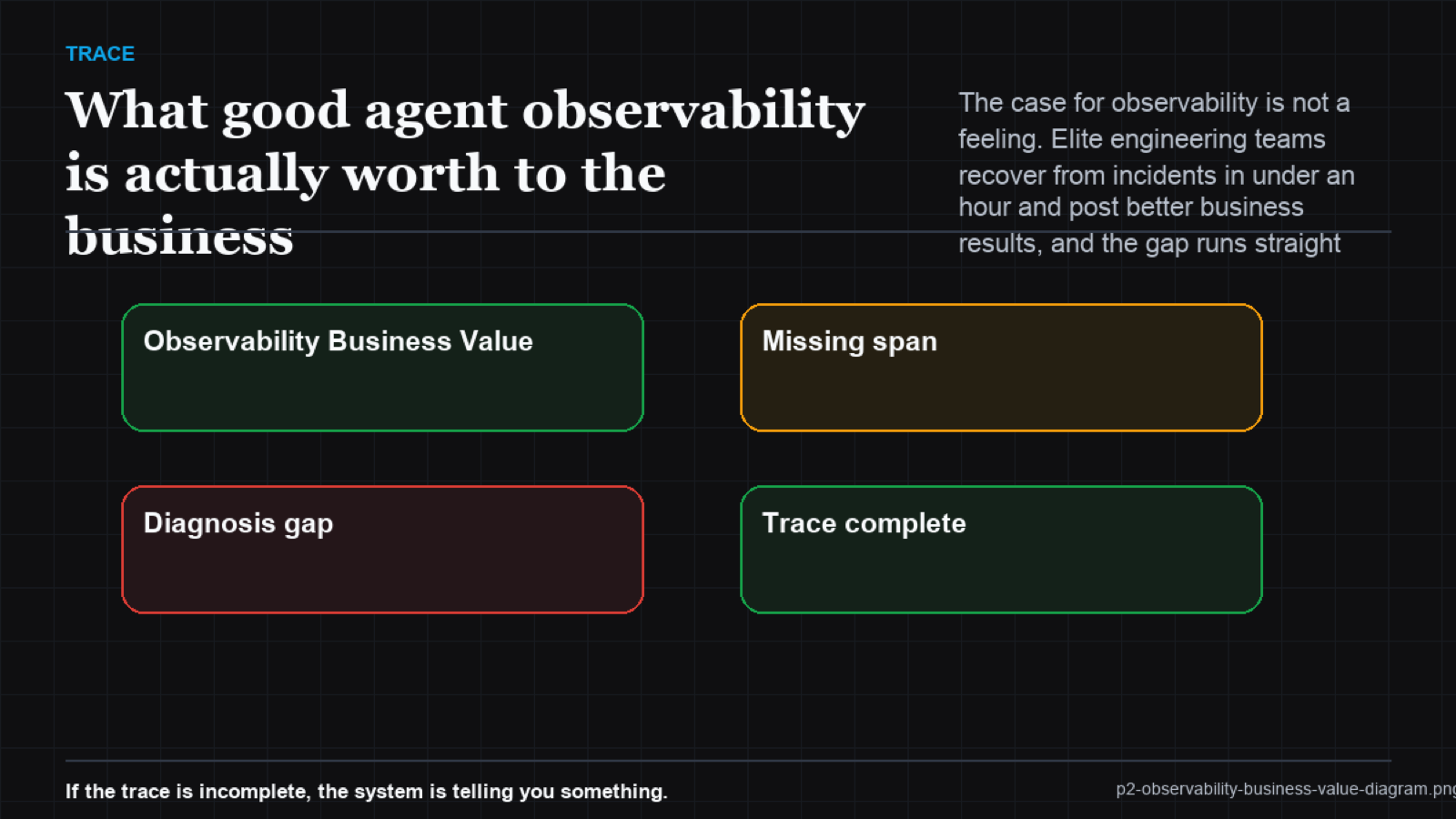
How does observability convert into business value for agents?
Three channels. Faster recovery: traced reasoning and tool calls turn an agent incident from an hours-long reconstruction into a quick read, which is the MTTR effect DORA measures. Trust and adoption: when a team can see why an agent decided what it did, leadership extends its scope instead of freezing it, so visibility is what lets an agent grow from pilot to production. Continuous improvement: tracing failures against business KPIs (task success, cost per task, user feedback) feeds an iteration loop that makes the agent better over time. Each channel ties a technical capability to a number leadership already cares about.
| Business outcome | What observability provides | Evidence strength |
|---|---|---|
| Faster incident recovery | Alerting, tracing, fast root cause | Strong (DORA, independent) |
| Trust and adoption | Visible reasoning, scope confidence | Moderate (surveys, correlational) |
| Continuous improvement | Failure traces tied to KPIs | Structural, emerging for agents |
| Quantified ROI | Avoided downtime, less manual debug | Vendor-reported, directional |
this is the business case a Pattern Intelligence Layer makes concrete. Reliability at the pattern level means the visibility that drives recovery, trust, and improvement is enforced around the agent on every run, so the value DORA documents for elite teams becomes available to your agent program. The model can change and the agent can scale, and the observability that makes the agent a dependable business asset rather than a risky experiment stays in place, which is the difference leadership actually pays for.
Frequently asked questions
what's the single most defensible stat for a budget case?
DORA's elite-versus-low recovery gap. it's independent, long-running research showing observability-mature teams restore service in under an hour and post better business results.
Can I trust the "cut MTTR by X%" numbers?
Treat them as directional. Most come from observability vendors. They align with the DORA pattern, but baseline against your own systems before quoting a target.
Does a better model deliver this value instead?
No. Frontier agents stay inconsistent across repeats, so the dependable value comes from seeing and fixing agent behavior. that's observability, not model choice.