


Key facts.
- Observability isn't something you wire in after the system is built; the teams that succeed build it in from the start.source
- Operating production autonomous agents without specialized observability is operating blind: traditional dashboards stay green while agents hallucinate, pick the wrong tool, and silently degrade.source
- The foundation of a reliable agent system is the harness (the orchestration logic, runtime, and telemetry wrapping the model), not the model itself; even a frontier model in a bare loop falls short of production quality without that structure.source
- Day-one instrumentation is enabled by standards like OpenTelemetry, which many agent frameworks use to share metadata, so building it in early is a known, supported path.source
Why build it in instead of adding it later?
The reliable part is the harness, not the model: even a frontier model in a bare loop finishes ~61% of retail tasks (tau-bench), so unseen behavior stays unfixed. (source)
Because retrofitting is both painful and incomplete. Adding traces, checkpoints, and semantic logging after the agent is built means invasive refactoring of flows that already work, and even then you're left with gaps in the historical data you never captured. Instrument from the start and every decision path is recorded naturally, with no rebuild and no blind spots in the record. The deeper reason is the one teams underestimate: you can't improve what you can't see. Without rich traces from day one you're flying blind on reasoning quality, tool effectiveness, and failure modes, and the surprises (silent degradations, recurring failures) all arrive after launch, when they're most expensive to diagnose.
this is why the model is the wrong place to put your faith. A strong model in a bare loop isn't a product, it's a demo. The orchestration that constrains it, the runtime that carries its state, and the telemetry that records what it did are what make it dependable, and all three are easier to build in than to bolt on.
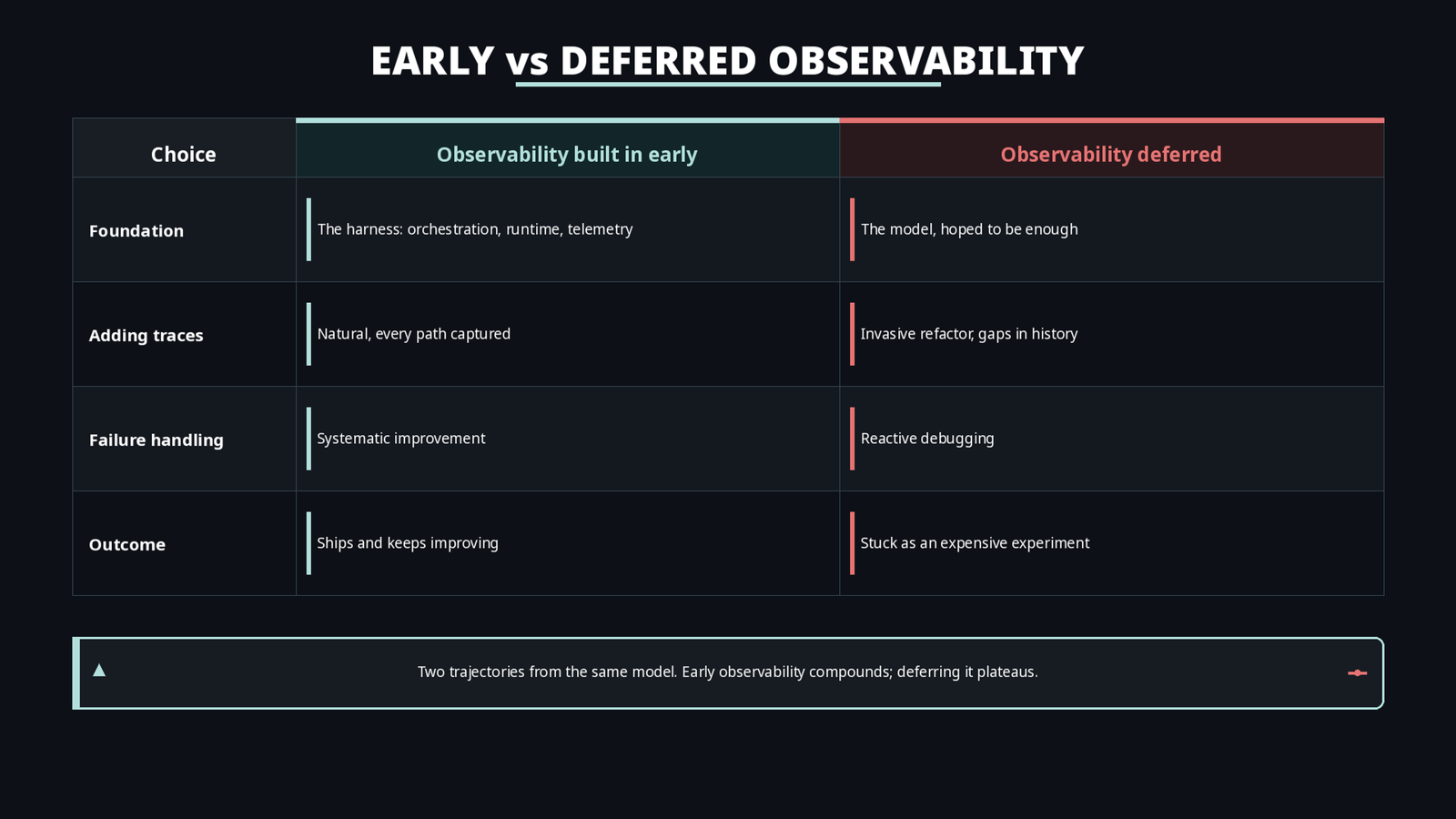
What separates the agents that ship from the experiments that don't?
The move from reactive debugging to systematic improvement, and that move is only possible with observability in place early. Teams stuck in pilots are debugging reactively: something breaks, they dig through whatever logs exist, they patch a symptom, and they wait for the next surprise. Teams that ship have the trace in front of them on day one, so they catch silent degradations before customers do, find the recurring failure pattern, and improve the harness on purpose. Be skeptical of vendor claims that a single platform makes you production-ready; the durable advantage is the discipline of instrumenting early on an open standard, not any one tool. The investment is front-loaded, and it's exactly the investment that pays for itself.
| Choice | Observability built in early | Observability deferred |
|---|---|---|
| Foundation | The harness: orchestration, runtime, telemetry | The model, hoped to be enough |
| Adding traces | Natural, every path captured | Invasive refactor, gaps in history |
| Failure handling | Systematic improvement | Reactive debugging |
| Outcome | Ships and keeps improving | Stuck as an expensive experiment |
Investing early is the Pattern Intelligence Layer mindset from the first commit. Reliability at the pattern level means the harness and its telemetry are the product you're actually building, with the model as a component you can swap, so the agent gets more dependable over time instead of more fragile. The teams that internalize this ship. The ones that keep waiting for a better model to rescue an un-instrumented system keep paying for experiments that never graduate.
Frequently asked questions
Can't we add observability once we know the agent works?
By then you're retrofitting into working flows and you have no history of the period that mattered most. Early instrumentation captures every path naturally and avoids the rebuild.
Isn't a better model the real lever?
No. Even a frontier model in a bare loop falls short of production quality. The harness (orchestration, runtime, telemetry) is what makes it reliable, and that's what you invest in.
Does a single observability platform make us production-ready?
Treat that as marketing. The durable advantage is instrumenting early on an open standard like OpenTelemetry, not any one vendor's tool.