


Key facts.
- Six agent-observability platforms anchor the 2026 market: LangSmith, Langfuse, Arize Phoenix, Helicone, Datadog LLM Observability, and Honeycomb LLM Observability.source
- These tools surface what APM doesn't: model drift, tool-call retry loops, prompt regressions on framework upgrades, and cost spikes from runaway loops.source
- Platforms differ on tracing overhead, with some adding virtually none and others noticeably more in multi-step workflows, so the choice has real production cost.source
- Most teams pick a primary platform and pair it with their infrastructure observability layer for whole-stack coverage.source
What makes observability infrastructure rather than tooling?
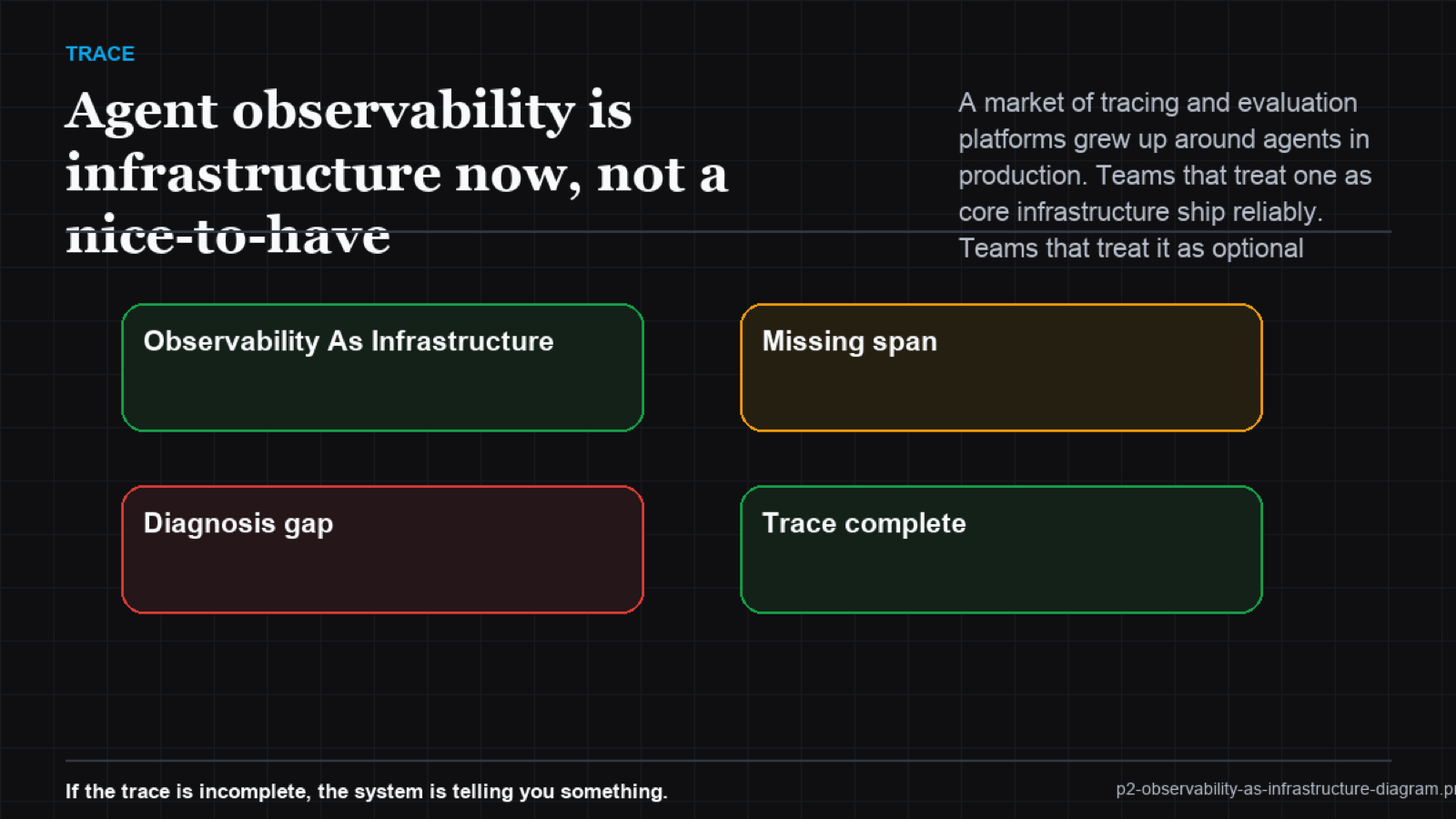
The test is whether the system can run safely without it. For a production agent, it can't. The failures that matter (a prompt regression after a framework bump, a tool-call retry loop quietly burning budget, a slow drift in answer quality) are invisible to uptime and latency dashboards. Without a platform that traces reasoning and evaluates output, those failures run unseen until a customer or a finance report flags them. that's the definition of infrastructure: the thing the system depends on to operate, not a convenience you add when you have time.
The market formed for exactly this reason. You don't get a half-dozen funded platforms competing on tracing overhead and evaluation quality unless production teams are treating the category as a requirement.
How do you choose without locking yourself in?
Pick a primary platform for tracing and evaluation, then keep your data portable. Emit OpenTelemetry GenAI-convention spans so you can move between backends. Weigh tracing overhead, because a platform that taxes every call is a tax on production. Make sure evaluation covers meaning, not just whether the call returned. And pair the agent-specific platform with the infrastructure observability you already run, so one view covers the whole stack.
| Signal | Traditional APM | Agent observability platform |
|---|---|---|
| Uptime, latency | Yes | Yes |
| Reasoning trace | No | Yes |
| Output evaluation | No | Yes |
| Drift and cost loops | No | Yes |
this is the Pattern Intelligence Layer expressed as a buying decision. Reliability at the pattern level means tracing, evaluation, drift detection, and cost telemetry are treated as core infrastructure around the agent, portable across backends and constant across model swaps. Choose the platform that fits your stack, keep the data portable, and you have made observability a property of how you run agents rather than a tool you reach for after the incident.
Frequently asked questions
Can a stronger model make agent observability optional?
Drift and regressions slip past APM, and a more capable model changes nothing here, since on GAIA a GPT-4 assistant reaches 15% where humans hit 92%. (source)
Do I need an agent-specific platform if I already have Datadog?
Often yes for the agent layer. Pair the agent-specific tracing and evaluation with your infrastructure observability so one view covers both technical health and agent behavior.
what's the hidden cost of the wrong choice?
Tracing overhead. Some platforms add almost none, others tax every call. In a high-volume workflow that overhead is a real production cost, so measure it.
How do I avoid lock-in?
Emit OpenTelemetry GenAI-convention spans. Portable data lets you switch primary platforms without re-instrumenting the agent.