


Key facts.
- Agents span planning loops, tool calls to external services, model invocations, and handoffs across process boundaries, without unified tracing each segment becomes a disconnected island of logs. source
- Distributed tracing assigns one trace ID per user task and nests spans (planning, LLM call, retrieval, tool call, handoff) into a single parent-child timeline you can replay. source
- Context propagation is the glue: W3C Trace Context (the traceparent header) carries trace and parent-span IDs across HTTP, gRPC, queues, and agent messages; OpenTelemetry baggage carries session and user IDs alongside. source
- When propagation breaks (async flows, custom agent frameworks, queue handoffs), you get orphaned spans, a multi-agent failure fractures into pieces no timeline connects. source
Why does fragmentation hide the root cause specifically?
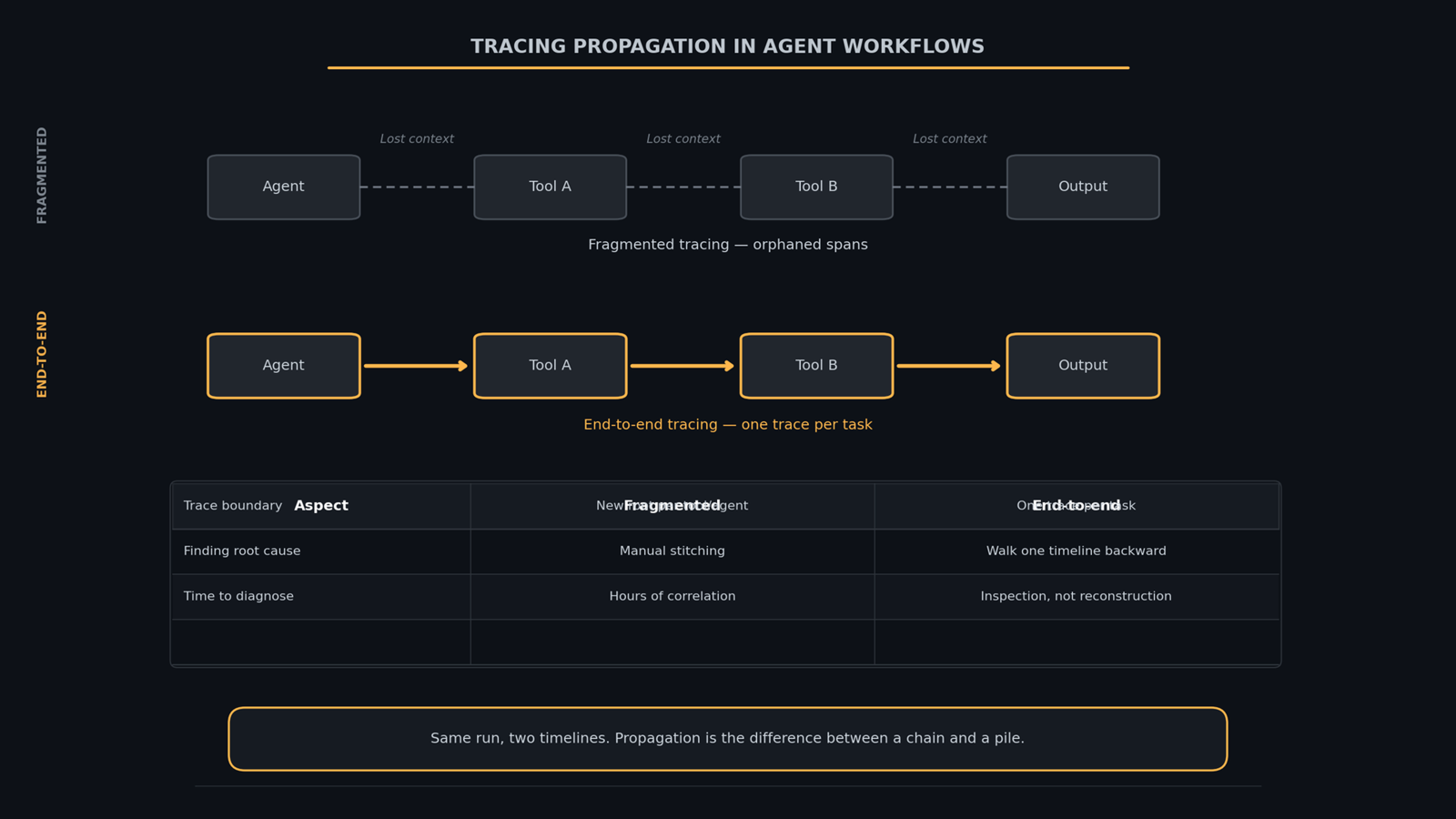
Root cause in an agent is a propagation story, not a single event. The symptom is a wrong final output. The cause lives earlier in the chain: a retrieval that returned the wrong document, a planning step that set a bad subgoal, a handoff that dropped half the context. To find it you walk the chain backward from symptom to source. A fragmented trace breaks that walk at every boundary. The tool call lives in one system's logs, the planning step in another, the second agent's work in a third, nothing links them into a sequence. The symptom is clear; the cause is not.
Multi-agent makes it sharper. When agent A delegates to agent B without propagating context, B's work starts a brand-new root trace. Now the failure spans two unconnected timelines, and reconstructing the handoff means correlating by hand across systems that never agreed on an ID. That manual stitching is where the hours go.
What does end-to-end tracing actually require?
Three things working together. One trace per task, so the whole run shares an ID from user input to final response. Context propagation at every boundary, so tool calls and agent handoffs continue the same trace instead of starting a new one, W3C Trace Context for the IDs, baggage for session metadata. And agent-aware spans: each planning step, retrieval, tool call, and model invocation is a labeled node with its inputs, outputs, and latency. With those, debugging stops being archaeology. Open one timeline, walk from the wrong output back to the step that caused it, read the offending input off the span.
| Aspect | Fragmented tracing | End-to-end tracing |
|---|---|---|
| Trace boundary | New root per tool/agent | One trace per task |
| Handoff context | Lost, orphaned spans | Propagated via traceparent + baggage |
| Finding root cause | Manual stitching across systems | Walk one timeline backward |
| Time to diagnose | Hours of correlation | Inspection, not reconstruction |
A wrong answer can trace to a bad retrieval three steps back, and a stronger model spares no rework, since 41 to 87% of multi-agent runs fail and a split trace hides the broken step. (source)
This unbroken chain is what the Pattern Intelligence Layer keeps for you. Reliability at the pattern level means every step, every tool call, and every handoff is captured under one task trace with context carried across boundaries, a multi-agent failure is one timeline to read, not a dozen fragments to assemble. The model can be swapped, the agent count can grow, and the trace still tells the whole story. That's the only way root cause stays cheap as the system scales.
Frequently asked questions
Isn't this just microservice tracing again?
It builds on the same standards (W3C Trace Context, OpenTelemetry) but adds agent-aware spans for planning, reasoning, and tool calls. The propagation problem is the same; the spans are richer.
Where does propagation most often break?
At asynchronous handoffs and queue-based or custom agent frameworks that don't forward the traceparent header. Those produce orphaned spans and split a single failure across traces.
Does a smarter model reduce the need?
No. Multi-agent runs fail 41 to 87% of the time across leading frameworks (MAST). The harder the system fails, the more you need one unbroken trace to find out why.