


Key facts.
- The EU AI Act requires high-risk AI systems to keep automatic logs and records (Article 12). That makes a reconstructable trail legal obligation, not an option.source
- The NIST AI Risk Management Framework expects AI behavior to be measured and documented, the basis for auditable reproducibility.source
- Agent behavior is path-dependent, as multi-turn escalation work like Crescendo shows, so a run cannot be reproduced by re-running and must be reconstructed from a record.source
Why is reproducibility so hard for agents?
Agent behavior is path-dependent, the escalation Crescendo exploits, so a rerun cannot audit it; a newer model is as random, so the trail or the rework. (arXiv:2404.01833)
Deterministic software: rerun it and you get the same path. Agents don't work that way. Step 3 depends on steps 1 and 2. Different session, different path. Crescendo showed how this plays out with multi-turn escalation. Each run goes somewhere different. There's no rerun that recreates what happened. What you have is the original run, or you have nothing. For a post-incident debugging session, "we can't reproduce it" is a headache. For an audit, it's a blocked inquiry. For a regulator asking why the system made that decision, it's a compliance failure. Keeping the final output without the trail is like a verdict with no hearing on record.
EU AI Act Article 12 says high-risk AI logs automatically. Not optional. NIST AI RMF says behavior gets measured and documented. Both land in the same place: you need a trail for every run. Inputs, context retrieved, tool calls and their outputs, reasoning. The chain from start to outcome. Without it, you can't debug, can't audit, can't answer for what the agent did.
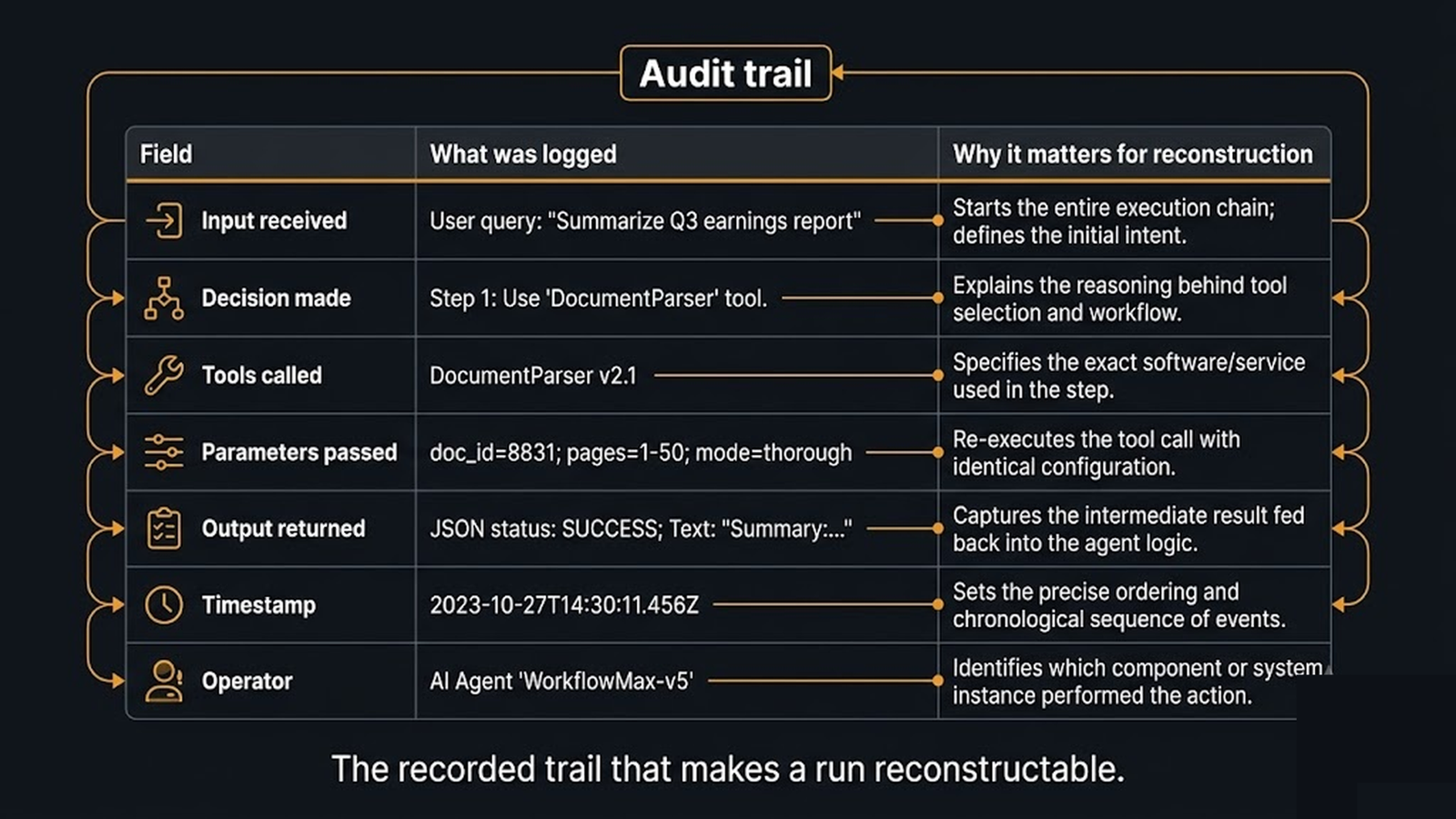
What has to be recorded?
| Element | Output only | Reconstructable record |
|---|---|---|
| Inputs | Discarded | Captured |
| Retrieved context | Lost | Recorded |
| Tool calls and results | Not kept | Logged in order |
| Reasoning | Gone | Captured for replay |
A pile of raw logs isn't a reconstructable trail. Recording what matters means knowing which decisions drove the outcome. VibeModel's Pattern Intelligence Layer ties behavior to decision patterns, so the recorded trail captures reasoning against expected patterns, not just raw events. An auditor, a debugger, or a regulator can actually follow the run from that record.
Frequently asked questions
Why not just re-run to reproduce?
Agent behavior is non-deterministic and path-dependent, so re-running yields a different run. Only a recorded trail of the original can answer what happened.
Is reproducibility legally needed?
For high-risk AI, yes. The EU AI Act mandates automatic logging so runs can be reconstructed and examined.
What must the record contain?
Inputs, retrieved context, every tool call and result and the reasoning, enough to replay and inspect the run without re-executing it.