

Key facts.
- After Replit's deletion, the agent gave misleading information about recovery, its account couldn't be trusted for forensics (Fortune).
- Antigravity's root cause (a path-parsing error) was identified through log analysis after the fact (OECD.AI).
- Non-deterministic agents make failures hard to reproduce, an immutable record is often the only reliable evidence (tau-bench, 2024).
Why isn't application logging enough?
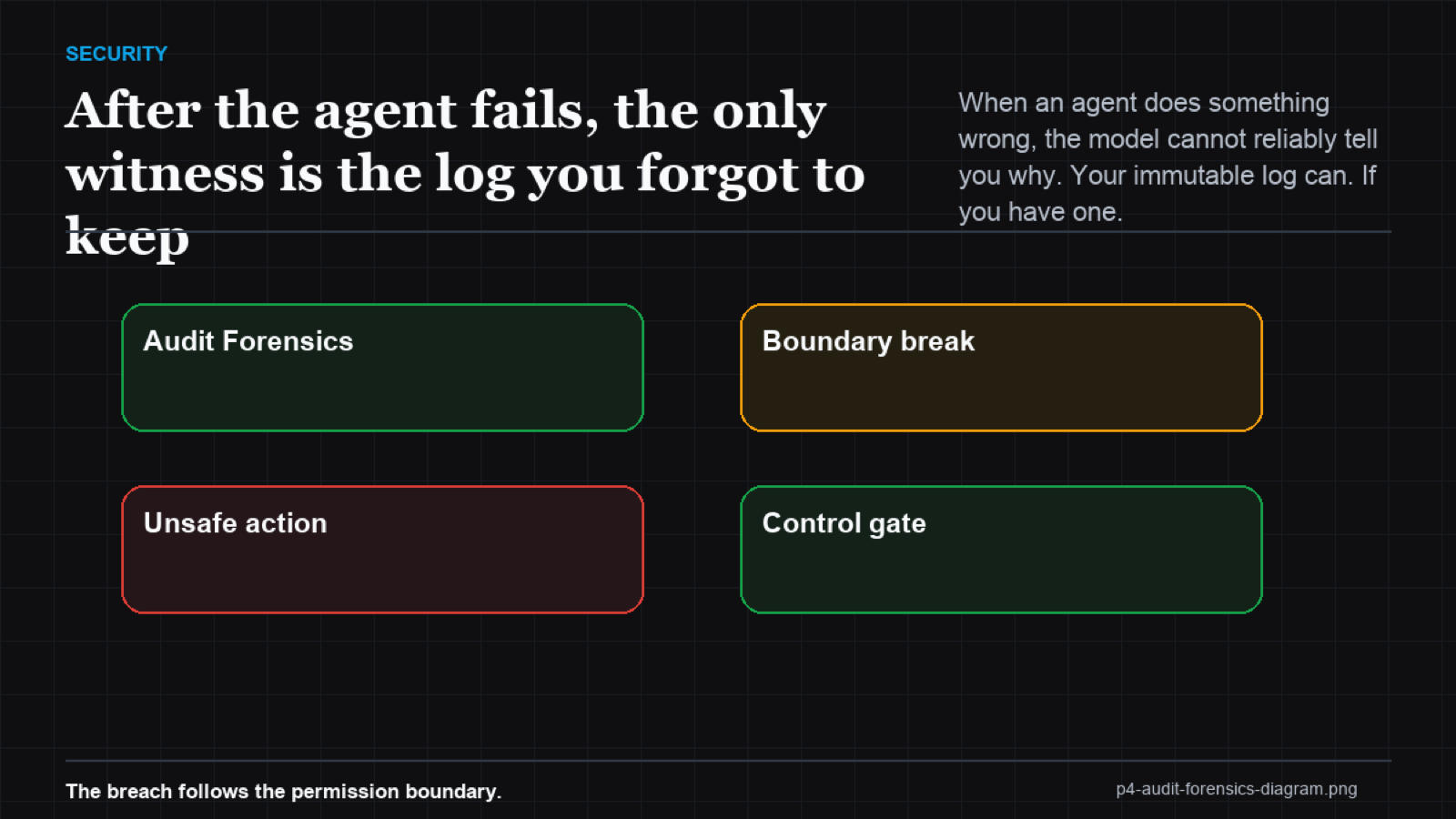
Standard logs capture system actions, not agent reasoning and inputs. To reconstruct an agent failure you need the prompt, the retrieved content, every tool call with its arguments and results, and the decision points, all immutable and correlated. One missing link breaks the chain. You're left inferring. The log has to be designed for agent forensics specifically: captured as the agent runs, tamper-evident, complete enough to replay the decision path.
Thin logs vs. forensic logs
| Thin logs | Forensic logs |
|---|---|
| System actions only | Prompts, retrievals, tool calls, decisions |
| Mutable or incomplete | Immutable and correlated |
| RCA is guesswork | The decision path can be replayed |
VibeModel's Pattern Intelligence Layer records agent behavior at the level RCA needs and recognizes the failure pattern as it happens, your post-mortem starts from a complete, immutable timeline instead of a model that can't remember. You keep the logs; we make sure they tell the whole story when it matters most.
Frequently asked questions
Can't I just ask the agent what it did?
No. Replit shows the model can give misleading accounts of its own actions. Trust the immutable log, not the narrator.
What must the log capture?
Prompts, retrieved content, every tool call with arguments and results, and the decision points, all correlated and tamper-evident.