


Key facts.
- EU AI Act Article 12 requires high-risk AI systems to technically allow automatic recording of events (logs) over the system's lifetime, generated by the system itself, not by an operator. source
- Those logs must be kept for a period appropriate to the intended use and at least six months, and must enable traceability of the system's operation. source
- The framework "Incident Analysis for AI Agents" argues public incident reports are insufficient because they exclude an agent's reasoning and browsing trail, the very data a proper audit log preserves. source
- OpenTelemetry GenAI semantic conventions give a standard way to capture that trail, so meeting the audit bar is an engineering pattern, not a bespoke compliance project. source
What does a regulator want that a debugger does not?
The EU AI Act makes high-risk systems log events six months (Article 12); a more capable model won't discharge it or stop HammerBench's parameter-name failures. (arXiv:2508.14231)
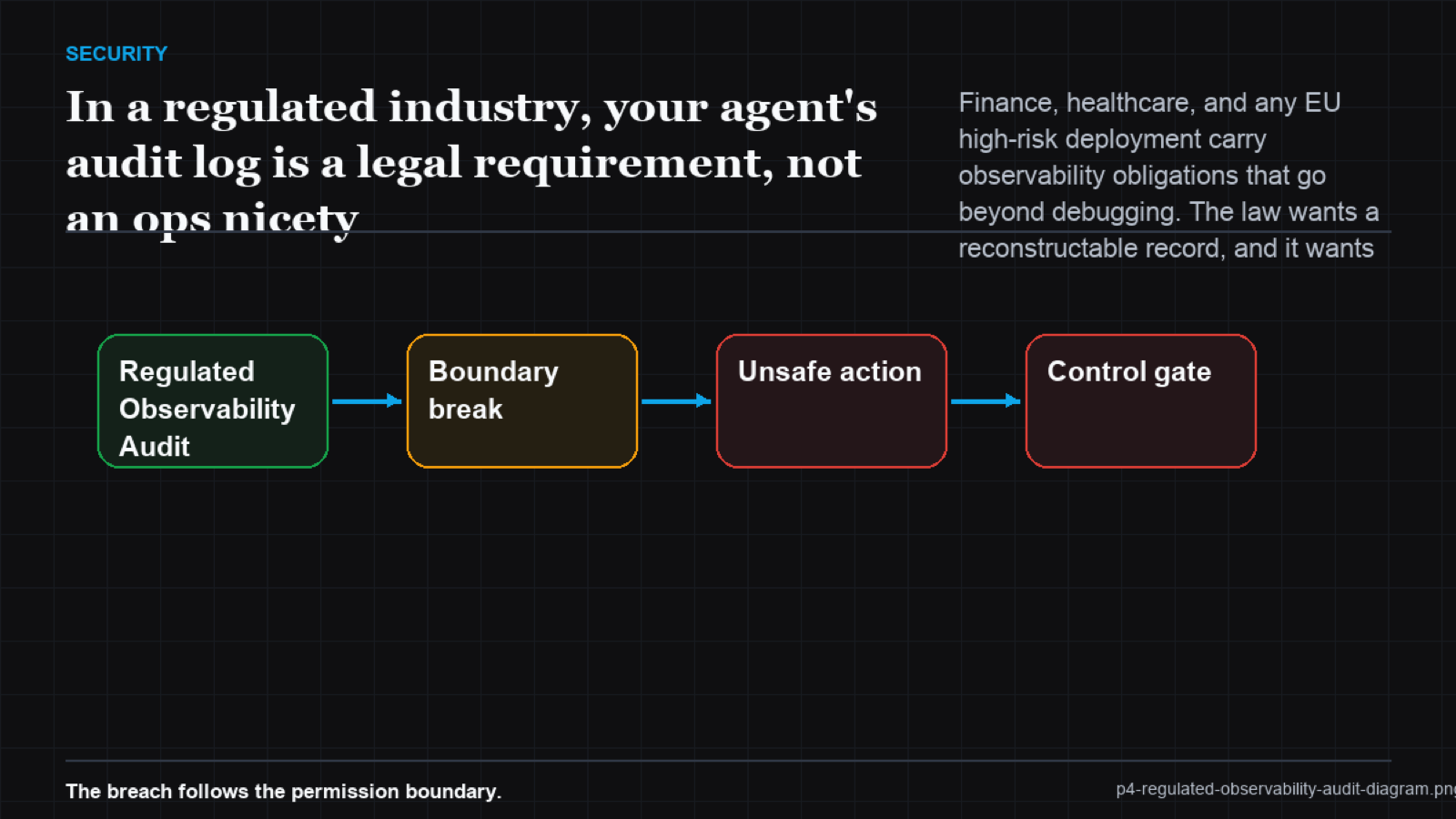
A debugger wants enough to fix the bug. A regulator wants enough to reconstruct a decision after the fact, on demand, for a defined retention window, with the assurance that the record was generated automatically and not edited. That is a higher bar in three specific ways. Completeness, because a partial trace that helps an engineer guess is not a record that survives scrutiny. Retention, because the obligation persists for months after the run, not until the incident is closed. And integrity, because a log a human could have altered is worth little in an audit. The same trace store serves both readers, but only if it was designed to the regulated bar from the start.
The cost asymmetry is the point. Building automatic, retained, reconstructable logging in while you build the agent is a design choice. Reconstructing months of decisions you never recorded, because an auditor asked, is not a project you can complete after the request arrives. In a regulated industry the absence of the log is itself the finding.
Why is this harder for agents than for traditional systems?
Because the thing a regulator increasingly wants recorded is not just the action but the reasoning behind it, and an agent's reasoning is ephemeral unless you capture it deliberately. A traditional system's audit log is a list of transactions. An agent's needs the decision context: what it retrieved, which tool it called, what the tool returned, and why it proceeded. That is the chain "Incident Analysis for AI Agents" says public reports lack. Capturing it is achievable, with standard conventions, but only if observability is treated as a first-class requirement rather than a debugging afterthought.
| Property | Debugging log | Regulated audit log |
|---|---|---|
| Completeness | Enough to diagnose | Enough to reconstruct on demand |
| Retention | Until incident closed | Defined window, months minimum |
| Integrity | Trusted internally | Tamper-evident, auto-generated |
| Scope | Actions | Actions plus reasoning and context |
The Pattern Intelligence Layer is where the regulated bar gets enforced consistently. Completeness, retention, integrity, and reasoning-capture become properties of the pattern, applied on every run, so the same record satisfies the engineer at 3am and the auditor six months later. Reliability at the pattern level includes the reliability of being able to prove, on demand, what your agent did and why.
Frequently asked questions
Is debugging-grade logging enough for compliance?
Usually not. Regulators add retention, integrity, and reasoning-capture requirements that a debugging log does not meet by default.
Does the EU AI Act apply if we are not in the EU?
It applies to high-risk systems placed on the EU market regardless of where you are. Many teams adopt its logging bar as a baseline anyway.
Can we add audit logging after launch?
You cannot reconstruct records you never captured. The retention clock and the auditor's request both assume the log already existed.