

Even a frontier agent's confident output is now a legal liability you must be able to reconstruct.In June 2026 a German court held Google liable for false claims its AI generated about named businesses after it failed to correct them, and the company, not the model, had to answer for it (Business Standard, 2026).

Key facts.
- The requirement is concrete: the HIPAA Security Rule requires audit controls that record and examine activity in systems containing electronic protected health information (HIPAA Security Rule, 45 CFR 164.312(b)).
- Liability requires reconstruction: in 2026 a German court held a company liable for false claims its AI generated and failed to correct, the kind of decision that must be auditable after the fact (Business Standard, 2026).
- An auditor must be able to examine the record, not just that one exists: the same rule requires the capability to review system activity, so the trail has to be queryable and complete, not a write-only log (45 CFR 164.312(b)).
What regulators actually want
A record an auditor can follow. That means a queryable, tamper-evident trail showing who or what decided what, the data behind it, the verification steps, the ability to reconstruct it years later for compliance, liability, or court. HIPAA says so directly for health data: audit controls must record and let you examine activity in systems holding protected health information (45 CFR 164.312(b)). Finance has parallel rules. The bar isn't "was the agent usually right." It's "can any decision be reconstructed and defended." Agent output is often confident and unverifiable, a German court in 2026 held a company liable for its AI's false claims (Business Standard, 2026). The trail of how it was checked is what makes the decision defensible.
Why don't typical agent stacks provide it?
Because they were architected for flexible LLM orchestration, not auditable determinism. A common agent stack is stochastic and LLM-centric: outputs vary run to run, tool calls are opaque, and shared state and memory are mutable. The logging, where it exists, is usually centralized and mutable, and often incomplete, missing the intermediate outputs and the verifier results that an audit needs. there's rarely cryptographic signing, immutable storage, or an explicit link from the high-level goal to the plan to the verification outcome to the final action. So you can't prove, after the fact, what data a decision rested on, what checks ran, or that the record wasn't altered. The stack optimized for demo velocity and iteration speed, and an immutable chain of custody was simply not the thing it was built to produce.
# Audit-by-design: an append-only, signed entry linking goal -> action
audit.append({
 "goal_id": g, "plan_step": s,
 "inputs": hash(inputs), "tool_call": call, "result": result,
 "verification": verifier_outcome, # the check, not just the action
 "ts": now, "prev_hash": last_hash, "sig": sign(entry) }) # tamper-evident chain
Six ways to build an agent that can be audited
Start by treating the trail as a product requirement, not a side effect. Don't let it be a byproduct of logging. Record the full run append-only: the goal, the plan, every intermediate output, every tool call with its args and result, and the verification outcome at each step. Not just the final action. Link each action back to its goal and to the verification evidence, content-addressable storage or a simple ledger both work, so the chain is reconstructable end to end. Sign and timestamp each entry. For high-stakes steps, run real verification, rule-based or formal, and write the result immutably. Keep replay so an auditor can re-run the trajectory. Do this and the agent builds something a regulator can actually use: a trail from goal to verified action that holds up years later.
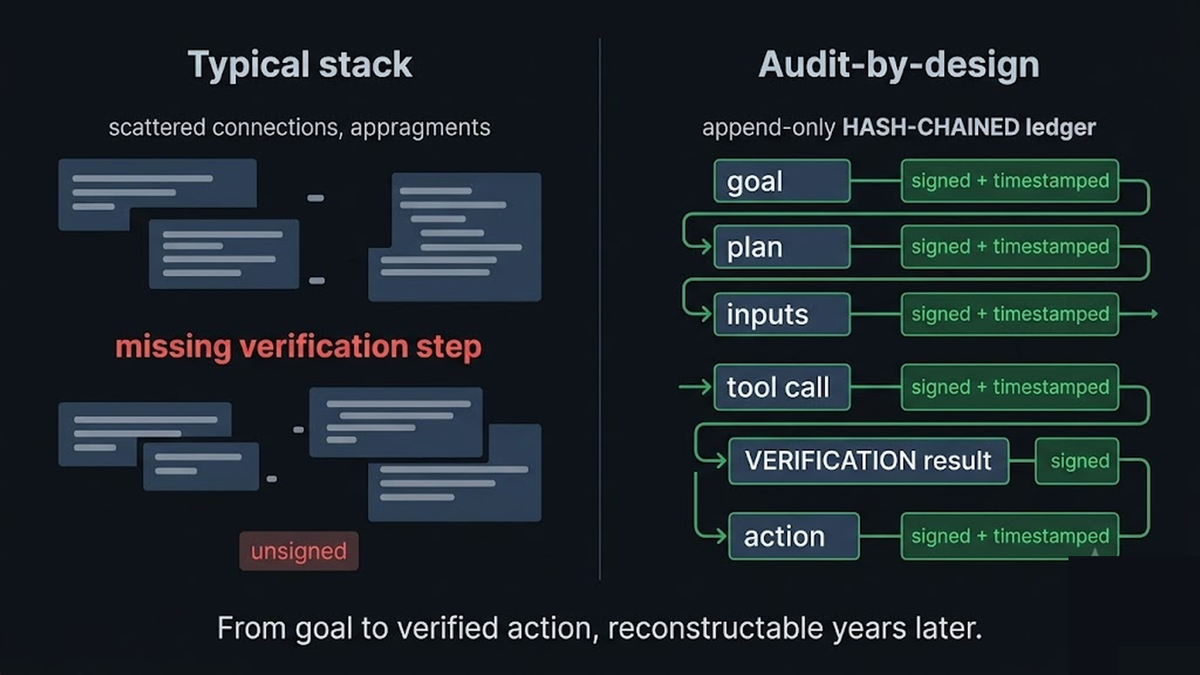
Typical logging versus audit-by-design
| Property | Typical agent stack | Audit-by-design |
|---|---|---|
| Mutability | Mutable logs | Append-only, hash-chained |
| Completeness | Missing intermediate/verifier steps | Full trace incl. verification |
| Provenance | None | Goal -> action linkage |
| Integrity | Unsigned | Timestamped and signed |
| Reconstruction | Hard or impossible | Replayable for an auditor |
Regulators want a reconstructible trail from goal to verified action. Most agent stacks were built for speed, so they keep mutable, incomplete logs that can't meet that bar. Build the trail append-only, signed, with verification at every step linked to its originating goal, and those decisions hold up years later. Auditability built in rather than bolted on is reliability at the pattern level, that's what VibeModel builds as the Pattern Intelligence Layer.
Frequently asked questions
Will a more capable model give regulators the reconstructible trail they need?
A more capable agent decides more fluently while the trace stays unauditable; reconstructing it later is the cost. (Business Standard, 2026)
Isn't logging enough for an audit?
Usually not. Typical logs are mutable, centralized, and incomplete, often missing the intermediate outputs and verification results, with no signing or provenance. An audit needs a tamper-evident, reconstructible chain from goal to verified action.
What goes in the trail beyond the final action?
Everything the decision rested on: the goal, the plan, the inputs and their lineage, each tool call and result, the verification outcome at each step, all recorded immutably so you can reconstruct and defend the decision later.
Can't I add this after launch?
You can add more logging going forward. But if intermediate state and verification results were never captured immutably, past decisions can't be reconstructed. What's gone is gone. That's why it needs to be in from the start.