

Key facts.
- tau2-bench (arXiv:2506.07982), a dual-control benchmark where agent and user share a dynamic environment, reports overall agent success in the mid-30s percent across domains, evidence that an unwatched agent errs often. source
- McKinsey's State of AI in 2025 found 51% of organizations report an AI-related incident and that the teams managing risk well use human-in-the-loop rules and centralized oversight, evidence that ongoing oversight is the norm, not a one-time launch check. source
- Google's DORA research on AI in software delivery reports that teams sustaining value tie it to continuous operational monitoring and feedback, the kind of standing signal a useful dashboard and review depend on. source
Why do all four controls have to be present?
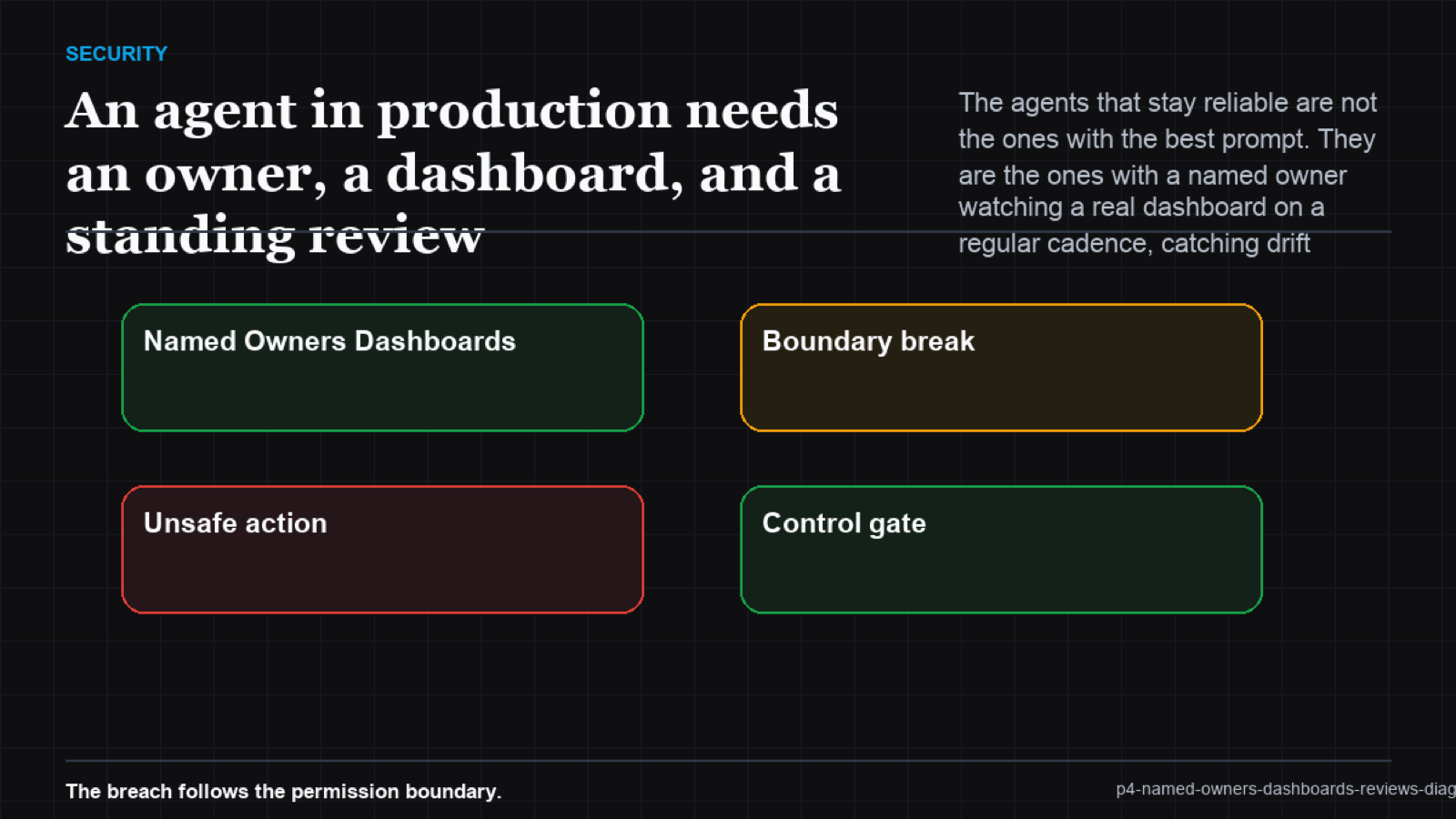
Because each one only works when the others are. A named owner is the person accountable, but accountability with nothing to look at is just exposure. A dashboard makes the agent's behavior visible, but an unowned dashboard is a screen nobody checks. Boundary monitoring catches the agent stepping outside its lane, but an alert with no review cadence becomes background noise that gets muted. And a review cadence without an owner, a dashboard and monitoring is a meeting with no content. The reason human review stays central, as tau2-bench underlines, is that agents fail on a real share of even structured tasks, so a person has to be in the loop and that person needs both the signal and the schedule to act on it.
A more capable model does not collapse these four into fewer. It changes how often the dashboard lights up, not whether you need one. Measuring Agents in Production names this directly: across 86 deployed systems, monitoring gaps were routine and most teams kept a human checkpoint within ten steps. Those are continuous activities tied to a person, not a checkbox at launch. The dashboard becomes useful when it surfaces the right signal, which is why a record of the agent's operation matters, the continuous operational monitoring DORA links to sustained value, so a failure can be localized rather than just noticed. Reliability is maintained, not granted and the four controls together are the maintenance.
What does each control actually do?
The owner provides a decision-maker, so a signal turns into an action. The dashboard provides visibility into whether the agent is working, not just running, so degradation is seen. Boundary monitoring provides an alert when the agent acts outside its defined scope, so a violation reaches a person while it matters. And the review cadence provides the rhythm that keeps the other three current as volume grows and the model changes. Together they are the difference between an agent that is watched and one that is merely deployed. The watched version is the norm among teams that sustain production and the structure is what makes the watching reliable rather than ad hoc.
| Control | Fails alone because | Working together |
|---|---|---|
| Named owner | Nothing to look at | Acts on real signals |
| Dashboard | Nobody reads it | Surfaces drift to the owner |
| Boundary monitor | Alerts get muted | Reviewed on cadence |
| Review cadence | No content | Keeps controls current |
The Pattern Intelligence Layer is where these four controls share one substrate. Behavior, boundary adherence and reasoning failures are tracked at the pattern level, so the owner reviews real signals on a cadence and the dashboard shows whether the agent is working, not just whether it ran. Reliability at the pattern level is what turns four separate controls into one functioning system of oversight.
Frequently asked questions
Can monitoring replace the human review?
No. tau2-bench shows agents fail on a real share of structured tasks, so human review stays necessary. Monitoring feeds the review, it does not replace it.
Why a cadence instead of just alerting on problems?
Because some drift is gradual and never trips a single alert. A regular review catches the slow degradation that no threshold would flag.
Does a better model reduce how much oversight I need?
It changes the frequency of issues, not the need to watch. McKinsey's State of AI in 2025 found 51% of organizations report an AI-related incident and the teams managing risk well keep a human in the loop regardless of model.