


Key facts.
- Gartner projects over 40% of agentic AI projects canceled by end of 2027 on cost, unclear value and inadequate risk controls.source
- Gartner also flags "agent washing," estimating only about 130 of thousands of vendors are genuinely agentic, which feeds the not-ready perception further.source
- The not-ready verdict is reinforced by hard adoption data: MIT's NANDA report found 95% of enterprise GenAI pilots stalled with no measurable return and a public planning failure is the legible face of that stall.source
Why do planning failures shape the verdict so heavily?
By 2027 over 40% of agentic projects get canceled; a more capable model cannot repair a not-ready perception built on watched flops. (source)
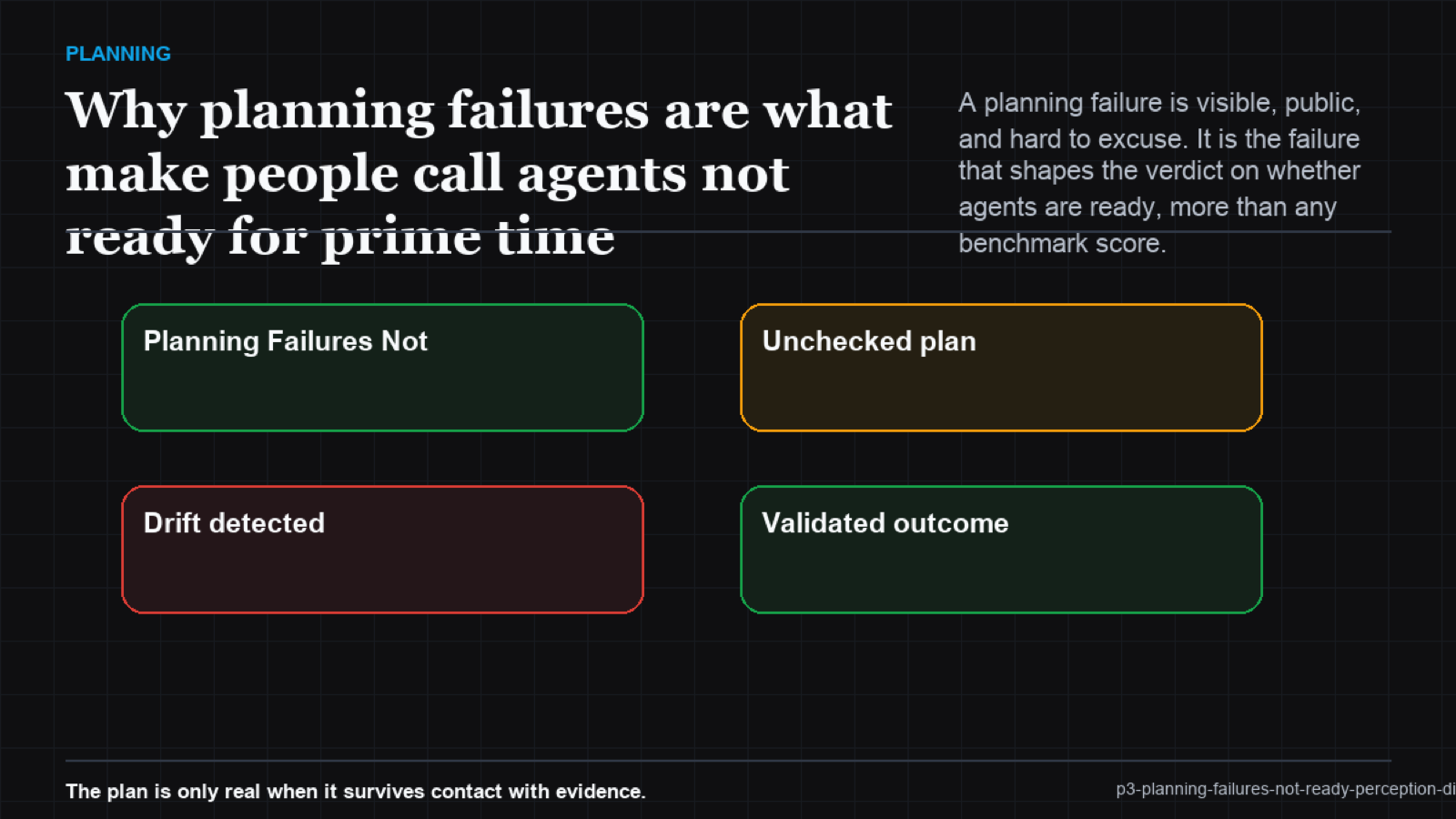
Planning failures are legible to non-experts in a way most agent failures are not. A retrieval gap or a calibration problem is invisible to anyone outside the team. A planning failure is the agent confidently doing the wrong sequence of things, in public, with consequences a customer or an executive can see and narrate. It is the booking that should not have been made. The action that should have been escalated, the plan that ignored an obvious constraint. These become the stories people tell about whether agents work, because they are concrete and damning in a way a benchmark number never is. The Gartner cancellation rate is the aggregate of those stories: projects pulled because the visible failures outweighed the invisible promise.
This is why the readiness perception does not move with model capability. The benchmark can climb while the perception sits still, because the perception is built from the failures people witnessed, not the scores they did not read. A more capable model that still produces an occasional public planning failure does not change the narrative. It just makes the next failure more surprising.
How do you shift the perception?
Eliminate the visible failure, not the benchmark gap. Make planning reliable enough that the public, legible, hard-to-excuse failures stop happening. Those are what the verdict is built from. Bound the autonomy so a bad plan cannot reach a customer unchecked. Verify the consequential steps. Keep a human on the calls that, if wrong, become a story. The perception that agents are ready follows from agents that stop failing where people can see. It is a planning-reliability problem before it is a capability one.
| What you improve | Effect on readiness perception |
|---|---|
| Benchmark score | Little, perception is built on visible failures |
| Visible planning reliability | Direct, the failures that shaped the verdict stop |
Stopping those visible failures is what VibeModel does as the Pattern Intelligence Layer. We model the planning patterns that produce the public, hard-to-excuse failures. The agent stops generating the stories that convince everyone it is not ready.
Frequently asked questions
Is the not-ready perception fair?
It is built from real, visible failures, so it is earned. The fix is to stop producing those failures, not to argue the perception away.
Why doesn't a higher benchmark help the narrative?
People form the verdict from failures they witnessed, not scores they did not see. Visible reliability is what moves it.
What failure matters most to perception?
The public, legible one with a consequence a non-expert can narrate. That is the story that spreads.