


Key facts.
- Gartner predicts over 40% of agentic AI projects will be canceled by the end of 2027, citing escalating costs, unclear business value, and inadequate risk controls. source
- A 2025 survey of teams with agents in production found observability the lowest-maturity part of the stack, the capability most directly tied to explaining incidents. source
- McKinsey's State of AI in 2025 found 51% of organizations report having experienced an AI-related incident, so incidents are not a sign of a uniquely bad build, they are expected, which makes the ability to explain them the differentiator. source
- MAST demonstrates that explained failures resolve into a finite set of fixable modes, so debuggability turns "uncontrolled" into "managed." source
How does an observability gap actually cancel a project?
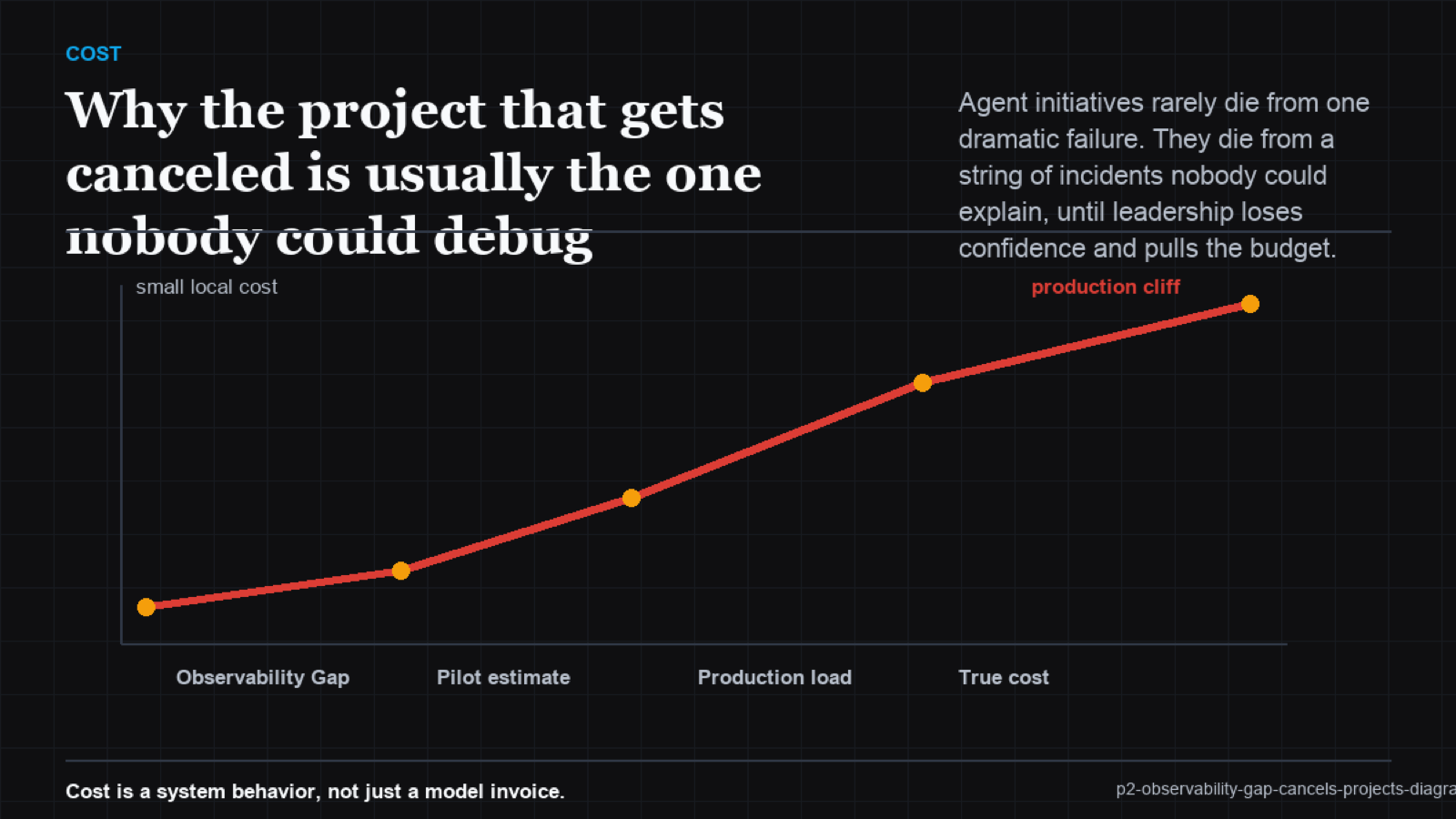
It works through confidence, not through any single metric. The first incident happens, support handles it, and the postmortem concludes the model misbehaved. The second happens, same conclusion. By the fourth, the pattern an executive sees is a system that fails in ways the team cannot explain or prevent. That is the moment the risk-control question gets asked, and "we are not sure why it does that" is not an answer that keeps a budget. The agent might be performing fine on average. What it lacks is a story for its failures, and the absence of that story is what reads as risk.
Teams with good observability tell a different story. The incident happens, the engineer opens the trace, names the failure mode, ships a fix, and reports it closed. To leadership, that is a controlled system having a normal bad day. Same incident rate, completely different read, entirely because one team can explain itself and the other cannot.
Why is this an observability problem and not a model problem?
Because the model will fail sometimes no matter how good it is, as tau-bench and MAST both show, so betting the project on a model that never fails is betting on something that does not exist. The controllable variable is whether your team can see the failure and respond. Swap the model and the incident rate changes a little. Add observability and the project survives, because survival is about explanation and response speed, not about a failure rate of zero.
The Pattern Intelligence Layer protects the project by making explanation a property of every run. The trace, the failure classification, and the response are part of the pattern, so when leadership asks the risk-control question, the answer is a demonstrated process, not a hope. Reliability at the pattern level is what keeps an initiative funded through the incidents that are coming whether you are ready or not.
Frequently asked questions
Our incident rate is low. Are we safe?
Not if you cannot explain the incidents you do have. Leadership reads unexplained failures as uncontrolled risk regardless of frequency.
Would a better model save the project instead?
It lowers the rate slightly but never to zero. The project-saving variable is your ability to explain and fix what does fail.
What is the cheapest insurance here?
A reconstructable trace per run plus a failure taxonomy, so every incident ends in a named, closed cause instead of a shrug.