


Key facts.
- Gartner predicted in June 2025 that over 40% of agentic AI projects will be canceled by the end of 2027, citing escalating costs, unclear business value and inadequate risk controls and warned of "agent washing" by vendors. source
- MIT's Project NANDA found about 95% of organizations saw zero measurable return on generative AI and stated the divide "does not seem to be driven by model quality or regulation, but seems to be determined by approach." source
- Gartner also estimated only about 130 of the thousands of self-described agentic vendors are genuinely agentic, which means many cost overruns come from tools that were never going to deliver the promised saving. source
Why does cost overrun cancel a project rather than just strain it?
Over 40% of agentic projects die with cost named first; a better model is no escape, MIT NANDA found ~95% saw no return, pinned on approach. (source)
Because a project survives on the gap between value delivered and cost incurred and an overrun closes that gap from the cost side. When the spend climbs past the value, the project is no longer an investment, it is a loss and a loss does not get a second budget cycle. The Gartner forecast naming escalating cost first is a recognition that this is the most common way the gap closes. It is not that the agent stopped working. It is that it kept working at a price the business could not justify and the decision to cancel is the rational response to a negative return, not a failure of nerve.
The MIT finding explains why teams cannot model their way out with a better model. If 95% of organizations cannot show a measurable return and the cause is approach rather than model quality, then the project that overran did so because of how it was scoped, integrated and cost-controlled, not because the model was too small. Swapping in a stronger model after the overrun changes the per-token price and nothing about the structure that produced the overrun. The cancellation was set in motion at design time, when cost was treated as a detail.
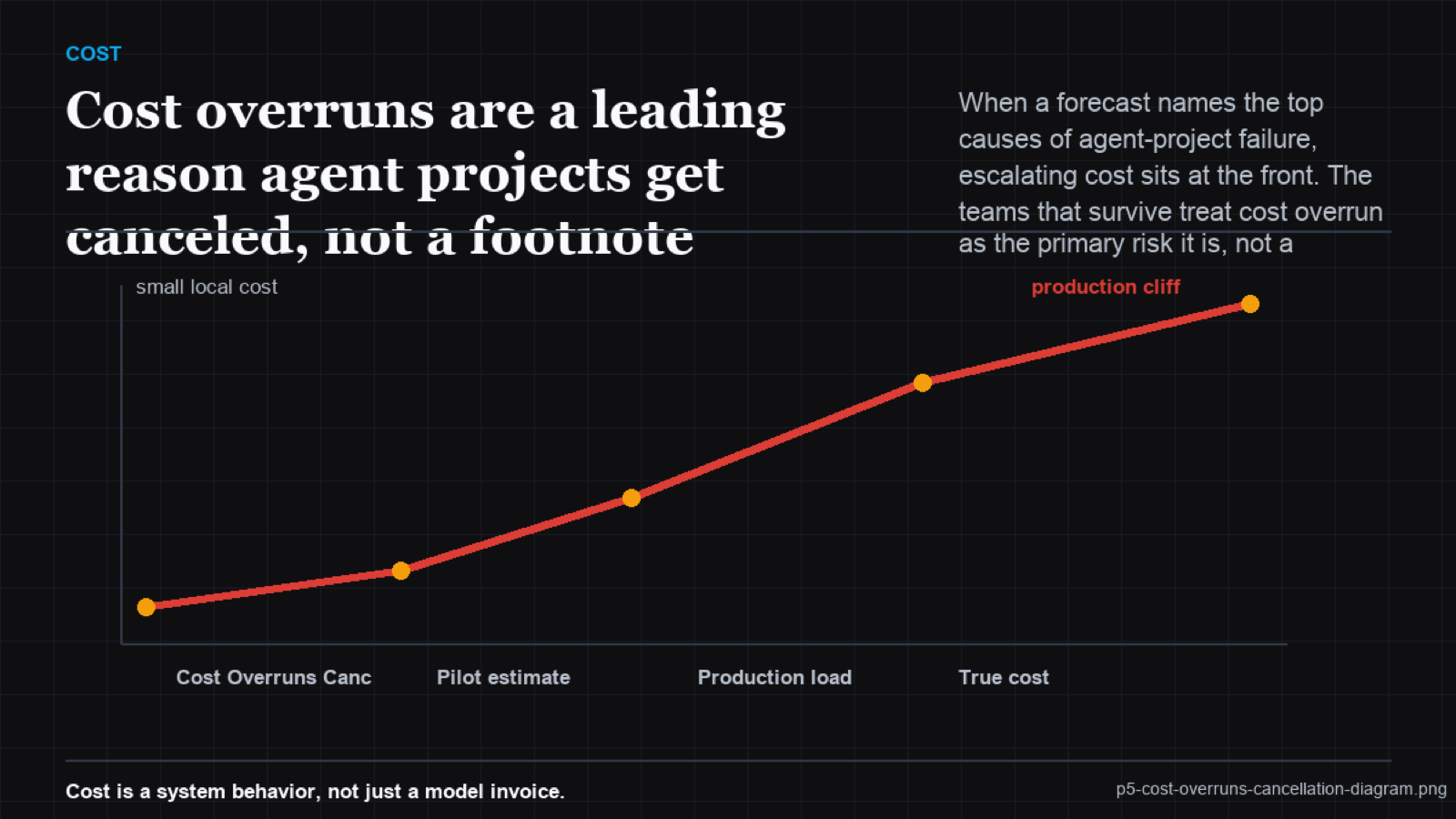
How do the projects that survive treat cost?
As the primary risk, tracked from day one. They forecast cost at production volume, not pilot volume, so the overrun shows up in the model before it shows up on the invoice. They put hard caps on per-task spend so a single runaway cannot blow the budget. They check whether the vendor's "agent" is real, given Gartner's warning that most are not, so they are not paying for capability that does not exist. And they tie spend to a value number leadership can see, so the gap between cost and value is visible while there is still time to act on it. None of this is exotic. It is the difference between a project that catches its overrun and one that gets canceled by it.
| Practice | Project that gets canceled | Project that survives |
|---|---|---|
| Cost forecast | Pilot volume | Production volume |
| Budget caps | None | Per-task hard limits |
| Vendor check | Takes "agent" at face value | Verifies real capability |
| Cost vs value | Discovered at review | Tracked continuously |
The Pattern Intelligence Layer is where cost overrun is caught as a trend, not a verdict. Cost per outcome and its trajectory are tracked at the pattern level, so a project drifting toward the crossover where cost overtakes value is flagged while there is still room to correct scope or caps. Reliability at the pattern level means the overrun that would have canceled the project becomes a number you manage, which is how the project ends up in the surviving share rather than the canceled one.
Frequently asked questions
Is cost really a top cause of agent-project cancellation?
Yes. Gartner's forecast that over 40% will be canceled by 2027 lists escalating costs first, alongside unclear value and inadequate risk controls. It is a named cause, not a footnote.
Can a better model save an over-budget project?
Rarely. MIT NANDA found the divide is about approach, not model quality. A stronger model changes the per-token price, not the structure that produced the overrun.
How do surviving projects avoid the overrun?
They forecast cost at production volume, cap per-task spend, verify the vendor's agent is real and track cost against value continuously, so the overrun is caught before it forces a cancellation.