


Key facts.
- Because LLM APIs bill the full conversation history on each call, doubling typical context length more than doubles per-step cost on long tasks, an effect industry analyses describe as scaling steeply with context (reported). source
- Anthropic reported multi-agent runs using roughly 15x the tokens of chat, a reminder that real workloads carry cost multipliers a pilot rarely triggers (reported). source
- MIT's NANDA "State of AI in Business 2025" found only about 5% of enterprise GenAI pilots delivered measurable financial impact, the outcome a cost estimate built on pilot numbers helps produce. source
- tau-bench shows frontier agents retry and fail inconsistently, so production volume includes retries a single-pass estimate ignores. source
Why are volume and context the two that bite?
Pilot volume and context both undercount, and APIs bill full history each call. A frontier model won't fix it: tau-bench shows agents retrying inconsistently, every retry unbudgeted volume. (arXiv:2406.12045)
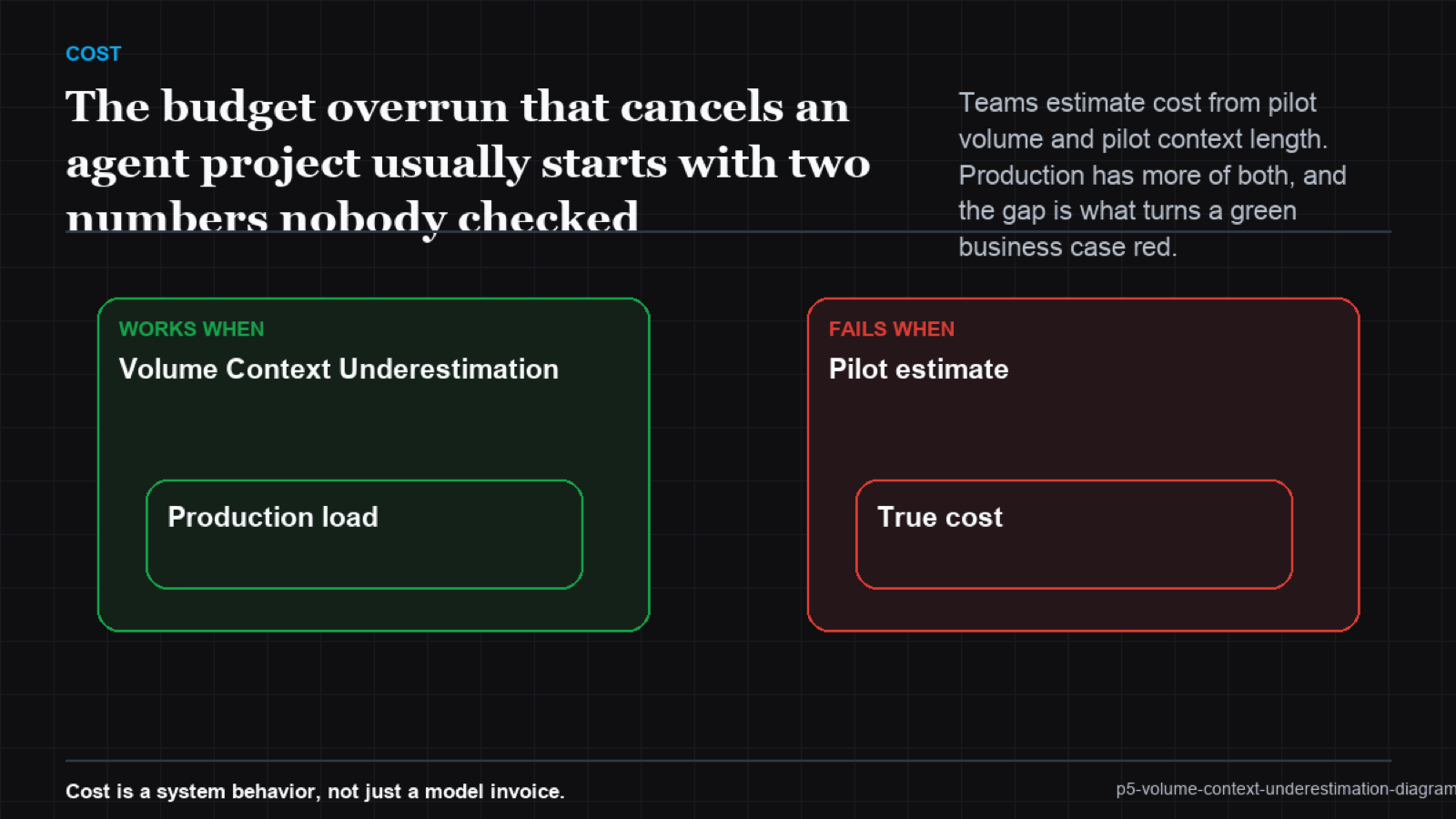
Because they both multiply, and they multiply the same base cost. Volume is the number of runs. Context length is the cost per run on long tasks. A pilot understates both: it serves limited traffic to limited users on curated, short tasks. Production serves full traffic to everyone on real tasks that carry long histories. If the estimate used pilot volume and pilot context, the production bill can land several multiples above the business case, and the overrun is not a rounding error, it is the difference between a funded project and a canceled one.
The trap is that the pilot looks like proof. It ran, it worked, the cost was modest, so the business case inherits those numbers. But the pilot was a measurement of the pilot, not of production. The teams that avoid the overrun model production volume and context explicitly, including the retries and loops that real failure rates produce, before they commit a budget.
How do you estimate production cost honestly?
Start from expected production volume, not pilot volume, including peak traffic, not just average. Use realistic context lengths sampled from real tasks, not the short pilot prompts. Add a retry and loop factor derived from your measured failure rate, because inconsistency is built in, as tau-bench shows. And include the non-inference costs that ride along, monitoring, human oversight, and the data bill from observability. The result is a number that survives production, which a pilot-based estimate does not.
| Input | Pilot estimate | Honest production estimate |
|---|---|---|
| Volume | Pilot traffic | Full production traffic incl. peak |
| Context length | Short pilot prompts | Real task histories |
| Retries / loops | Assumed zero | From measured failure rate |
| Non-inference cost | Ignored | Monitoring, oversight, data |
The Pattern Intelligence Layer is where realistic cost modeling becomes routine instead of a fire drill after the first invoice. Volume assumptions, context discipline, and retry factors are properties of the pattern you can measure and hold steady, so the business case reflects how the agent actually runs. Reliability at the pattern level includes the reliability of a budget that does not get the project canceled.
Frequently asked questions
Our pilot cost was fine. Why model further?
The pilot measured the pilot. Production has more volume and longer context, both of which multiply the same base cost. Model those before committing a budget.
How much higher can production be?
Several multiples, depending on how far pilot volume and context sat below production. The exact factor is yours to measure; the direction is always up.
What is the most-missed input?
Retries and loops. Estimates assume a single clean pass, but measured failure rates guarantee extra runs you have to budget for.