


Key facts.
- An IMF staff note (2026/004) on agentic AI warns that weak controls let escalating cost and a single agent error cascade, the kind of unbounded exposure that gets a project canceled. source
- On GAIA, GPT-4 with plugins solves about 15% of real-world assistant tasks versus a 92% human baseline, so an ungoverned agent fails often enough to trigger cancellation. source
- The MIT NANDA State of AI in Business 2025 reports the large majority of GenAI pilots show no measurable P&L impact, a value-demonstration failure governance is meant to prevent. source
- Canceled projects share one shortfall in different clothes: no owner, no audit, no containment and a stronger model would not have saved them (GAIA: 15%). (arXiv:2311.12983)
Why do these projects get canceled on governance, not capability?
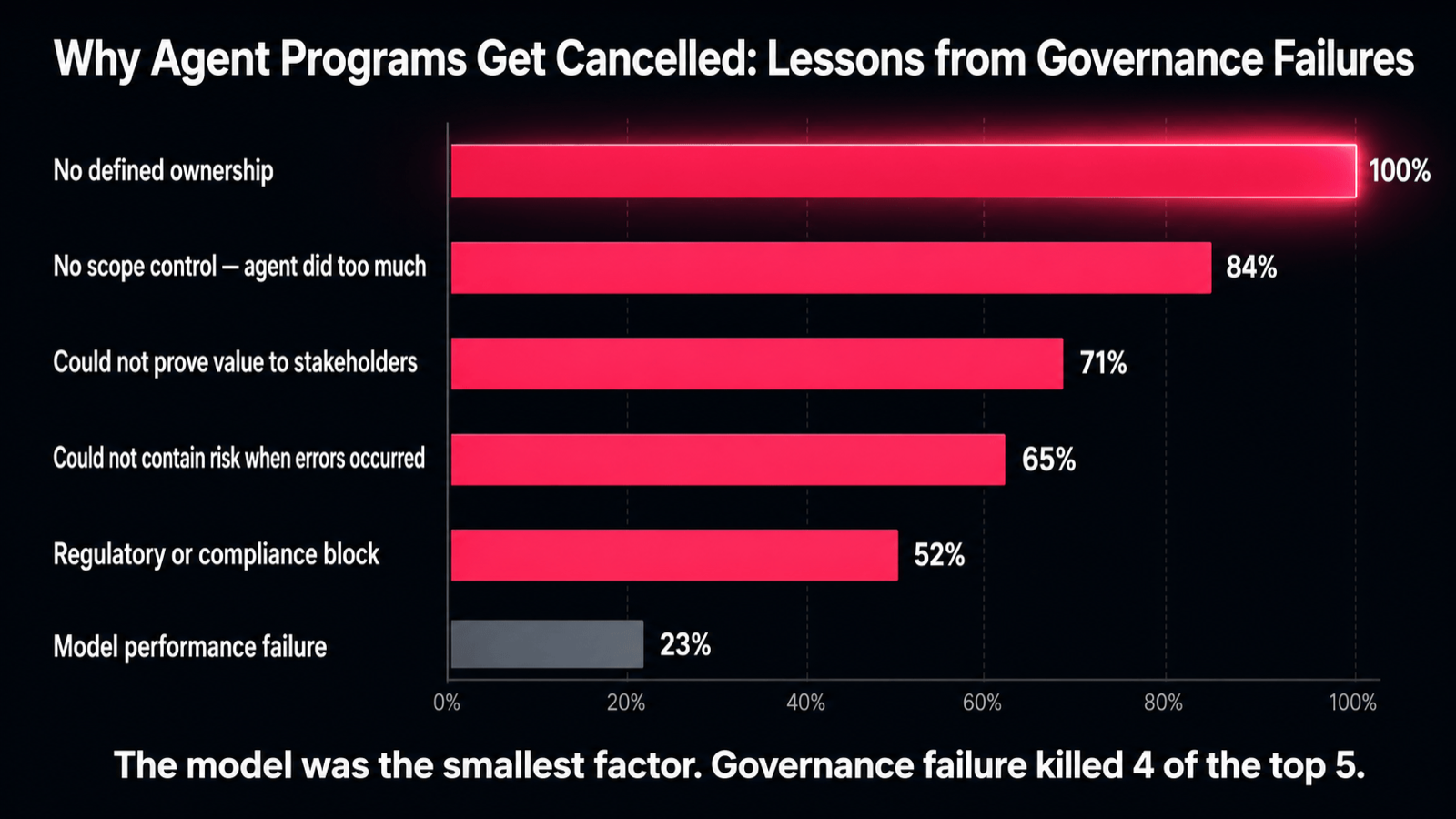
Because capability got them to the pilot and the missing governance is what failed them after. Look at the recurring causes: escalating costs, unclear value, inadequate risk controls. None of those is a model problem. Escalating costs is the absence of a budget cap and usage monitoring. Unclear value is the absence of a way to measure and demonstrate the outcome. Inadequate risk controls is the absence of boundaries, oversight and an audit trail. Each is a governance control that was never built and each is the kind of thing that does not hurt during a clean demo and becomes fatal when the project has to justify itself or survive an incident. The cancellation is not the model giving up; it is the organization concluding it cannot operate or justify the agent, which is a governance conclusion.
The GAIA number is why the missing controls turn into cancellation rather than a rough patch. GPT-4 with plugins gets real assistant tasks right about one time in seven against a 92% human baseline, so an ungoverned agent fails frequently and visibly and without an audit trail to diagnose it, a boundary to contain it or a value measure to weigh against the cost, each failure is pure liability with nothing to offset it. The MIT NANDA finding that most pilots show no measurable P&L impact is the same story from the value side: a project that cannot demonstrate its worth loses its budget and demonstrating worth is a governance discipline, defining the metric, measuring the outcome, reporting it. The canceled projects teach the controls to build, because they are the controls those projects did not.
What is the checklist the cancellations leave behind?
Four controls, each the inverse of a common cancellation cause. A budget cap with usage monitoring, so cost cannot escalate unseen. A value measure defined up front, so the project can prove its worth when asked. Risk controls, boundaries, oversight, audit trails, so a failure is contained and diagnosable instead of fatal. A named owner accountable for all of the above, so none of it is everyone's job and therefore no one's. A project that has these is not immune to failure, but it is immune to the specific failures that get projects canceled, because it can contain the incident, justify the cost and answer for the behavior.
| Common cancellation cause | The control that prevents it |
|---|---|
| Escalating costs | Budget cap plus usage monitoring |
| Unclear value | Value measure defined and reported up front |
| Inadequate risk controls | Boundaries, oversight, audit trail |
| No accountability | Named owner for the above |
The Pattern Intelligence Layer is where these controls live, so the budget caps, value measures, risk boundaries and ownership that canceled projects skipped are enforced at the pattern level from the start. A project built on it carries the controls whose absence kills the others. Reliability at the pattern level is what keeps an agent project off the cancellation list.
Frequently asked questions
Don't projects get canceled because the model wasn't good enough?
Rarely. The recurring causes are cost, unclear value and inadequate risk controls, all governance gaps. The model got the project to the pilot; the missing controls failed it after.
Why is value demonstration a governance issue?
Because proving worth requires defining a metric, measuring the outcome and reporting it. Most pilots show no measurable P&L impact precisely because that discipline was missing.
What's the single most common shortfall?
No named owner. Without one, the budget cap, the value measure and the risk controls are everyone's job and therefore no one's and the project drifts to cancellation.