


Key facts.
- Gartner's prediction: over 40% of agentic AI projects canceled by end of 2027. Why? Escalating costs, unclear value, and weak risk controls. The weak controls piece isn't a model problem. Nobody built the governance before the agent shipped.source
- ISO/IEC 42001:2023 gives organizations a proven AI management system structure to work from. Defined roles, controls, and oversight already built in. You adopt a structure that exists rather than inventing one on the fly after something goes wrong.source
- A Cloud Security Alliance survey of enterprise AI adopters found a real gap: governance and oversight maturity was trailing deployment speed. Agents were live before the accountability frame to manage them was in place.source
Why is an undefined model the same as inadequate controls?
Gartner blames over 40% of canceled agentic projects partly on weak risk controls; an undefined governance model is that case and a stronger model does not supply governance. (source)
No governance model means no controls. Not weak controls. None. If nobody wrote down what the agent can't do, there's no boundary to enforce. A scope violation lands and everyone argues about whether it was actually a violation. An incident happens and nobody knows whose job it is to call halt. Problems accumulate in silence because there's no cadence to surface them until they're already crises. That's the inadequate-risk-controls condition. Not a model failure. An organizational structure failure. The agent didn't get canceled. The missing governance made it uncancelable in any controlled way, so someone pulled the plug instead.
A smarter model doesn't fix this. It might reduce how often incidents happen. It can't define who owns the response. It can't set the review cadence. It can't write the policy. ISO/IEC 42001 is the framework that does. It's already built. You're adopting a structure, not inventing one under time pressure after an incident.
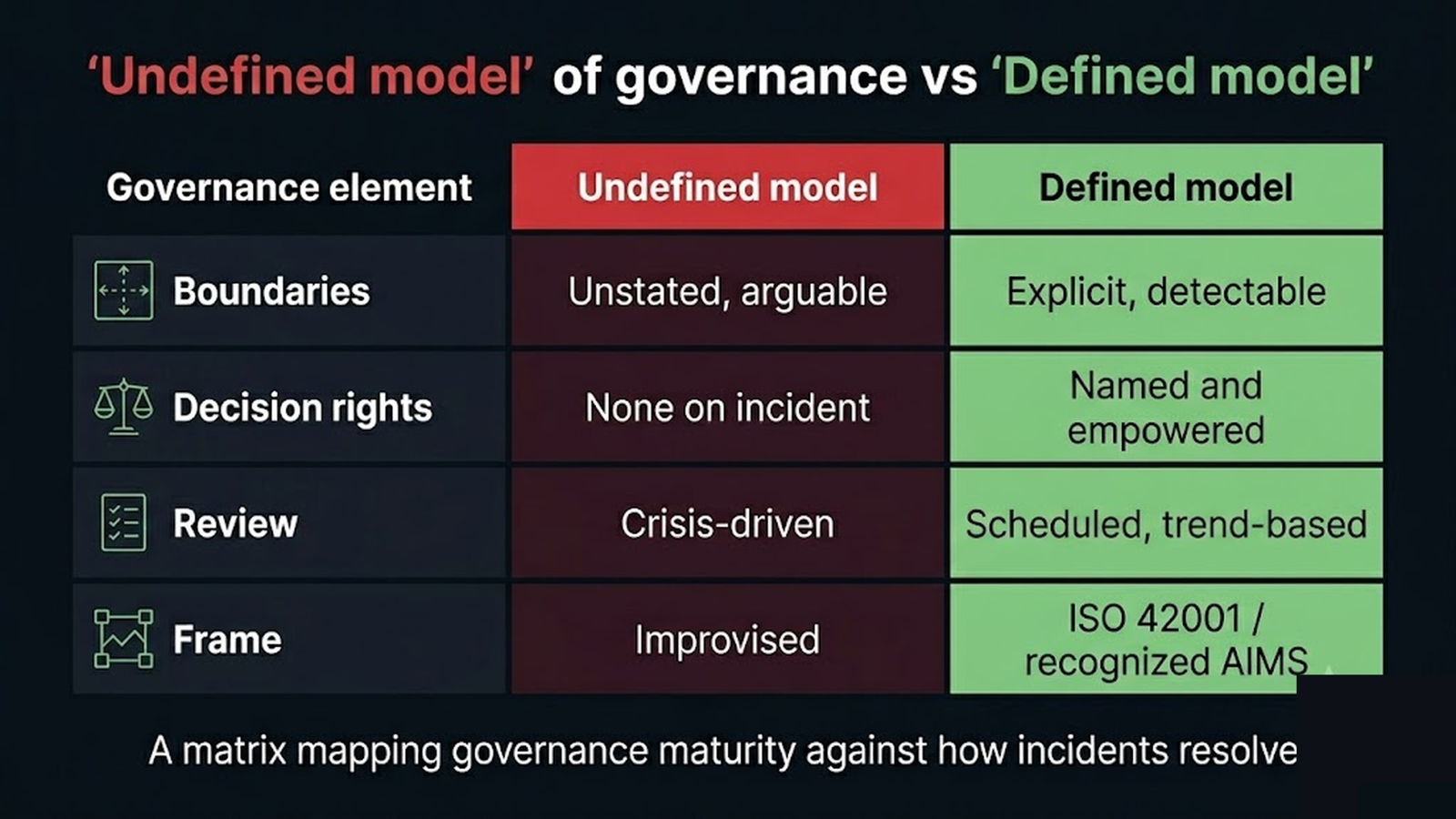
What does defining the model actually take?
Less than a cancellation costs. Draw the boundary. What the agent can do without a human, what it can't. That line has to exist before a violation happens, or there's no violation, just a dispute. Name who owns the incident response. Route incidents to that person, not to a committee that needs to form first. Set a review schedule so problems show up as trends, not crises. ISO/IEC 42001 is the management system standard that structures all of this. You're not building from scratch, you're implementing something that's already figured out. Projects that survive their first incident have this. Projects that get canceled usually don't.
| Governance element | Undefined model | Defined model |
|---|---|---|
| Boundaries | Unstated, arguable | Explicit, detectable |
| Decision rights | None on incident | Named and enabled |
| Review | Crisis-driven | Scheduled, trend-based |
| Frame | Improvised | ISO 42001 / recognized AIMS |
The Pattern Intelligence Layer is where a defined governance model gets its signals. Boundaries, violations and behavior trends are tracked at the pattern level. The structure you defined has live evidence to act on and incidents arrive as managed trends rather than surprises. Reliability at the pattern level is what makes a governance model operational instead of a document. It's what keeps the project off the cancellation branch.
Frequently asked questions
Is governance really why projects get canceled or is it cost?
Gartner names both, plus unclear value. They interact: an undefined governance model leaves cost and risk uncontrolled, so an incident or overrun has no frame to be managed inside and cancellation becomes the default.
Do I have to build a governance model from scratch?
No. ISO/IEC 42001 gives a recognized AI management system you can adopt, so you build on an existing structure rather than inventing one.
Will a better model reduce the cancellation risk on its own?
Only at the margin. It lowers incident frequency but does not define boundaries, decision rights or review, which are what turn an incident into a managed event instead of a cancellation.