

Key facts.
- Deloitte's State of Generative AI in the Enterprise found more than two-thirds of organizations expect 30% or fewer of their experiments to fully scale in the next three to six months, the drop-off an unowned, unmaintained agent falls into. source
- MIT NANDA's "State of AI in Business 2025" found only about 5% of enterprise GenAI pilots delivered measurable financial impact, the kind of value an unowned, neglected agent never gets the chance to demonstrate (reported). source
- In Moffatt v. Air Canada (2024 BCCRT 149), a tribunal held the company liable for its chatbot's wrong answer, the accountability that has to be owned by a named person after launch or it lands on the business by default. source
How does a working agent get abandoned?
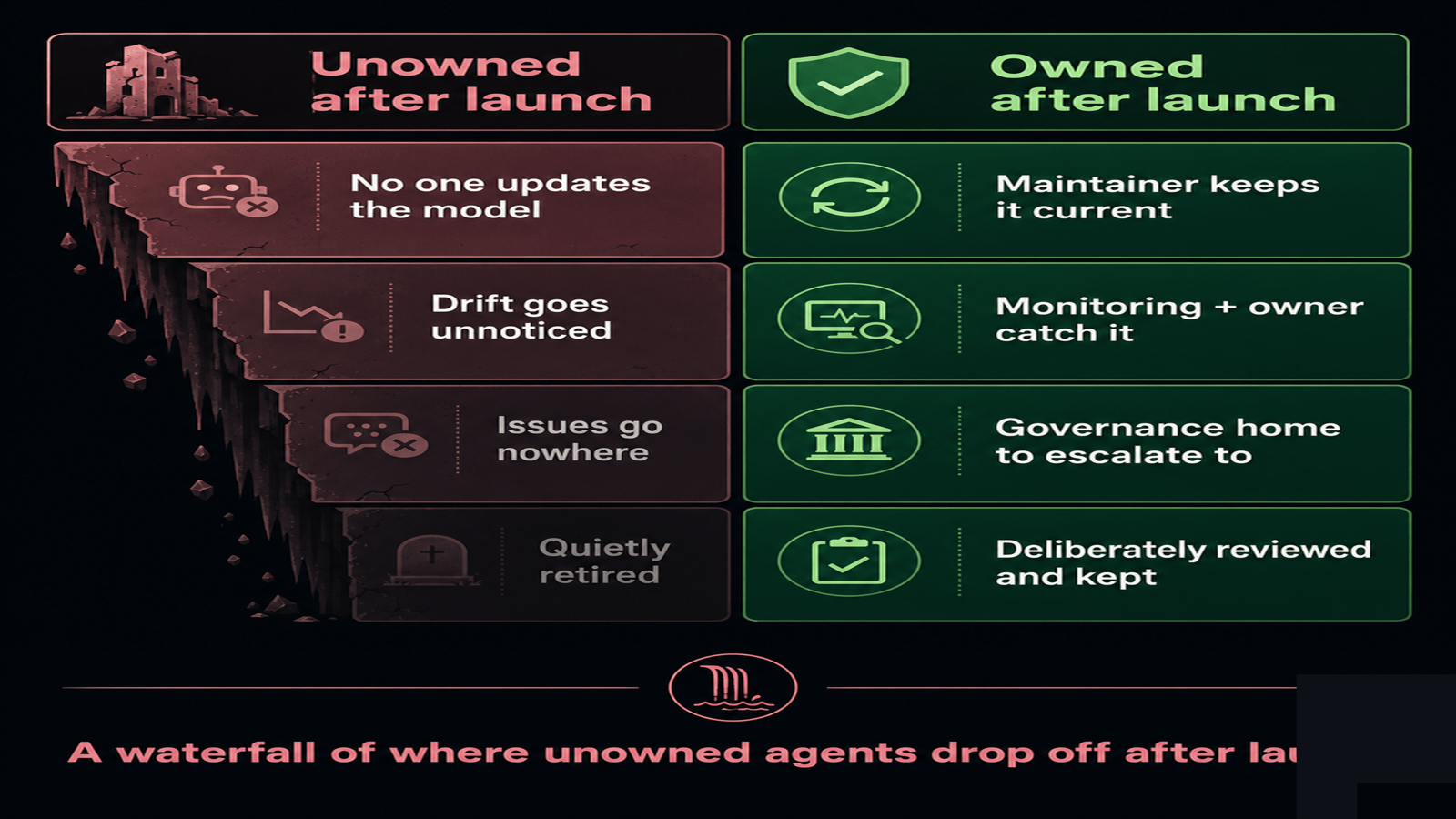
Quietly and not from a bug. An agent reaches production because a team got it working, but reaching production is a build milestone, not an operating commitment. If nobody is named as its owner, then when the model needs updating, no one updates it; when its behavior drifts, no one notices; when a user reports a problem, it goes nowhere; when its original champion changes teams, it loses its only advocate. The agent keeps technically running while slowly becoming stale, unmonitored and untrusted and one day it is switched off because no one is accountable for keeping it on. Deloitte's finding that most organizations expect only a small share of experiments to fully scale is the aggregate of this slow abandonment, repeated across many unowned agents.
A more capable model does nothing to prevent this, because the failure is the absence of an owner, not a deficit of capability. MIT NANDA's finding that only about 5% of enterprise GenAI pilots delivered measurable financial impact is the value side of the same story: an agent nobody owns has no one improving its value or proving it, so it drifts toward the share that shows nothing. Moffatt v. Air Canada is the accountability side: a tribunal held a company liable for what its chatbot told a customer, which means an agent's behavior is the business's responsibility whether or not anyone was assigned to own it. Naming an owner is how that responsibility gets held by a person instead of falling on the company by default and an agent that shipped without one shipped without the thing that keeps it alive. The agents that survive past launch are the ones with a named owner, a maintenance plan and a governance home before they ever reached production.
What keeps a shipped agent from being abandoned?
An owner who is accountable for it operating, a maintainer responsible for keeping it current, a governance body it reports into and a review cadence that revisits whether it still earns its keep. Those four turn launch from an ending into a beginning: the agent has someone to update it, someone to watch it, somewhere to escalate and a regular moment where its value is re-confirmed or it is deliberately retired rather than left to rot. The difference between an agent that lives and one that is abandoned is rarely the code; it is whether anyone was made responsible for its life after launch.
| Unowned after launch | Owned after launch |
|---|---|
| No one updates the model | Maintainer keeps it current |
| Drift goes unnoticed | Monitoring + owner catch it |
| Issues go nowhere | Governance home to escalate to |
| Quietly retired | Deliberately reviewed and kept |
The Pattern Intelligence Layer is where ownership and governance outlast the launch. Accountability, maintenance and review are tracked at the pattern level, so a shipped agent has an owner, a watcher and a home rather than drifting toward quiet abandonment. Reliability at the pattern level is what keeps an agent that reached production actually running there.
Frequently asked questions
Can a stronger model keep an unowned agent alive?
An unowned agent drifts and is quietly retired though it worked; a more capable model does not save it, and Deloitte found two-thirds expect few to scale, so rework follows. (source)
If the agent reached production, isn't the hard part done?
No. Reaching production is a build milestone. Without a named owner and maintenance plan, the agent drifts and is quietly retired even though it launched fine.
Why doesn't a strong model prevent abandonment?
Because the failure is organizational: no owner, no maintainer, no governance home. Capability does not assign accountability and unowned agents drift regardless.
What's the minimum to keep an agent alive post-launch?
A named owner, a maintainer, a governance body to escalate to and a review cadence. Those turn launch into the start of an operated system, not the end of a project.