


Key facts.
- Gartner predicts over 40% of agentic AI projects will be canceled by end of 2027 due to costs, unclear value and inadequate risk controls.source
- Gartner also notes widespread "agent washing," estimating only about 130 of thousands of agentic vendors are real, which means most validation claims deserve scrutiny.source
- The validation gap shows up in the returns: MIT's NANDA State of AI in Business 2025, drawing on 150 leader interviews and 300 public deployments, found 95% of enterprise GenAI pilots delivered no measurable P&L impact, most stalling at exactly the demo-to-production leap.source
Why isn't a great demo enough?
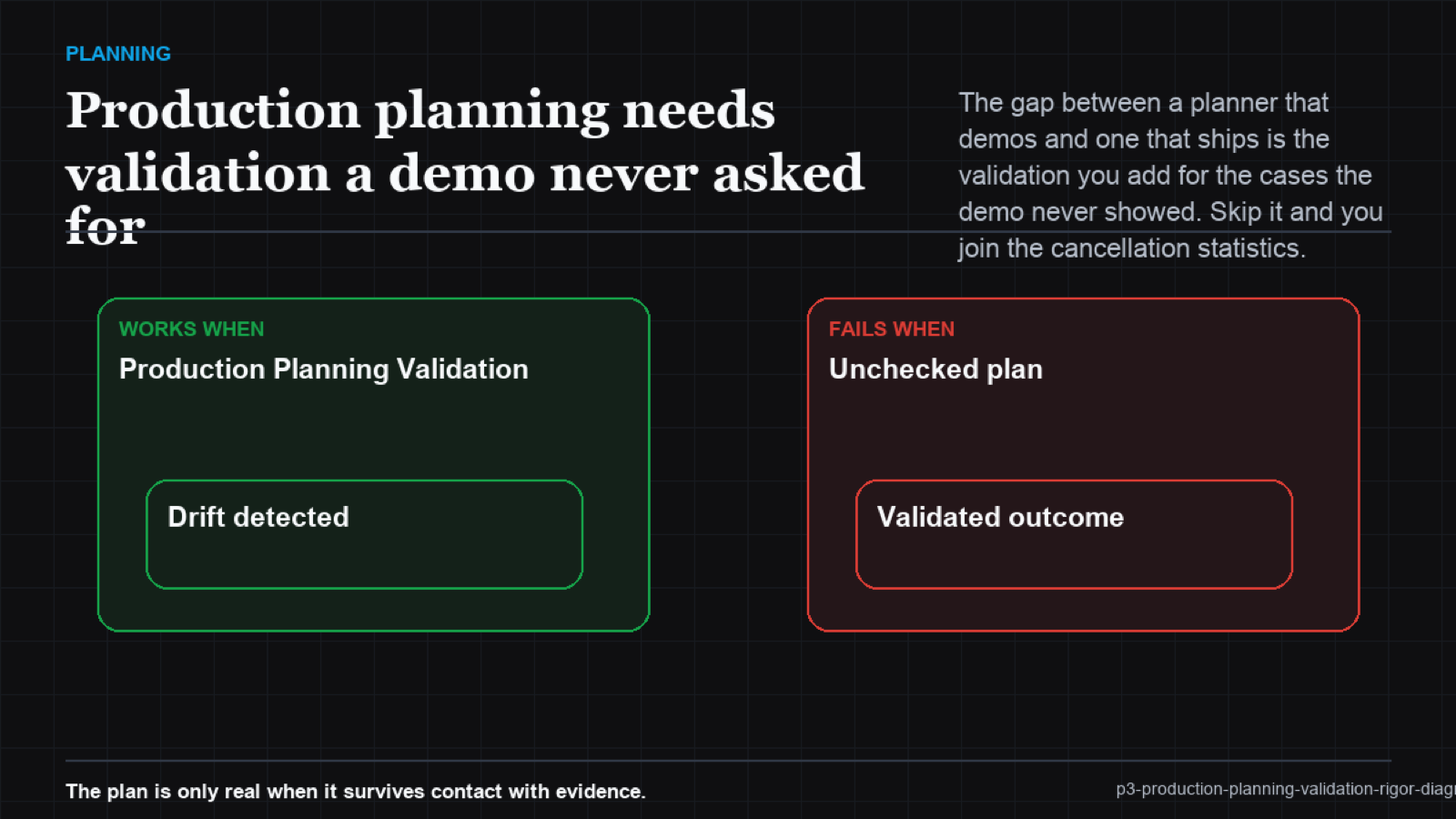
Every convincing demo was built on the cases the builder picked. The angry user, the malformed input, the conflicting constraint. None of those were in it. Production finds them on day one. A planning agent tested only against the demo path has been tested against maybe 5% of what it will actually encounter. The other 95% is where the cost overruns and the uncontrolled failures come from. That's what the Gartner cancellation number is tracking. Not failed demos. Failed productions after demos that passed.
SWE-bench-Verified's top completion rate is 65.8%. The best agent, on the benchmark that approximates real software work, fails 34% of tasks. Those aren't the demo tasks. Those are the production tasks. If you didn't test against that distribution before shipping, you found out in production what it looked like.
What does production-grade validation cover?
The cases the demo skipped. Adversarial inputs. Constraint conflicts. Edge cases the builder didn't think of. Failure injection to see what happens when a step breaks. The rare but costly scenario that decides whether you can trust this thing unattended. Test it against the workload it will actually see. The teams that don't get canceled are the ones who ran this validation before the pilot. Not after.
| Validation grade | What it tests | Production outcome |
|---|---|---|
| Demo-grade | The curated happy path | Fails on the other 95% |
| Production-grade | Edge cases, conflicts, failure injection | Holds under real conditions |
Gartner sees over 40% of agentic projects canceled by 2027; an upgrade cannot save plans validated only on clean demos. (source)
This is the bar VibeModel builds toward as the Pattern Intelligence Layer. We model the patterns a plan must survive in production, the edge cases and conflicts and failures, and validate against them. Your agent is tested on the workload it will face rather than the one that demoed well.
Frequently asked questions
How much validation is enough?
Enough to cover the costly edge cases and the adversarial paths. The demo path is the start, not the standard.
Is the cancellation rate really about validation?
Cost, value and risk controls all trace back to whether the agent was validated for production conditions before it was trusted with them.
Does this slow shipping?
It slows the demo-to-pilot leap and speeds the pilot-to-production one, because the agent actually holds.