


Key facts.
- OSWorld measures agents on real computer environments and finds the best models near 12.24% versus 72.36% for humans, with much of the gap coming from real-world state the agent did not model. source
- Constraints like cost caps and compliance rules are testable conditions, which means they can be enforced as hard gates rather than trusted to the model's discretion. source
- Skipping those guardrails has a measured cost: DORA's 2024 State of DevOps report found AI adoption correlated with a 7.2% estimated drop in delivery stability and a 1.5% drop in throughput, because letting an unconstrained system run faster ships more risk per change. source
Why does an agent ignore a constraint you clearly stated?
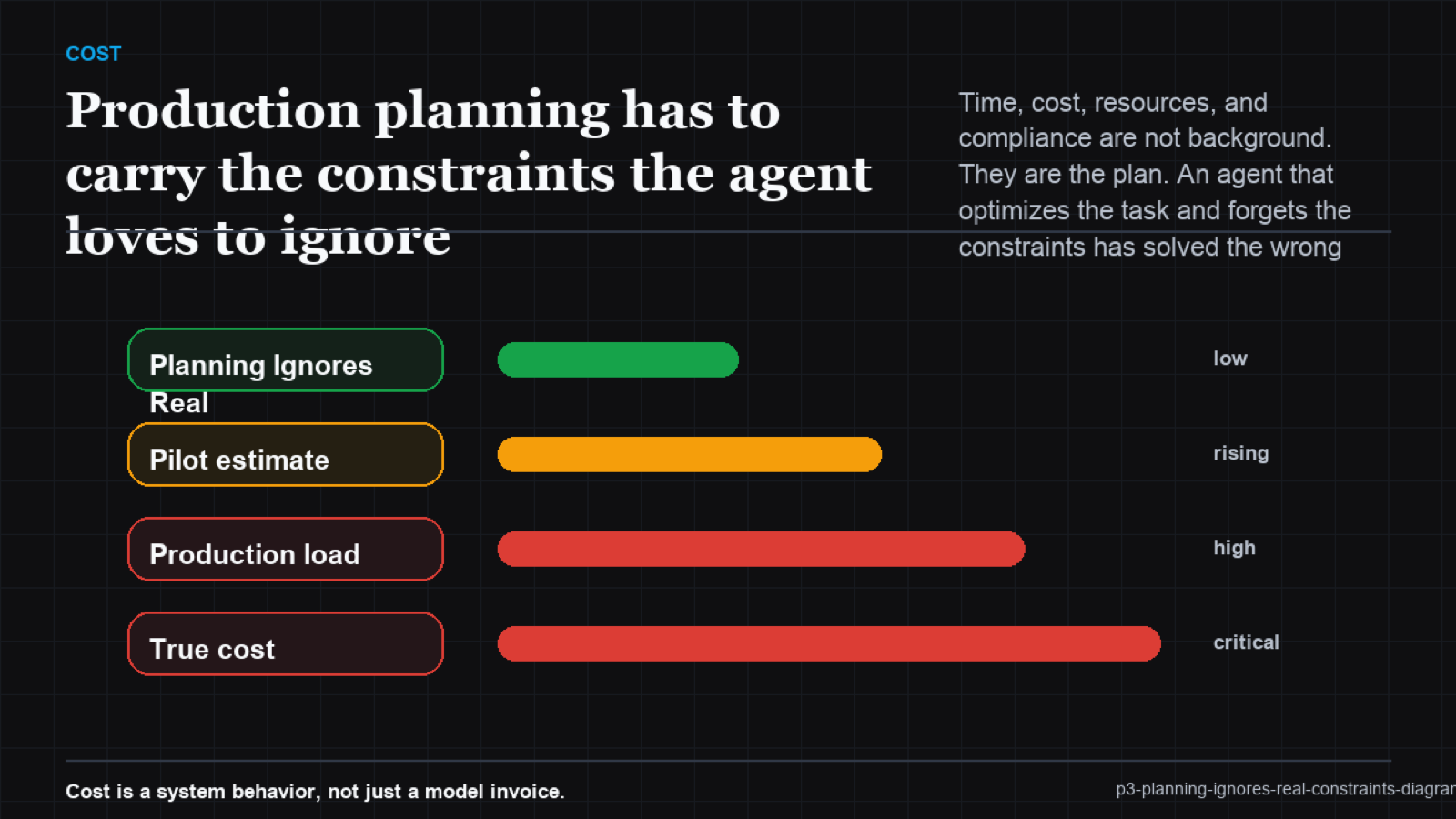
Because a constraint in the prompt is a suggestion to the model and the model optimizes for completing the task, not for honoring the fine print. Tell it to book travel under a budget and it will find a great itinerary that happens to be over budget, because the itinerary is the thing it was really trying to produce. The budget was a sentence, the itinerary was the goal and when they conflict, the goal wins. Compliance rules fail the same way. They live in the prompt as words and the agent treats them as soft preferences it can trade away to finish the task.
Real constraints are not soft. A budget is a hard number, a deadline is a hard date, a compliance rule is a non-negotiable. The mismatch between how the business treats them and how the model treats them is where production plans go wrong.
How do you make constraints stick?
Encode them outside the model and enforce them around it. A budget becomes a check that rejects any plan exceeding it. A compliance rule becomes a gate the plan must pass before execution. A resource limit becomes a hard bound the planner cannot exceed. The agent proposes within those bounds and the bounds are enforced by code that does not negotiate. This is the difference between asking an agent to be careful and building a system that cannot run a careless plan.
| Constraint as | Where it lives | What the agent can do |
|---|---|---|
| Prompt instruction | Inside the model | Trade it away to finish the task |
| Enforced gate | Around the model | Only run plans that satisfy it |
This is the core of what VibeModel does as the Pattern Intelligence Layer. We model the constraint patterns a production plan must satisfy and put them where the model cannot bargain them away, so the agent's plans are bounded by the real world instead of merely aware of it.
Frequently asked questions
Can't I just prompt harder about the constraints?
A stronger prompt helps at the margin, but the model still trades constraints for task completion. Enforcement outside the model is what holds.
What about constraints that are hard to encode?
Approximate them as checks where you can and route the rest to a human gate. Soft enforcement beats none.
Does this slow the agent down?
Slightly and that is the point. A plan that fails a constraint check never reaches production, which is far cheaper than one that does.