


Key facts.
- tau2-bench models a dual-control Telecom domain as a Dec-POMDP where agent and user both change a shared state, exposing how agents fail to coordinate around goals that shift mid-task. source
- Enterprises keep humans close to exactly this kind of judgment: a Cloud Security Alliance survey of 285 IT and security professionals found organizations leaning on human-in-the-loop oversight and containment rather than trusting agents to resolve high-stakes calls on their own. source
- An agent given competing objectives without weights will satisfy the one that is easiest to optimize, not the one that matters most to the business. source
Why doesn't the agent just ask which goal wins?
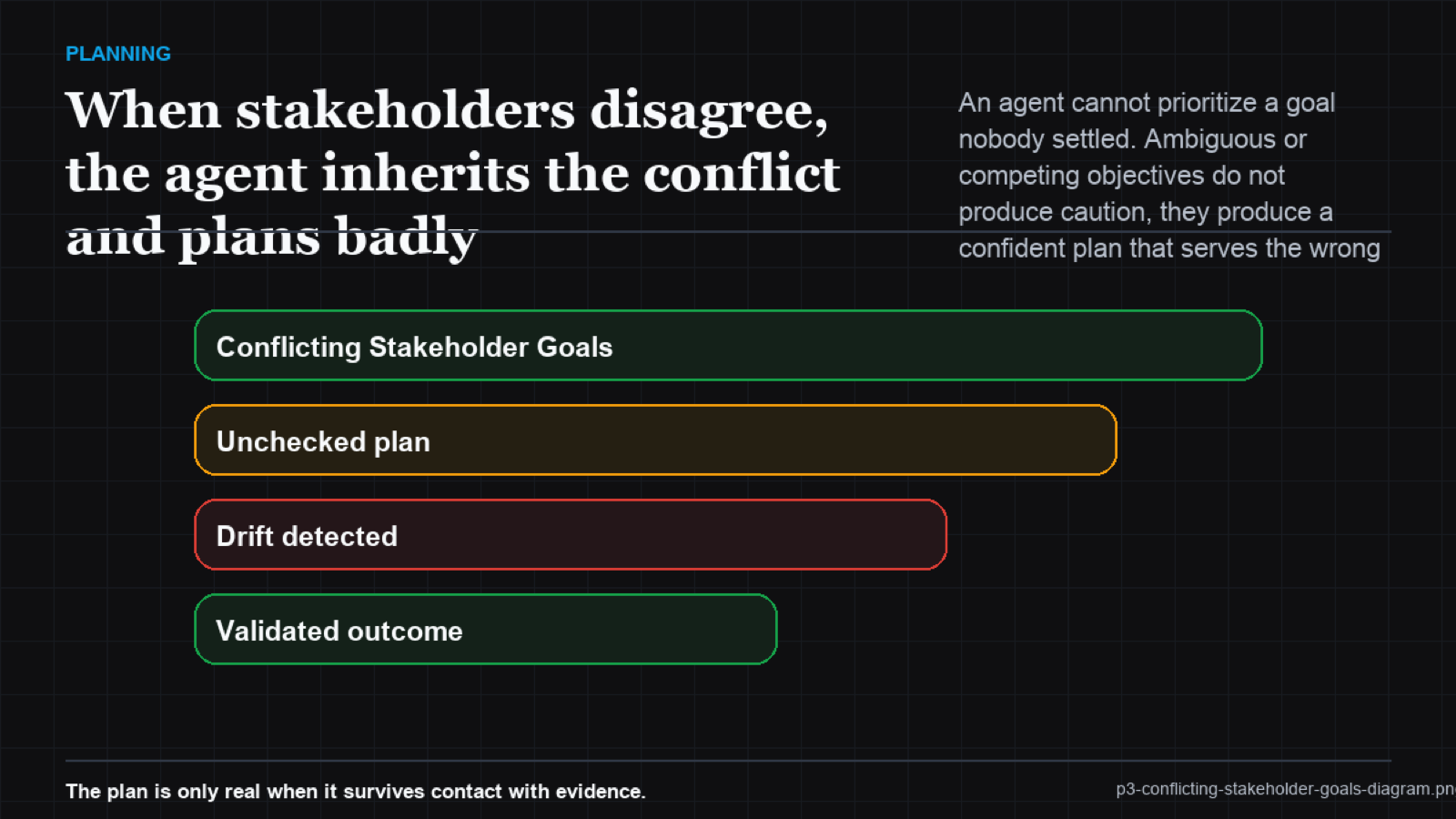
Because nothing in its training rewards hesitation over conflict the way a good employee's instincts do. A person handed "cut cost and improve quality and ship faster" knows those pull against each other and goes back for priorities. An agent reads it as a single objective and finds the path of least resistance, usually the goal with the clearest signal. Cost is measurable, so it cuts cost and the quality you cared about quietly erodes. The plan looks fine. It optimized something. It just optimized the thing you could measure instead of the thing you meant.
The conflict was never the agent's to resolve. It belongs to the people who set the goals and when they leave it unresolved, they have handed the agent a decision it will make badly and confidently on their behalf.
What resolves it?
Make the priorities explicit before the agent plans. Give it ranked objectives or weights or hard constraints that bound the tradeoffs, so the conflict is settled by the people who own it. Where goals genuinely cannot be ranked in advance, build the agent to surface the conflict and ask, rather than to guess. The fix is upstream of the model. An agent cannot prioritize what the organization never prioritized.
| Goal input | Agent behavior | Result |
|---|---|---|
| Competing goals, no weights | Optimizes the easiest to measure | Serves the wrong objective confidently |
| Ranked goals or constraints | Follows the agreed priority | Plans toward what the business meant |
tau2-bench shows an agent handed conflicting goals optimizes one hard; a more capable model commits more decisively to its guess, worse. (arXiv:2506.07982)
This is where the Pattern Intelligence Layer earns its place. VibeModel models the patterns of a well-specified objective, the priorities, constraints and tradeoffs a reliable plan needs, so the agent acts on goals that were actually resolved rather than ones it had to invent.
Frequently asked questions
Can the agent detect goal conflict on its own?
Sometimes, if you build it to. Left to default behavior it will not pause, it will pick. Detection has to be designed in.
Is this a prompt problem?
Partly. A prompt with ranked priorities helps, but the real fix is organizational: someone has to decide what wins before the agent runs.
What about goals that change mid-task?
That is the dual-control case tau2-bench studies. Moving goals need explicit re-checks, not a one-time spec.