


Key facts.
- Tran and Kiela show single agents match or beat multi-agent systems on multi-hop reasoning under equal budgets, with the Data Processing Inequality explaining why handoffs lose information. source
- Multi-agent becomes competitive mainly in degraded contexts where no single agent can hold coherence, which is a narrow regime, not a default. source
- Tool-heavy single agents fail differently again, on tool selection and the seams between planning and execution. source
How do the architectures fail differently?
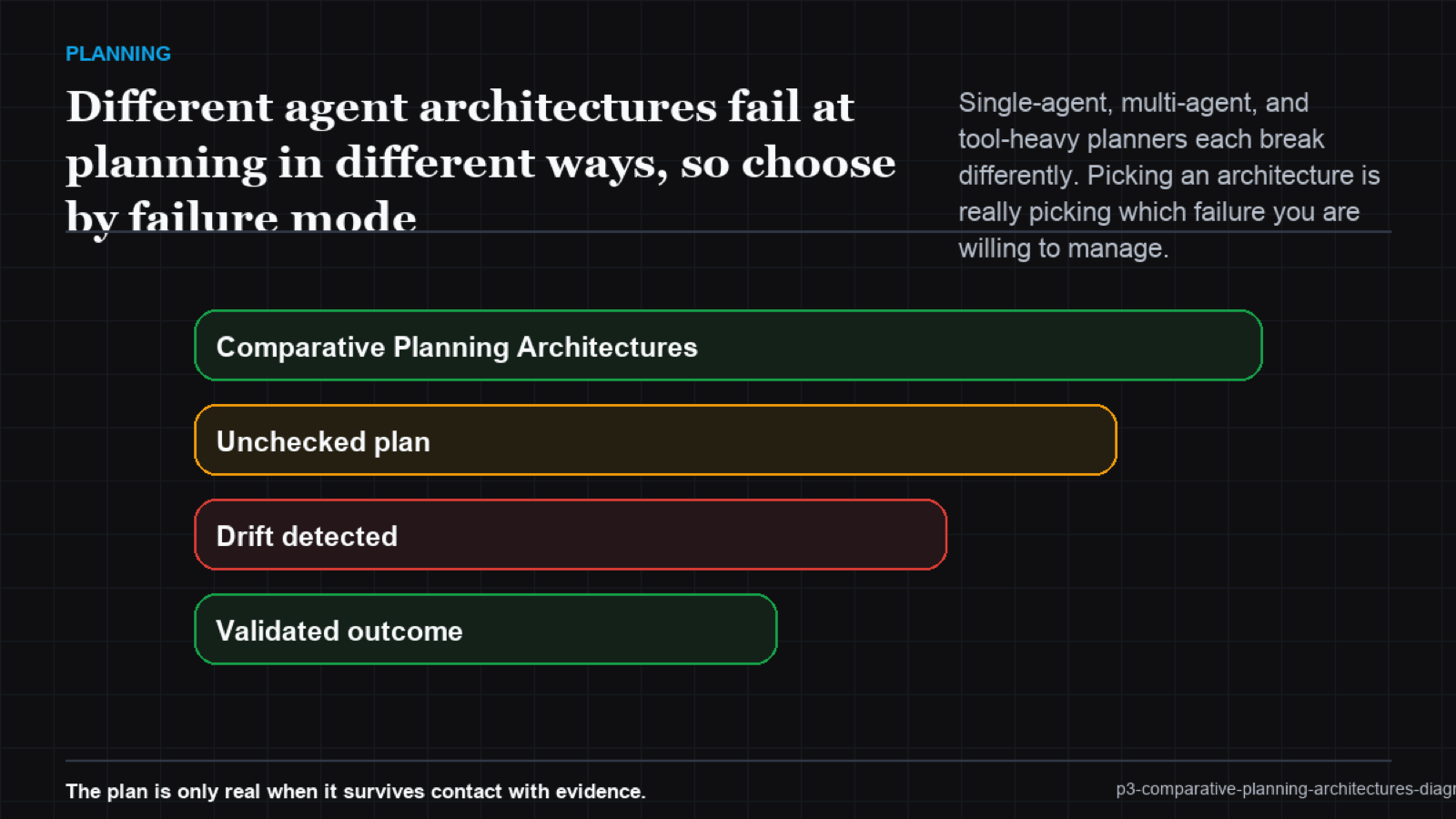
A single-agent planner fails by losing coherence over a long or complex task, because one context is carrying everything and that context degrades. A multi-agent planner fails at the handoffs, where information passes between agents and, per the Data Processing Inequality, can only be preserved or lost, never improved, so each boundary is a chance for the plan to drift between participants. A tool-heavy planner fails at tool selection and the seams between deciding and doing. None of these is strictly better. They are different bets. Tran and Kiela's result matters because it punctures the common assumption that more agents means more capability: under a fair budget, the handoff losses often outweigh the parallelism gains on reasoning tasks, so the multi-agent failure mode costs you without buying the reliability you expected.
This reframes architecture choice. You are not picking the most powerful design, you are picking the failure mode your task and your team can best detect and contain. A task with clean parallelism and good handoff discipline can afford the multi-agent failure mode. A reasoning-heavy task usually cannot and a single agent's coherence failure is easier to manage there.
So how should you choose?
Start from the task and the failure you can contain. If the work is reasoning-heavy and hard to parallelize cleanly, a single agent's coherence failure is the one to manage and the budget evidence favors it. If the work genuinely splits into independent parts with disciplined handoffs, multi-agent earns its coordination failure mode. If it is tool-intensive, plan for tool-selection and seam failures. The mistake is choosing by sophistication, which picks a failure mode by accident rather than on purpose.
| Architecture | Characteristic failure | Best when |
|---|---|---|
| Single agent | Coherence loss over long tasks | Reasoning-heavy, hard to parallelize |
| Multi-agent | Information loss at handoffs | Cleanly parallel with disciplined handoffs |
| Tool-heavy | Tool selection and seam errors | Tool-intensive workflows |
At equal budget one agent matches multi-agent; a stronger model will not change which failure mode or cost, you traded. (arXiv:2604.02460)
Matching architecture to failure mode is part of what VibeModel does as the Pattern Intelligence Layer. We model the failure patterns each design carries, so you choose the architecture whose failure you can contain rather than the one that sounds most advanced.
Frequently asked questions
Is multi-agent ever the right call?
Yes, for genuinely parallel work with disciplined handoffs or degraded-context cases. Just not as a default for reasoning tasks.
Why does an equal budget matter so much?
Many multi-agent wins came from spending more compute. Equalize the budget and the handoff losses often erase the advantage.
Can I mix architectures?
Yes, by sub-task. Match each part of the workload to the failure mode you can best contain there.