


Key facts.
- MIT NANDA's State of AI in Business 2025 found about 95% of enterprise generative-AI initiatives delivered no measurable P&L return despite an estimated $30-40B of spend, so unmeasured value is the norm, not the exception. source
- The same study attributes the gap to a learning and adoption problem rather than model quality, meaning a stronger model does not by itself produce the return. source
- McKinsey's State of AI 2025 found only about 39% of organizations report any enterprise-level EBIT impact from AI, so bottom-line value is concentrated in a minority. source
Why does timing decide the project's fate?
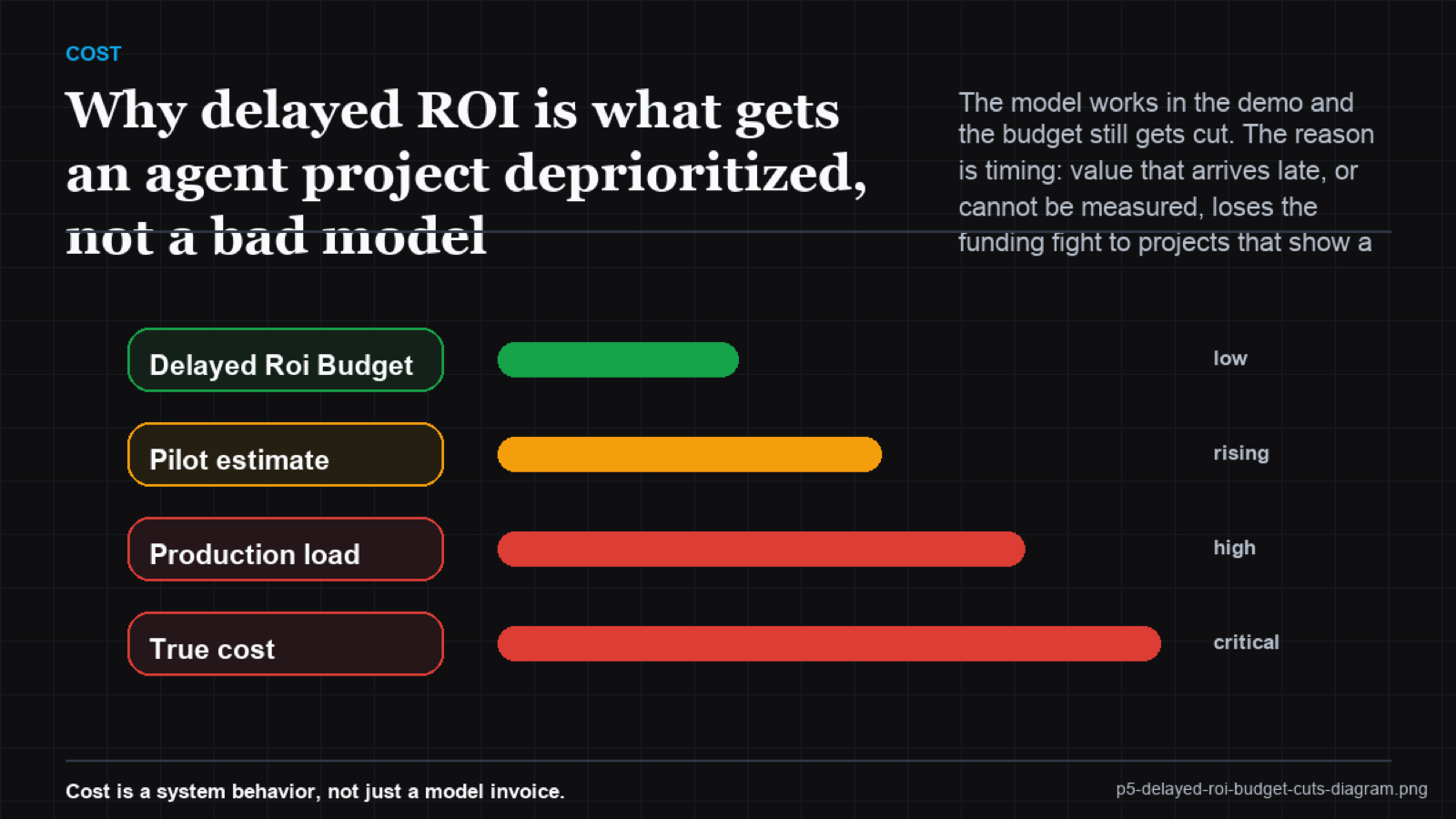
Because budgets are allocated on a cycle and a project that cannot show value within the cycle is competing against ones that can. The agent might be on track to deliver real savings in nine months, but the review happens in three and at that review it has a cost line and no return line. Decision-makers are not judging the model, they are judging the number in front of them and a blank return column reads as a project that has not paid off. The MIT finding is the scale of this: most initiatives reach this point with no measurable P&L impact, so most are exposed to exactly this cut. The value may be coming, but the funding decision does not wait for it.
A more capable model does not change the timing or the measurement. It can improve the work the agent does, but the return still has to land on a metric the business tracks and it still has to land before the review. The MIT study is explicit that the gap is about adoption and measurement, not capability, which is why teams that upgrade the model and skip the measurement still lose the budget. The fix is to make the value visible and early, not to make the model bigger.
How do you keep the project funded?
Tie the agent to a metric the business already reports, so the return shows up where leadership is already looking. Scope the first phase to a place where value lands fast, even if it is small, because an early measurable win buys the patience for the larger one. Instrument the outcome from day one, so when the review comes you have a number, not a story. And set expectations honestly about when the full return arrives, so the gap between cost and value is planned rather than discovered. The projects that survive the budget cycle are the ones that made their value legible on the business's own terms and on the business's own clock, which is a discipline, not a model upgrade.
| Funding outcome | Project that gets cut | Project that holds |
|---|---|---|
| Return timing | After the review | An early win before it |
| Metric | Novel, hard to read | One the business tracks |
| Measurement | Started late | Instrumented day one |
| Expectation | Vague upside | Planned cost-to-value gap |
The Pattern Intelligence Layer is where the return is made visible early. Outcome metrics and cost per outcome are tracked at the pattern level from the first run, so the value the agent produces is legible at the next review instead of arriving after it. Reliability at the pattern level is what turns a promising pilot into a funded program, by giving the budget cycle the number it decides on.
Frequently asked questions
Is the agent getting cut because the model underperformed?
Usually not. MIT's data shows most initiatives stall with no measurable P&L impact regardless of capability. The cut tends to follow late or unmeasured value, not a bad model.
What is the single highest-impact move?
Tie the agent to a metric the business already reports and instrument it from day one, so the return is visible at the review rather than a quarter too late.
Does a stronger model speed up ROI?
Not on its own. The MIT study ties the gap to adoption and measurement, so without an early, legible metric the return still misses the funding window.