


Key facts.
- McKinsey's State of AI in 2025 reports 51% of organizations have hit an AI-related incident and that the teams managing risk well rely on human-in-the-loop rules and centralized oversight, evidence that bounded autonomy is how real deployments stay controllable.source
- WebArena found the best agent completing only 14.4% of real web tasks against 78.2% for humans, so a meaningful share of production runs hit the retry-and-recover path that drives spend, which is exactly what live monitoring is meant to catch.source
- On SWE-bench Pro, a benchmark of long-horizon software tasks, the strongest frontier models resolve only about 23%, so multi-step runs hit failure and retry often, which is the worst-case spend a threshold and an automatic throttle exist to bound.source
What does a live cost control loop look like?
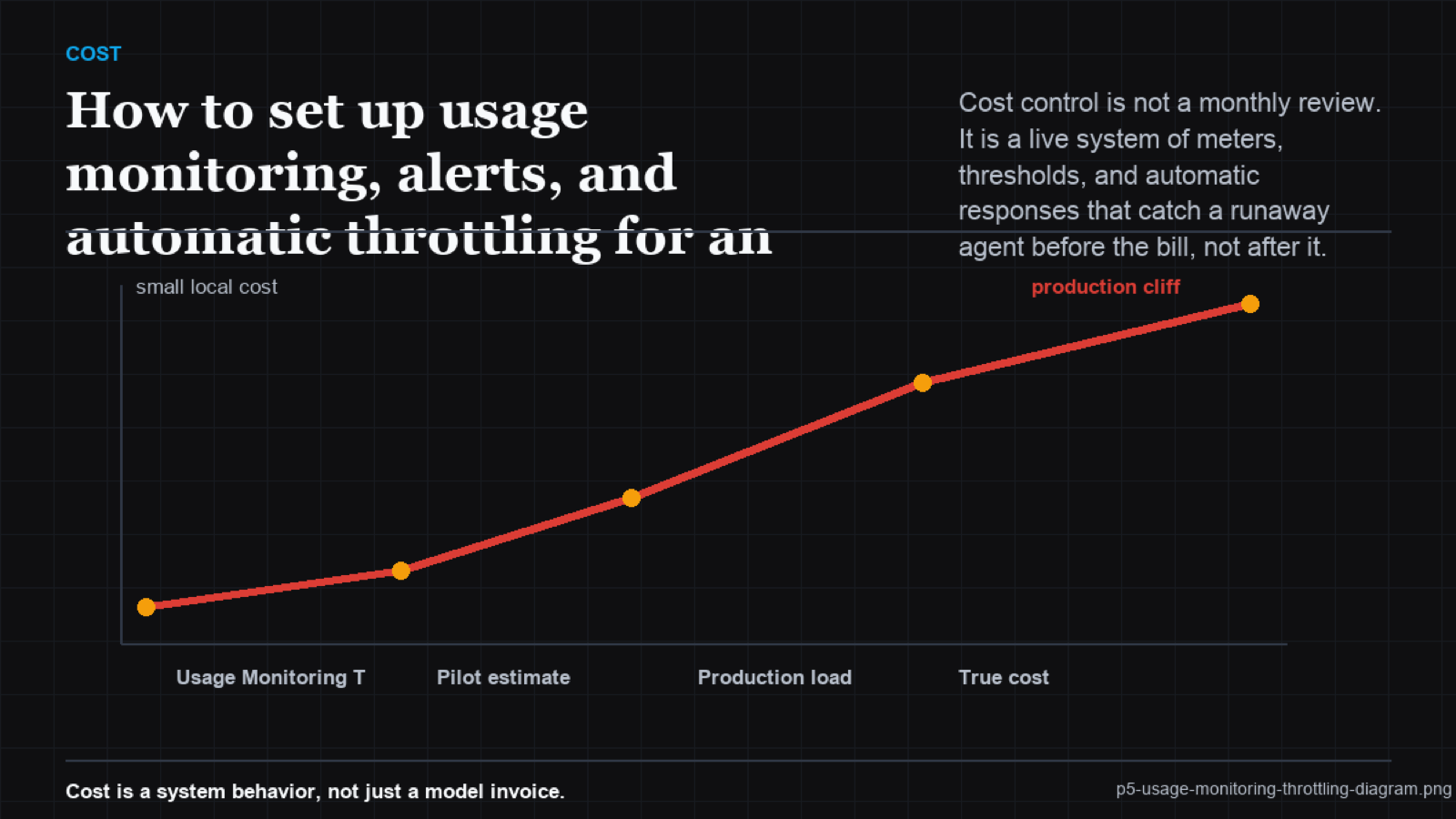
Three layers. Meters that track spend per task, per agent, and per time window in real time, so you can see consumption as it happens rather than reconstruct it later. Alert thresholds set on those meters, so a task that crosses its expected cost, or an agent whose hourly spend spikes, triggers a notification immediately. And an automatic response when a hard threshold is hit: throttle the agent's request rate, downgrade it to a cheaper model, or halt and escalate the specific run. The first two give you visibility. The third gives you a bound that doesn't depend on a human noticing in time, which matters because the expensive runs, as the WebArena and SWE-bench Pro completion rates show, can spike fast.
The automatic response is the part teams skip and regret. An alert without an automatic action just means a human finds out faster that money was already spent. The throttle or downgrade is what actually stops the spend, and tying it to a threshold means it works at 3am when no one is watching. The same bounded-autonomy instinct that keeps production agents to ten steps applies to cost: don't let a single run consume without a ceiling and an automatic brake.
What should trigger a downgrade versus a halt?
Match the response to the breach. A soft threshold, where a task is running costlier than expected but still progressing, is a good trigger for a model downgrade or a request-rate throttle, because the work can continue more cheaply. A hard threshold, where a run has blown past any reasonable cost for its value, is a trigger for a clean halt and escalation, because continuing is throwing good money after bad. The point is that both responses are automatic and tiered, so routine overruns get cheaper handling and pathological ones get stopped, without a human in the critical path of either.
| Signal | Threshold | Automatic response |
|---|---|---|
| Task costlier than expected | Soft | Throttle or downgrade model |
| Agent hourly spend spike | Soft | Rate-limit the agent |
| Run past max viable cost | Hard | Halt and escalate |
A monthly invoice is a postmortem, not a control; live meters bound the damage in minutes. The runs go bad even for a frontier model: on WebArena the best GPT-4 agent finished 14.4% to humans' 78.2%. (arXiv:2307.13854)
The Pattern Intelligence Layer is where metering, thresholds, and automatic responses become properties of every run rather than a dashboard someone built once. The meters, the alert levels, and the throttle-downgrade-halt behavior are enforced at the pattern level, so cost control operates continuously across models and agents. Reliability at the pattern level includes the reliability of a spend bound that acts on its own, before the invoice.
Frequently asked questions
Is an alert enough to control cost?
No. An alert tells you money was spent. The automatic throttle, downgrade, or halt is what stops the spend, especially when no one is watching.
Why monitor per task, not just per month?
Because a single runaway run can spike fast. WebArena shows failure is common and the Anthropic 15x multiplier shows the worst case is far above average, so you need the run-level signal.
Downgrade or halt?
Downgrade or throttle on a soft overrun where work can continue cheaper; halt and escalate on a hard breach where continuing wastes money.