


Key facts.
- The FinOps Foundation's State of FinOps 2026 reports 98% of practices now manage AI spend, up from 63% in 2025 and 31% in 2024, a sharp rise that shows AI cost is a moving, growing concern not a settled one.source
- The FinOps framework uses a "Crawl, Walk, Run" maturity model, treating cost optimization as a progressive, ongoing capability not a one-time project.source
- The IMF's 2026 Note on agentic AI notes that agents are probabilistic and can produce different outcomes from identical inputs, which means the cost of a given task is not fixed and has to be monitored over time.source
Why does a one-time optimization drift back up?
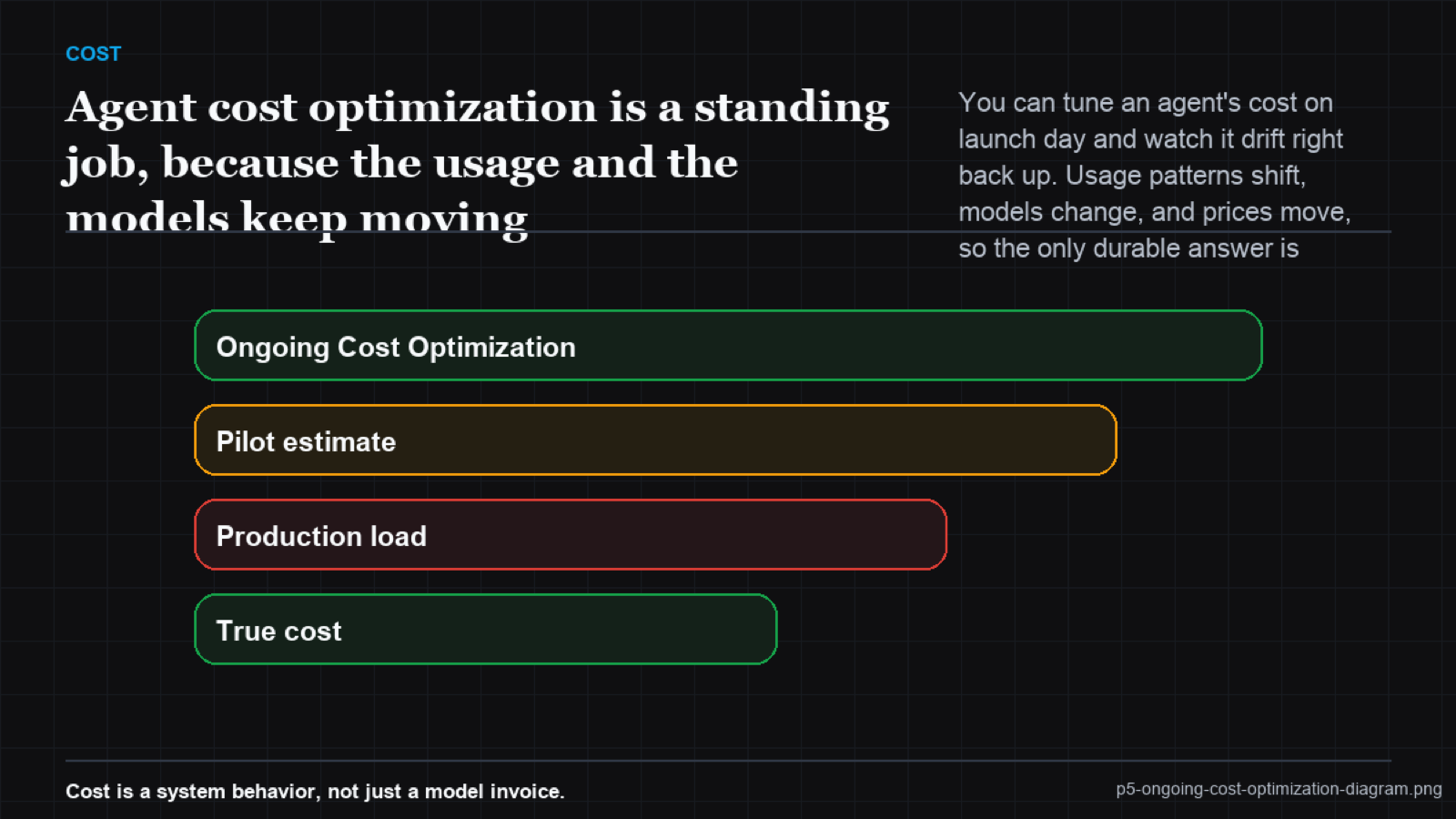
Because three inputs to cost keep moving after you tune it. Usage shifts: real users send longer inputs, hit edge cases and use the agent in ways the launch-day traffic did not, so the average cost per task drifts as the traffic mix changes. Models change: providers deprecate the model you optimized for, release new ones at different prices and capabilities and the routing and prompts you tuned for the old model are no longer optimal for the new one. And the agent's own behavior varies, because it is probabilistic, so the same input can cost differently on different runs. Each of these moves the cost after your one-time pass and together they pull it back up unless something is watching and re-tuning.
This is why the FinOps trajectory matters. AI spend management going from a third of teams to nearly all of them in two years is not a sign that the problem got solved. It is a sign that the cost kept moving and more teams had to stand up a standing capability to keep up. The "Crawl, Walk, Run" framing is the same admission: you do not finish cost optimization, you mature it, because the thing you are optimizing does not hold still.
What does continuous optimization actually require?
A standing loop, not a launch checklist. Monitor cost per outcome over time, so drift shows up as a trend before it shows up as a budget overrun. Re-evaluate model routing when providers change their lineup, so a deprecated or repriced model does not silently raise your bill. Watch the traffic mix, so a shift toward longer or harder inputs triggers a re-tune of context strategy and caps. And treat the optimization itself as owned work with a cadence, the "Run" end of the maturity model, rather than a thing someone did once at launch. The cost stays low not because you optimized it, but because you keep optimizing it as the ground moves.
| What changes | Effect on cost | Continuous response |
|---|---|---|
| Usage / traffic mix | Drifts as inputs get longer/harder | Re-tune context strategy and caps |
| Model lineup | Deprecation, new prices | Re-evaluate routing and prompts |
| Probabilistic behavior | Same input, different cost | Monitor cost-per-outcome trend |
| Maturity | One-time pass decays | Owned cadence (Crawl/Walk/Run) |
The Pattern Intelligence Layer is where continuous optimization runs as a capability, not a chore. Cost per outcome, traffic mix and routing efficiency are tracked at the pattern level over time, so drift is caught as a trend and the re-tune happens before the bill climbs. Reliability at the pattern level is what keeps the cost where you set it, by treating optimization as the standing job it is rather than the one-time pass it is often mistaken for.
Frequently asked questions
Does the next model make cost tuning a one-time task?
Usage shifts, models get deprecated, outputs vary, so a one-time tune-up never holds; a more capable model only resets what you re-optimize against. (source)
Can't I just optimize the agent's cost once?
The tune will drift back up. Usage shifts, models change and the agent's probabilistic behavior varies, so the cost you set does not hold without ongoing monitoring and re-tuning.
Why did AI spend management spread so fast?
FinOps data shows it went from 31% to 63% to 98% of teams in two years. That is the cost staying in motion and more teams needing a standing capability to manage it.
Does upgrading the model end the optimization work?
No. A new model changes the price and behavior you optimize against. It is a reason to re-tune routing and prompts, not a reason the job is finished.