


Key facts.
- McKinsey's State of AI 2025 found only ~39% of organizations report enterprise-level EBIT impact from AI, and ~6% are "AI high performers" attributing more than 5% of EBIT to AI, so bottom-line value is concentrated and rare. source
- The same report ties the difference to approach and workflow redesign rather than model quality, meaning a more capable model does not convert autonomy into savings on its own. source
- Operational cost also includes the downside an autonomous agent can trigger: IBM's Cost of a Data Breach 2025 puts the average breach at USD 4.44 million globally and USD 10.22 million in the US, the kind of exposure that runs alongside the inference and oversight bills. source
Why doesn't autonomy translate into savings?
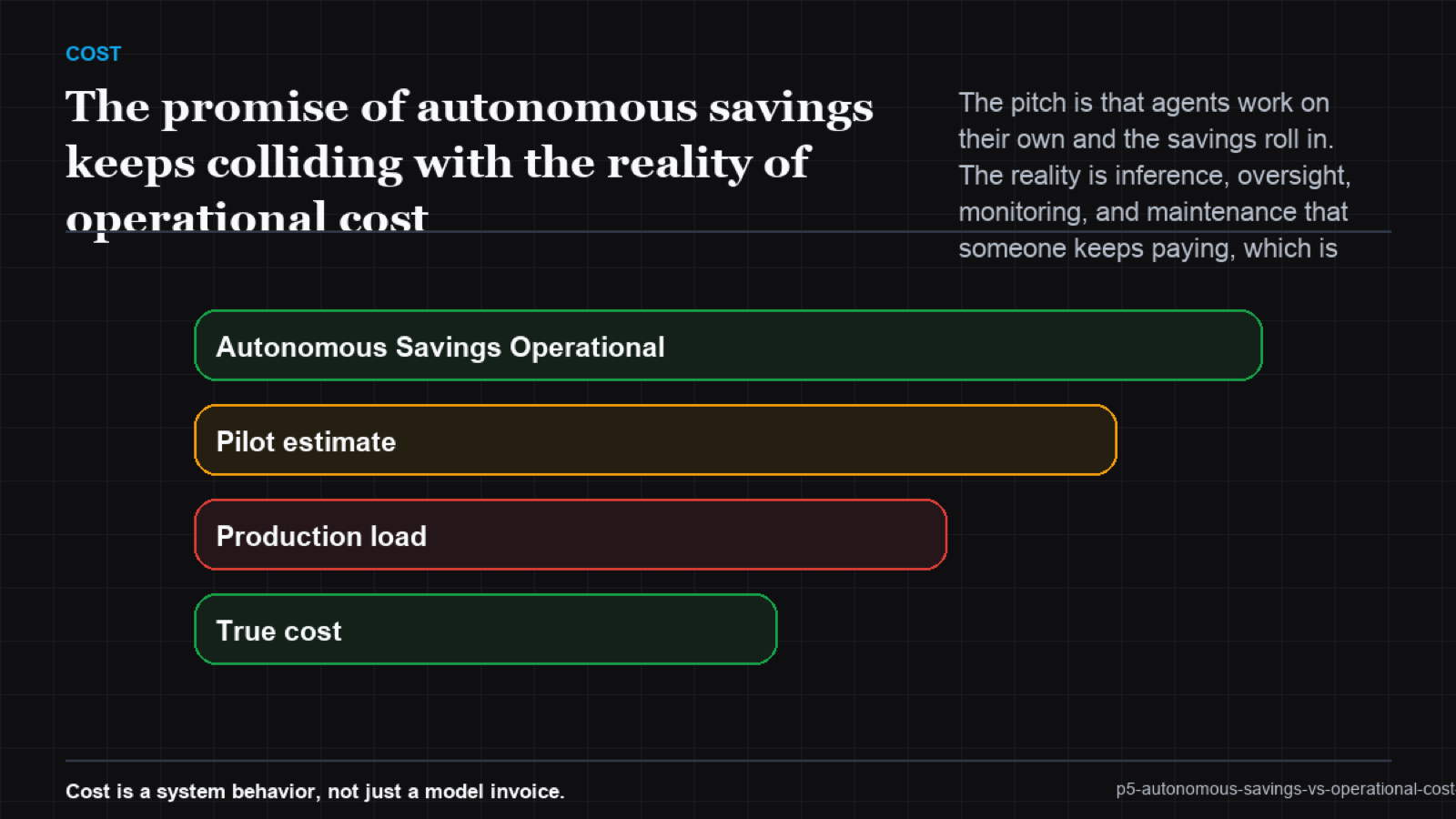
Because "autonomous" describes how the agent runs, not what it costs to keep running. The inference bill accrues on every call. The oversight cost accrues because, as production data shows, teams still rely on human evaluation to catch the agent's mistakes. Monitoring and observability are infrastructure that has to be built and maintained. And the agent itself needs maintenance as tools, models and the surrounding systems change. None of these stop because the agent is autonomous. They are the operating cost of autonomy and they run continuously underneath the saving the agent was supposed to deliver. When you net the operating cost against the gross saving, the result is often the McKinsey reality: most organizations cannot point to a bottom-line impact.
The reason a better model does not fix this is that the operating cost is mostly not about the model. Oversight exists because the agent is probabilistic, which a stronger model reduces but does not remove. Monitoring and maintenance are properties of running any production system. So upgrading the model trims one input and leaves the rest, while the gap McKinsey measured stays where it is, in approach and operation rather than capability.
How do the few that capture savings do it?
They treat the operating cost as part of the case from the start, not a surprise that erodes it later. They scope the agent narrowly so the oversight cost is small, because a reliable narrow agent needs spot checks rather than per-item review. They build the monitoring and maintenance into the budget rather than discovering them. And they redesign the workflow around the agent, which is the move McKinsey found correlates most with actual EBIT impact, so the saving is structural rather than a thin margin the operating cost can swallow. The autonomous agent that pays is the one whose full operating cost was subtracted before anyone called it a saving.
| Cost of autonomy | Assumed in the pitch | Reality |
|---|---|---|
| Inference | Cheap | Accrues per call, scales with volume |
| Oversight | Removed by autonomy | Still needed, agents stay probabilistic |
| Monitoring | Free | Infrastructure to build and run |
| Maintenance | One-time | Ongoing as systems change |
Inference, oversight and monitoring run whether or not the agent is autonomous; a stronger model does not close that gap, approach does. (source)
The Pattern Intelligence Layer is where the operating cost of autonomy is visible next to the saving. Inference, oversight load and maintenance are tracked at the pattern level, so the net saving, not the gross pitch, is the number you manage. Reliability at the pattern level is what lets an autonomous agent actually reach the bottom line, by making sure its operating cost was counted before its saving was claimed.
Frequently asked questions
If the agent is autonomous, why is there still a cost?
Autonomy describes how it runs, not what running it costs. Inference, oversight, monitoring and maintenance accrue continuously and they are what net the gross saving down, often to little or nothing.
Why do so few organizations see bottom-line impact?
McKinsey found only ~39% report any enterprise EBIT impact and ~6% are high performers. The operating cost of autonomy eats the saving unless it was scoped and budgeted from the start.
Will a more capable model deliver the savings?
Not on its own. McKinsey ties impact to approach, not model quality. A better model trims inference but leaves oversight, monitoring and maintenance, which is where most of the operating cost lives.