

Cheaper frontier tokens do not protect you: one mishandled error can loop an agent into a five-figure bill before anyone notices. A market-research pipeline of four agents ran an unintended loop for 11 days and billed $47,000, and retry loops have been reported to burn many times the tokens of a clean run (TechCrunch, 2026, reported).

Key facts.
- The hidden cost is human, not model: in production deployments the ratio of human oversight cost to token cost has been put between 20:1 and 200:1, because knowledge-worker time dwarfs cheap inference (Sondera, 2026, reported).
- Naive retries compound spend: the standard retry assumes transient faults, so pointing it at a semantic failure re-runs paid model work, and an unbounded loop multiplies a cheap run's cost before a guard stops it (Pebblous, 2026, reported).
- The cost curve runs the wrong way: agents can multiply token demand sharply as they retry and reload context, so per-call cheapness is swamped by volume (Goldman Sachs via Tom's Hardware, 2026, reported).
- Quiet one misread error and the class remains; a better model still floods tickets and re-runs paid work. (TechCrunch, 2026)
Why does poor error handling raise human cost?
Because an error the agent cannot classify becomes an error a person has to resolve. When a tool wrapper treats any non-exception as success and has no notion of transient versus permanent versus business-rule failure, every real failure either propagates as bad state or stops the run, and both routes end at a human. The agent that was supposed to remove work now generates it: each mishandled error is a ticket, a triage, a manual fix. And because agents are inconsistent across runs, those failures are not rare. The per-call model price is trivial next to the standing cost of people babysitting the failures it cannot handle, a human-to-token cost ratio reported as high as 200:1 (Sondera, reported).
Where does the spend and the trust go?
Into retries and into confidence. The standard retry, backoff with jitter, is built for transient faults, so pointing it at a semantic failure re-runs the same paid model work for nothing, and an unbounded loop can spiral into a retry storm that multiplies a cheap run's cost many times over (Pebblous, reported). The deeper cost is trust, which does not erode linearly. Months of quiet competence can be undone by one visible, high-impact failure, after which the conversation becomes whether to trust agents at all, not what the average success rate was. Poor error handling makes those visible failures more likely, and trust is the budget that funds the whole initiative.
How do you stop the cost from compounding?
Handle errors as first-class, typed outcomes. Classify every tool error, transient, auth, rate-limit, business-rule, and apply backoff only to the transient ones, while routing semantic and permanent failures to a re-plan or a clean escalation instead of a blind retry. Validate outcomes before accepting success, so bad state does not propagate into downstream work and tickets. Gate handoffs on confidence with clear ownership, so a human is brought in early and with full context rather than after the damage. Trace every tool call and error so failures are diagnosable in minutes, not days. Each of these converts an open-ended human-and-retry cost into a bounded, designed one, which is what makes an agent actually cheaper than the work it replaces.
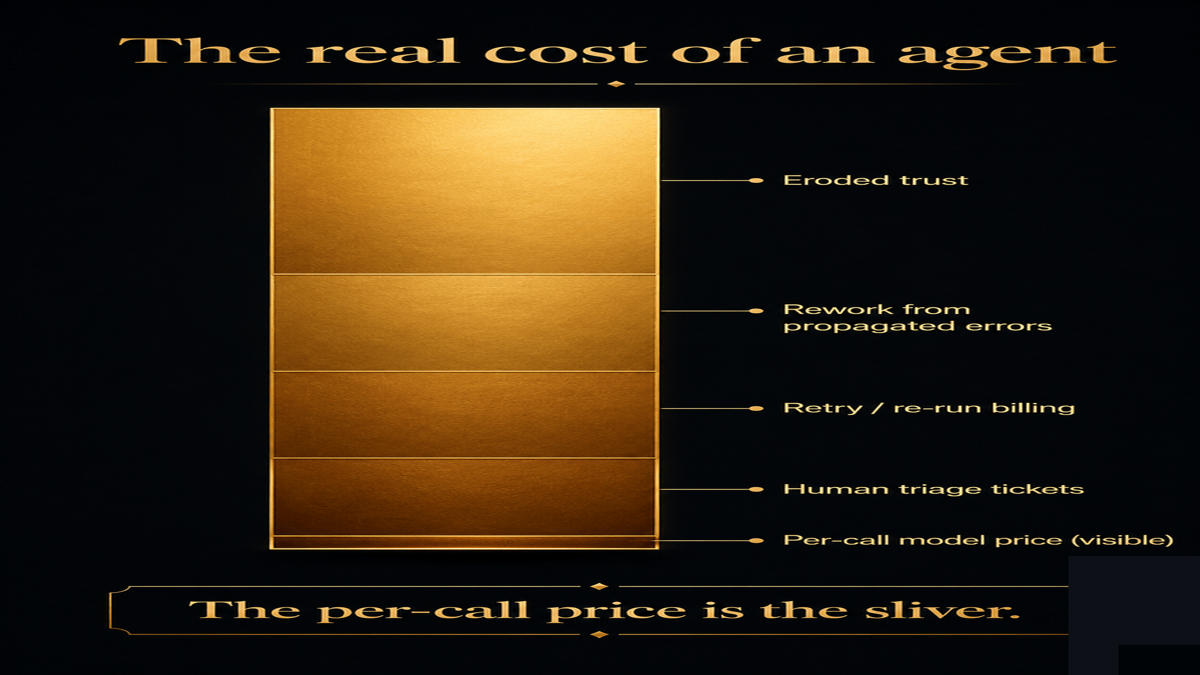
The hidden cost and the control
| Cost | Caused by | Control |
|---|---|---|
| Human intervention | Unclassified errors become tickets | Typed error classification + clean escalation |
| Retry spend | Backoff applied to semantic failures | Retry only transient; re-plan the rest |
| Rework | Bad state propagates downstream | Outcome validation before success |
| Trust collapse | Visible, high-impact failure | Gates + verification on risky actions |
| Slow diagnosis | No trace of tool calls/errors | Full trajectory tracing |
The pattern is that the cost of an agent is not the per-call model price, it is the human triage, the retry spend, the rework, and the trust it burns when errors are handled poorly. Classify errors, validate outcomes, escalate on confidence, and trace everything, and those open-ended costs become bounded and the agent is genuinely cheaper than the work it replaces. Designing error handling as a first-class part of the system, rather than an afterthought, is reliability at the pattern level, which is what VibeModel builds as the Pattern Intelligence Layer.
Frequently asked questions
Isn't the model the main cost of an agent?
Rarely. The per-call price is small next to the standing cost of humans triaging mishandled errors, the retry spend on semantic failures, and the rework from propagated bad state. Error handling is where the budget is won or lost.
Why does one failure hurt so much?
Because trust does not erode linearly. A single visible, high-impact failure can stop an initiative regardless of average performance, so reducing catastrophic failures matters more than nudging the mean.
What is the cheapest cost-saving change?
Typed error classification so transient faults get backoff and semantic ones get a re-plan or escalation. It stops both the retry spend and the flood of tickets that unclassified errors create.