


Key facts.
- The "Expensively Quadratic" analysis of the LLM agent cost curve shows agent loops grow cost roughly quadratically because each turn re-sends the full history, so a ten-turn session lands near 50x a single call rather than 10x, with cache reads dominating long conversations. source
- "The Illusion of Diminishing Returns" found per-step execution accuracy degrades as steps increase, partly through a self-conditioning effect where prior errors in context make further errors more likely, so success after t steps falls roughly as p to the power t. source
- Together these mean the longest, most retry-heavy runs are both the most expensive and the most error-prone, which is the mechanism of the spiral. source
How does the spiral actually start?
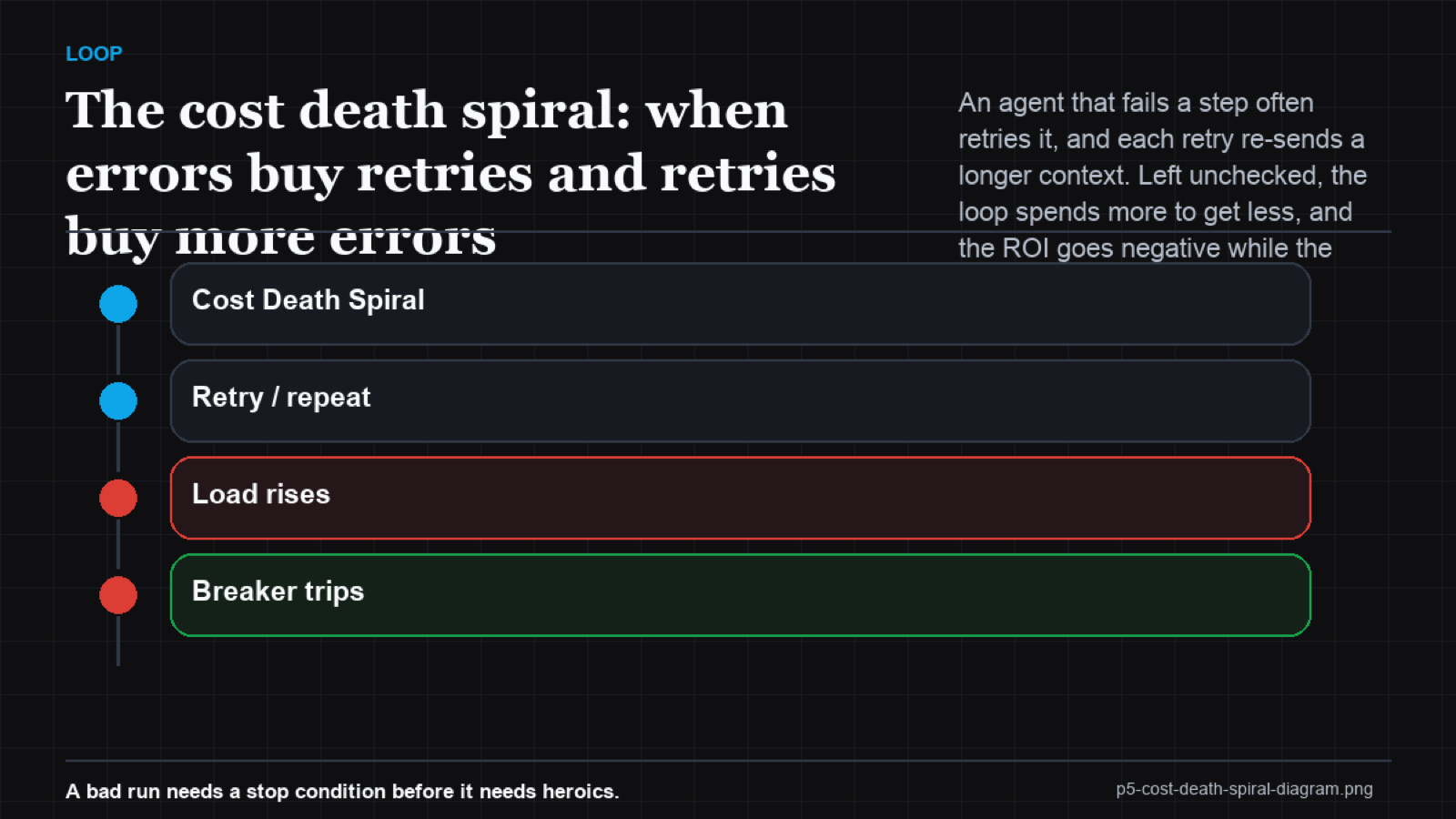
It starts with a single unhandled failure. A tool returns an error, or a step produces a wrong result, and the agent decides to try again. That retry re-sends the conversation so far, which is now longer, so it costs more. The longer context is also harder to reason over, and the self-conditioning effect means the earlier error sitting in the context nudges the model toward another. So the retry is both more expensive and more likely to fail than the original attempt. When it fails, the agent retries again, with an even longer context, and the loop has begun. Each turn around the loop spends more and succeeds less, which is the definition of a spiral.
The reason a stronger model does not save you is that neither driver is about raw capability. The cost driver is the quadratic accumulation of re-sent history, which is the same for any model. The error driver is per-step degradation over long runs, which holds across model sizes. A more capable model might start the spiral less often, but once it is in one, it pays the same accumulation tax and faces the same long-horizon decay. The fix is not a better model. It is a circuit breaker.
What stops a cost death spiral?
A hard limit and a reset. The hard limit is a per-task budget cap and a retry ceiling, so the loop cannot run unbounded no matter what the agent decides. The reset is context management: instead of re-sending an ever-growing transcript, summarize the state and start the retry from a compact context, which breaks both the cost accumulation and the self-conditioning that the old errors were feeding. With those two controls, a failure becomes a bounded, cheap event that either recovers quickly or escalates to a human, rather than an open-ended loop that drains the budget while the dashboard reports the agent as busy.
| Without controls | With circuit breaker |
|---|---|
| Retries unbounded | Retry ceiling enforced |
| Context grows every retry | Context reset to compact state |
| Cost accumulates quadratically | Cost capped per task |
| Errors self-condition more errors | Old errors cleared on reset |
The Pattern Intelligence Layer is where the spiral is caught as a pattern, not after the invoice. Retry rate, context growth, and cost per task are tracked at the pattern level, so a run that starts to loop is flagged and capped before it drains the budget. Reliability at the pattern level means a failed step is a bounded cost with a known exit, which is what keeps one bad attempt from turning into a death spiral.
Frequently asked questions
Why don't retries just fix the problem?
Because each retry re-sends a longer context, costing more, and the earlier error in that context makes another error more likely. The retry is both pricier and less reliable than the first attempt.
Will a better model avoid the spiral?
It may start one less often, but once in it, the same quadratic cost accumulation and long-horizon accuracy decay apply. The fix is a budget cap and context reset, not a bigger model.
How do I cap it without losing recovery?
Set a retry ceiling and per-task budget, and reset context to a compact summary on retry. A failure then recovers cheaply or escalates, instead of looping unbounded.