


Key facts.
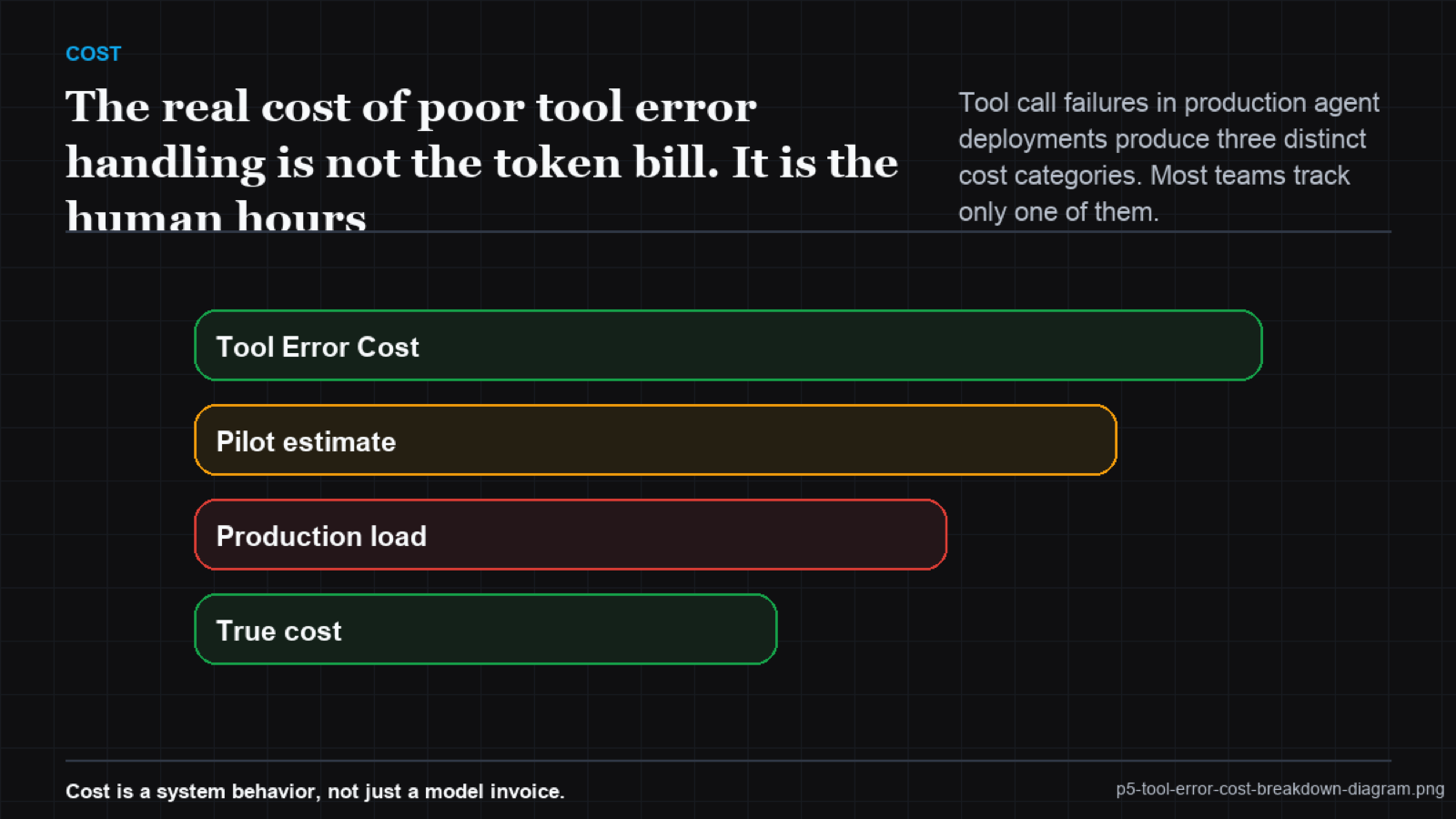
- Measuring Agents in Production (arXiv:2512.04123) documented that production agent deployments incur costs across direct token consumption, human intervention requirements, and business outcome errors - with human intervention often being the largest cost category (Measuring Agents in Production, arXiv:2512.04123).
- IMF Note 2026/004 on agentic payments identified regulatory remediation costs from incorrect agentic financial actions as a significant risk, noting that these costs can include fines, reconciliation overhead, and customer compensation that exceed the original transaction value.
- DORA 2024 research found that production incidents in software systems typically cost 4-10x more to remediate than to prevent - a ratio that applies directly to agent tool errors, where the cost of an unhandled failure is consistently higher than the cost of the error handling code.
- Human escalation costs from agent tool failures typically include: operator time to diagnose the failure, time to remediate the incorrect action, time to notify affected customers, and quality assurance time to verify the remediation - each individually trackable but often not attributed to tool error handling gaps.
- Customer trust costs from agent tool errors - particularly in customer service contexts where the agent's failure is directly visible to the affected customer - are among the hardest to quantify and among the highest in long-term business impact.
- Production data splits the bill into tokens, human hours, and bad outcomes; a more capable model trims tokens, the human hours stay. (arXiv:2512.04123)
The three cost categories and why teams track only one
Direct LLM costs (token consumption, API calls) are easy to track because they appear in the API bill. Human intervention costs are harder to track because they appear in support ticket resolution time, operator hours, and incident response logs - all in different systems, none automatically attributed to the upstream tool error that caused them. Business outcome costs are hardest to track because they require correlating agent actions with customer outcomes across a time horizon that extends beyond the agent session - sometimes days, sometimes weeks.
The result is a systematic underestimation of tool error costs that leads to systematic underinvestment in tool error handling. The engineering team sees a $200 overage in the LLM bill from retry spirals and fixes the retry logic. They do not see the 40 support tickets, 8 hours of operator time, and 3 customer churn events that the same retry spirals - and the underlying unhandled errors that caused them - produced over the same period.
Building a complete tool error cost model
A complete cost model for tool error handling requires three tracking components. First, instrument your LLM API calls to tag retry calls with the underlying failure type and root cause. Second, integrate your support ticketing system with your agent session logs so support tickets can be attributed to the agent sessions and tool calls that preceded them. Third, set up customer outcome sampling that follows a cohort of agent-served customers over 30 days to detect churn, return contacts, and satisfaction patterns that correlate with specific session types. Together, these give you the denominator that makes tool error handling investment justifiable to any business stakeholder.
Tool error cost by category and tracking method
| Cost category | Example cost item | Tracking method | Typical magnitude |
|---|---|---|---|
| Direct LLM | Token cost of retry spirals | API call tagging | 1x (baseline) |
| Human intervention | Operator hours per escalated failure | Ticket attribution | 3-8x LLM cost |
| Business outcome | Customer churn from bad agent action | Cohort outcome sampling | 10-50x LLM cost |
| Regulatory | Fine or remediation for incorrect financial action | Incident tracking, legal | Highly variable, up to 100x+ |
VibeModel's Pattern Intelligence Layer surfaces the tool call patterns that are highest-cost in your specific deployment - not by token consumption but by the human intervention and business outcome costs they have historically triggered. A tool call sequence that costs $0.05 in tokens but generates an average of $180 in human remediation time is a different risk profile than a sequence that costs $2 in tokens and generates zero escalations. The pattern layer makes that distinction visible so that tool reliability investment can be directed where it produces the highest return.
Frequently asked questions
How do we convince finance to approve budget for tool error handling improvements when the cost savings are spread across multiple systems?
Build the attribution chain explicitly: take your most frequent escalated agent failure type, trace it to the underlying tool error, calculate the loaded cost of all escalations in a quarter, and compare that to the engineering cost of preventing the error class. The ratio is typically 10:1 or higher in favor of prevention.
Are there industry benchmarks for agent tool error cost ratios?
Not yet standardized, but DORA's 4-10x remediation versus prevention ratio in traditional software provides a reasonable floor estimate for direct comparison. The ratio for agent systems is typically higher because agent errors propagate more broadly and are harder to diagnose than traditional software failures.
How do we handle the attribution problem when a tool error causes a customer problem that surfaces 2 weeks later?
Session ID propagation: the agent session ID should be stored with every record the agent creates or modifies, and with every customer interaction. When a problem surfaces 2 weeks later, the session ID enables you to retrieve the original agent session, the tool calls it made, and the specific failure that produced the downstream problem.