


Key facts.
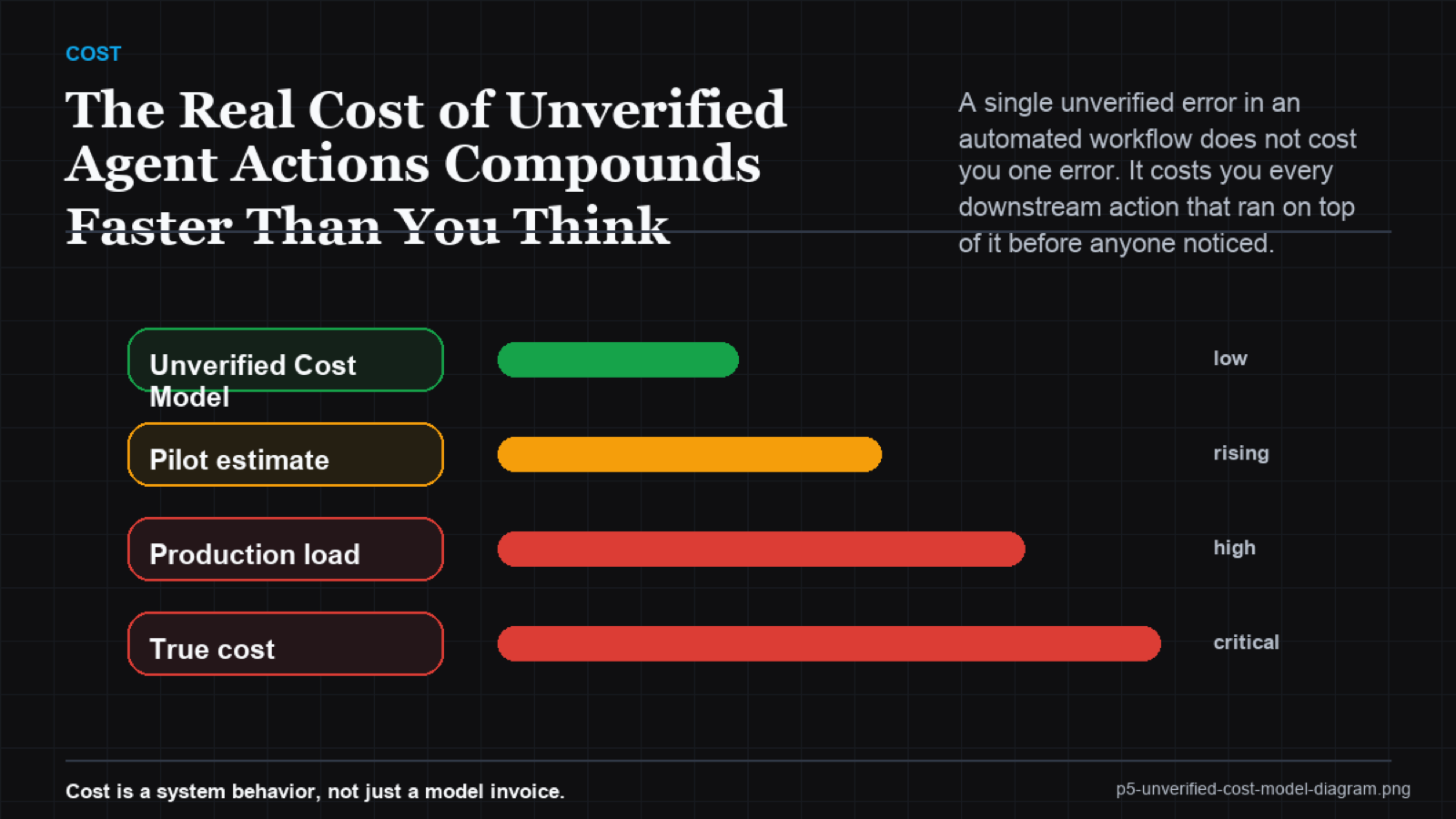
- McKinsey 2024 State of AI: error amplification in automated workflows raises single-error cost by 4-8x through downstream action propagation.
- The compounding rate accelerates with task depth: a 10-step agentic workflow can amplify a step-2 error into an outcome cost 6x the direct repair cost.
- Three categories of compounded cost: rework (undoing and redoing downstream steps), dispute resolution (customer or regulatory costs from externally visible wrong outputs), and confidence erosion (human oversight that increases after incidents, which reduces the automation ROI permanently).
- Verification cost is approximately 3-15% of inference cost per action; error amplification cost can reach 400-800% of that same inference cost in high-volume workflows.
How error costs compound
A billing agent in a subscription SaaS product incorrectly classifies a customer's plan tier at step one of a 6-step renewal workflow. The classification error isn't verified. Steps two through six - proration calculation, invoice generation, payment charge, confirmation email, CRM update - all execute on top of the wrong tier. The customer is charged incorrectly. The confirmation email states the wrong amount. The CRM reflects wrong entitlements.
Remediation requires reversing the payment charge (payment processing fees, potential chargeback risk), sending a correction email (customer trust cost), regenerating the invoice (support and accounting time), correcting the CRM record (data integrity risk for downstream reports), and potentially crediting the customer for the error. The original billing classification error cost nothing to fix if caught at step one. It costs 400-600% of that to remediate after step six.
The compounding rate depends on three factors: how many downstream steps ran on top of the error, how many external parties were notified before detection (customers, regulators, partners), and whether any of the downstream actions were irreversible (payments processed, records published, permissions granted).
Calculating the verification ROI
Verification at step one in a 6-step workflow costs approximately one verification check per action. Let that be V (typically 3-15% of inference cost). Without verification, the expected cost per error is E (error rate) times A (average amplification, 4-8x per McKinsey) times R (raw repair cost).
For a billing workflow running 10,000 times per month at 2% error rate, with 6 downstream steps and average amplification of 5x, and a raw repair cost of $50 per error: unverified monthly error cost = 10,000 * 0.02 * 5 * $50 = $50,000. Verification cost at 5% of inference ($0.10 per run) = $1,000. Verification ROI in this example: 50x.
The ROI calculation changes the economics of verification from "nice to have" to "mandatory at scale." Teams that treat verification as overhead rather than error-amplification insurance are making a category error about which cost is optional.
# Compounding cost calculator
def amplified_error_cost(
 monthly_volume, error_rate, downstream_steps,
 amplification_factor, raw_repair_cost
):
 monthly_errors = monthly_volume * error_rate
 # Amplification grows with downstream steps
 step_factor = 1 + (downstream_steps - 1) * (amplification_factor - 1) / 5
 return monthly_errors * raw_repair_cost * step_factorVerification breaks the compounding chain at step 1
def verification_roi(monthly_volume, error_rate, downstream_steps,
 amplification_factor, raw_repair_cost, verification_cost_per_run):
 unverified = amplified_error_cost(monthly_volume, error_rate,
 downstream_steps, amplification_factor, raw_repair_cost)
 verification_cost = monthly_volume * verification_cost_per_run
 return (unverified - verification_cost) / verification_cost
Cost comparison by detection point
| Detection point | Steps already run | Rework scope | External notifications sent | Relative cost |
|---|---|---|---|---|
| Pre-action verification | 0 | None | None | 1x (verification only) |
| After step 2 | 1 | 1 step | Rare | 2-3x |
| After step 4 | 3 | 3 steps | Possible | 4-6x |
| After step 6 (end) | 5 | Full pipeline | Likely | 5-8x |
| After customer complaint | Full pipeline | Full pipeline + customer recovery | Yes, externally | 8-15x |
The Pattern Intelligence Layer builds cost-aware verification into its pattern economics. Each pattern specifies the verification checkpoint that yields the highest error interception rate at the lowest amplification stage. Verification isn't overhead on top of automation - it's the mechanism that keeps automation ROI positive at scale.